
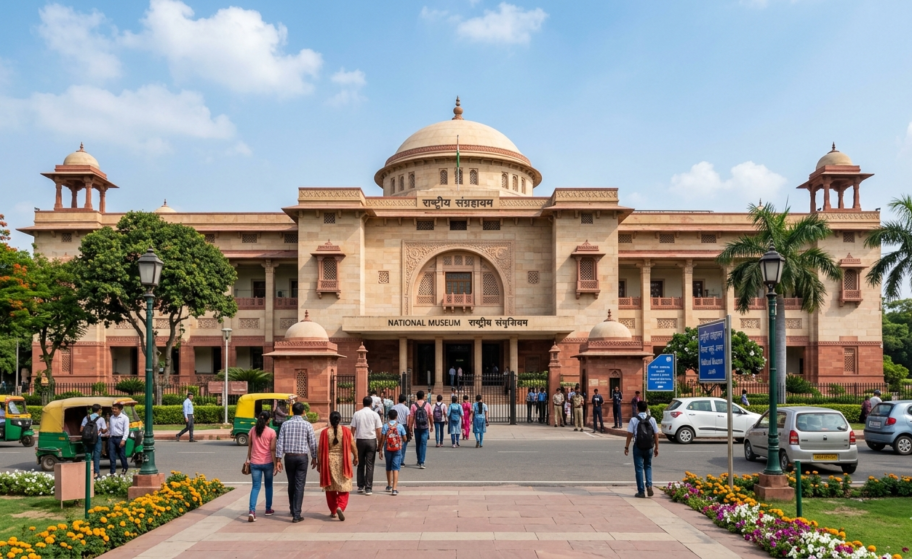
National Museum, New Delhi :- The Grand Repository of India’s 5,000-Year-Old Civilization and Artistic Heritage
Situated majestically in the heart of Lutyens’ Delhi at the prominent intersection of Janpath and Rajpath (now Kartavya Path), the National Museum stands as the premier cultural custodian and the largest multi-disciplinary museum in the country. Far from being a mere institutional archive, it operates as a profound historical time machine, compressing over five millennia of subcontinental evolution, philosophical thought, and master craftsmanship into a single architectural expanse. From the prehistoric dawn and the sophisticated urban planning of the Indus Valley Civilization to the artistic golden ages of the Maurya, Gupta, and Chhol empires, followed by the medieval Mughal opulence, this institution houses an unparalleled treasury of human heritage. For any traveler or scholar wishing to understand the actual depth of Indian civilization, an exploration of the National Museum’s silent, highly curated galleries remains an absolutely essential and deeply enriching pilgrimage.
Detailed History
The historical genesis and operational growth of the National Museum are fundamentally bound to India’s post-colonial cultural renaissance and nation-building era.
- The Blueprint and London Exposition :– The structural idea of the museum was sparked between 1947 and 1948, when an extraordinary, comprehensive exhibition of Indian art antiquities was mounted at the Royal Academy of Arts in London. Upon the safe return of these priceless masterworks to Indian soil, state leaders and visionary scholars—prominently including Chakravarti Rajagopalachari and Prime Minister Jawaharlal Nehru—determined that these crown jewels must be institutionalized permanently as a cohesive national collection for the public.
- Inauguration and Architectural Foundation :– The National Museum was formally inaugurated on August 15, 1949, within the historic Durbar Hall of the Rashtrapati Bhavan (then the Governor-General’s Palace). Subsequently, the foundation stone of the dedicated modern edifice was laid by Pandit Jawaharlal Nehru on May 12, 1955. The structural completion of Phase I culminated in its grand opening to the global public on December 18, 1960.
- Institutional Status :– Operating dynamically under the Ministry of Culture, Government of India, the repository now holds more than 2,00,000 distinct, high-value cultural artifacts, serving as the definitive global benchmark for Indological research and historical preservation.
Detailed Architecture
The physical structure of the National Museum is a brilliant manifestation of Mid-Century Indian monumental architecture, beautifully harmonizing Western neo-classical proportions with traditional Indian sandstone work.
- Spatial Configuration and Layout :– The massive ashlar masonry building rises across three expansive floors, intentionally engineered around a central, sweeping circular courtyard. The exterior cladding utilizes fine-grained pink and cream Chunar sandstone, meticulously designed to align with the imperial architectural aesthetic of the surrounding Lutyens’ administrative estates, such as the Rashtrapati Bhavan.
- Interior Gallery Trajectory :– Internally, the spatial matrix is organized in a strict, logically sequenced Chronological Sequence. It spans over 30 specialized theme-based galleries. The entry thresholds feature expansive vaulted ceilings, monumental pillars, and deeply recessed corridors that evoke the architectural gravity of ancient Indian royal courts. The specialized display micro-lighting is engineered to accent the minute carving variances, textures, and inscriptions of the ancient stone reliefs without exposing the materials to structural degradation.
- The Central Atrium Courtyard :– Serving as the structural heart of the complex is a vast, manicured open-air circular lawn. This open atrium hosts monumental stone structural components, mediaeval pillars, and massive temple sculptures, allowing visitors a serene, natural-light transition space between intensive gallery navigations.
Travel Guide & Routes
To plan an exceptionally systematic, organized, and time-efficient navigation through the extensive corridors of the National Museum, refer to this detailed logistical index.
- Museum Timings :–
- The institution is fully operational from 10:00 AM to 06:00 PM daily.
- Weekly Holiday :– The National Museum remains strictly closed on Mondays. Additionally, it observes complete closure on the three main national holidays: Republic Day (Jan 26), Independence Day (Aug 15), and Gandhi Jayanti (Oct 2).
- Entry Fee :–
- For Indian Citizens :– ₹20 per individual.
- For Foreign Nationals :– ₹500 per individual (this premium tier access automatically includes a high-fidelity electronic audio guide system).
- For Students :– Upon presentation of a valid institutional Identification Card, the entry tariff is subsidized to ₹10.
- How to Reach :–
- By Metro (The Most Recommended Node) :– The site is expertly connected via two central mass transit stations. The closest is the Janpath Metro Station on the Violet Line, situated barely a 5-minute linear pedestrian walk from the museum’s primary gates. Alternatively, the Udyog Bhawan Metro Station on the Yellow Line provides immediate access via a brief auto-rickshaw hop or a comfortable short walk along the central avenues.
- By Road/Bus :– Located right on Janpath Road within the primary administrative grid, it is seamlessly reachable via app-based cabs, local auto-rickshaws, and central DTC bus routes dropping directly at the National Museum designated stop.
- Photography Framework :–
- Non-commercial photography utilizing personal smartphones is permitted throughout the primary galleries. However, to safeguard the ancient organic pigments and delicate structural textiles, the use of camera flash is strictly prohibited.
- Key Photographic Compositions :– The towering Gandhara Buddha structures, the iconic Bronze Dancing Girl display node, and the highly symmetrical entryway arches of the Miniature Painting gallery provide exceptional visual balance.
- Culinary Provisions (Local Flavors) :–
- The Institutional Canteen :– Positioned within the secure perimeter, a clean, dedicated cafe serves standard refreshments including South Indian crêpes (dosa), artisanal sandwiches, traditional samosas, hot tea, and iced coffees at highly regulated institutional pricing.
- Surrounding Epicurean Zones :– A short drive leads directly to the Janpath commercial block—famous for Depaul’s signature bottled cold coffee—or the wider ring of Connaught Place, hosting a world-class array of fine dining and historical cafes.
- Famous Masterpieces to Witness :–
- The Indus Valley Civilization Gallery :– Houses the supreme archaeological fragments of Harappa and Mohenjo-daro. The absolute crown jewel is the 4,500-year-old bronze ‘Dancing Girl’ figurine, alongside the stone Priest-King bust and elaborate terracotta seal systems.
- The Sacred Buddhist Relics Gallery :– A highly revered spiritual zone displaying the authentic, sacred corporeal relics (bone fragments) of Lord Buddha excavated from Piprahwa. This gallery is a profound global pilgrimage site for international Buddhist monks. It also showcases magnificent Gandhara and Mathura school stone sculptures from the Kushan era.
- The Miniature Painting Gallery :– A rare repository of thousands of highly detailed, jewel-toned hand-painted miniatures mapping out the fine stylistic evolutions of Mughal, Rajasthani, Pahari, and Deccani royal ateliers.
- The Chola Bronze Gallery :– Showcases the apex of medieval South Indian metal casting, highlighted by the sublime, compositionally flawless bronze structures of Nataraja (Lord Shiva executing his cosmic dance of dissolution).
- The Arms and Armor Gallery :– An extensive collection tracking the evolution of subcontinental defensive technology, featuring personal etched steel swords of Rajput and Mughal emperors, damascened shields, protective chainmail, and ornate gem-encrusted daggers.
Nearby Attractions
Given its prime placement within the cultural and political core of New Delhi, an itinerary here can be integrated effortlessly with these neighboring national landmarks.
- Kartavya Path & India Gate :– Located steps away, this ceremonial grand avenue leads directly to the war memorial of India Gate, acting as the definitive public space for evening walks.
- National Gallery of Modern Art (NGMA) :– Situated near the India Gate circle, this magnificent heritage palace museum houses India’s premier collections of modern and contemporary fine arts and sculptures.
- Janpath Market & Connaught Place :– Positioned 1.5 kilometers north, offering an exceptional transition into high-street commercial shopping, local street food hubs, and colonial marketplace architecture.
- National Science Centre :– Located near the Pragati Maidan corridor, this multi-story interactive museum offers deep engagement with physics, planetary sciences, and technological history, making it highly recommended for families.
Interesting Facts
- The Lost-Wax Precision :– The iconic 10.5-centimeter Bronze Dancing Girl figurine dates to circa 2500 BCE. Its production via the complex cire perdue (lost-wax casting) technique reveals that subcontinental metalworkers possessed advanced metallurgical engineering capabilities thousands of years before these practices stabilized in Western Europe.
- The Sonic Guide Experience :– The museum features an advanced localized Audio Guide system. Upon standing before a designated artifact cluster, the receiver automatically transmits high-fidelity curatorial narrations detailing its discovery, political context, and aesthetic values in multiple global languages.
- Global Diplomatic Loans :– The masterpieces preserved within this national repository are of such profound international value that institutions like the Louvre in Paris or the Metropolitan Museum of Art in New York frequently request diplomatic loans of these sculptures for high-level global cultural expositions.
Important Questions and Answer :-
Question 1:– Is a single-day visit sufficient to comprehensively browse the entire National Museum?
Answer:– Due to the extraordinary scale of the physical complex and the massive density of the collections, absorbing every single display block in a single day is practically impossible. For general visitors operating on constrained timelines, dedicating a focused window of 3 to 4 hours is highly recommended to explore the core historic galleries: namely the Indus Valley artifacts, the Sacred Buddhist Relics, and the Chola Bronzes.
Question 2:– What are the regulations regarding personal bags, water bottles, or advanced camera gear inside the galleries?
Answer:– To ensure absolute artifact security and climate-controlled environment stabilization, large backpacks, outdoor food items, liquids, and heavy photography tripods are strictly prohibited within the main gallery rooms. The museum operates a secure, complimentary Cloak Room at the primary lobby entrance where all personal belongings can be safely checked in prior to entry. Visitors are permitted to retain their mobile phones and personal wallets.
Question 3:– Is the National Museum an appropriate and engaging destination for young children?
Answer:– Yes, it functions as an extraordinary physical textbook that brings history to life. The dramatic arrays of real royal armor, ancient weaponry, intricate clay animal toys from Harappan times, and sparkling royal crowns consistently fascinate young minds. The museum also regularly curates educational weekend workshops and interactive guided walks designed specifically for school students.
Author’s Thoughts
From an analytical and museological perspective, the National Museum of New Delhi is far more than a stately concrete repository of antiquity; it is the living, breathing physical subconscious of our nation. In an era dominated by high-speed digital ephemeral trends, this institution serves as a vital, immovable anchor, reminding us of the profound continuous historical currents that have shaped our contemporary identity. Standing before an unblemished, 4,500-year-old Harappan storage jar, one can literally trace the ancient thumbprint of the potter pressed into the clay—a striking bridge across time that dissolves centuries in a single gaze. The true genius of the National Museum lies in its majestic silence; it demands that you slow down your cognitive pace and engage deeply with the material evidence of our ancestors’ philosophical, spiritual, and aesthetic achievements. Whether you are a dedicated scholar of archaeology or a curious traveler navigating the wide avenues of the capital, spending a quiet afternoon walking these hallowed, sandstone-framed corridors will profoundly expand your understanding of India’s immutable contribution to global human civilization.
“A silent, monumental sanctuary where the dust of centuries turns into pure art, and the five-thousand-year-old soul of India speaks to the modern world—that is the enduring majesty of the National Museum.”