
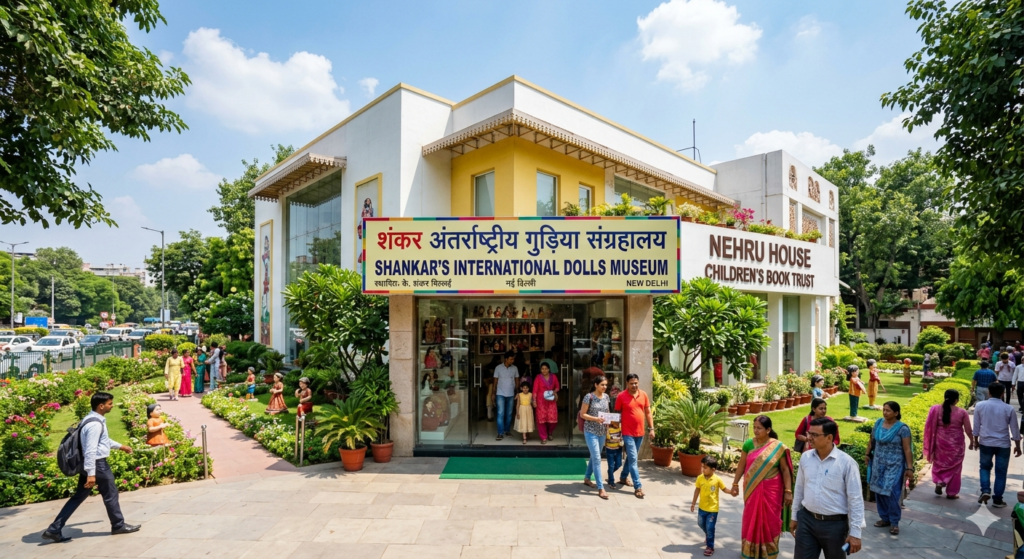
Shankar’s International Dolls Museum, New Delhi :- A Magnificent World of Art Encompassing Global Cultures and Unique Traditions
Located on Bahadur Shah Zafar Marg in the bustling ITO area of New Delhi, Shankar’s International Dolls Museum stands as one of India’s most celebrated, unique, and globally renowned costume doll museums. Far from being a mere recreational space for children, it operates as a magical cultural bridge that guides visitors through the traditional attires, folk arts, and socio-cultural histories of over 85 nations under a single roof. Brainchild of the country’s iconic political cartoonist, K. Shankar Pillai, the museum hosts thousands of meticulously styled dolls arranged inside massive glass showcases. These displays seamlessly captivate young minds while transporting adult visitors into an enchanting realm of fine craftsmanship and cross-border heritage. If you are exploring the national capital for a destination that impeccably balances education, art, and nostalgic leisure, this museum promises a deeply rewarding experience.
Detailed History
The operational genesis of Shankar’s International Dolls Museum is rooted in a deeply passionate and fascinating personal anecdote.
- A Cartoonist’s Vision :– The structural blueprint of this museum was conceived by the legendary political cartoonist K. Shankar Pillai (1902–1989). In the early 1950s, Shankar received an exquisitely crafted foreign doll dressed in Hungarian folk attire from the then-Ambassador of Hungary. Deeply enchanted by its intricate detailing and textile accuracy, Shankar began a lifelong pursuit of collecting indigenous, costume-accurate dolls from every single foreign nation he visited on his journalistic tours.
- The Prime Ministerial Intervention :– Over time, his private collection swelled to over 500 distinct international pieces. Shankar began dispatching these items across various Indian territories, showcasing them parallelly with competitive children’s art exhibitions. However, the relentless logistical cycles of packing and transshipment began inflicting structural damage on these delicate figures. During a prominent exhibition in Delhi, the then Prime Minister Pandit Jawaharlal Nehru and his daughter Indira Gandhi visited the gallery. Upon witnessing Shankar’s deep anxiety regarding the preservation of these pieces, Indira Gandhi immediately intervened, suggesting the immediate construction of a permanent, state-of-the-art sanctuary for the collection.
- The Grand Inauguration: When the dedicated corporate headquarters for the ‘Children’s Book Trust‘ was engineered on Bahadur Shah Zafar Marg, an entire expansive floor was structurally reserved for this specialized museum collection. The monumental facility was formally inaugurated on November 30, 1965, by the then President of India, Dr. S. Radhakrishnan, and the complex was christened ‘Nehru House’ in honor of the late Prime Minister. While operations commenced with just 1,000 distinct dolls, the repository has systematically expanded to house a stellar collection of over 7,000 global exhibits today.
Detailed Architecture
The museum occupies a prime spatial footprint on the first floor of Nehru House, expanding fluidly over an estimated 5,184 square feet of highly optimized exhibition space. Its inner and outer designs serve as exemplary benchmarks for thematic mid-century exhibition planning.
- Primary Threshold and Layout Dynamics :– Visitors gain access to the museum floor via a beautifully engineered, wide winding staircase that channels the public smoothly toward the main reception foyer. The internal matrix is designed as a continuous, linear viewing gallery flanked by over 1,000 feet of continuous wall-mounted displays. These feature approximately 160 meticulously sealed, deep glass showcases, structurally configured to afford both children and adult enthusiasts an unobstructed, close-up panoramic view of the miniature features.
- The Dual Cultural Demarcations :– The curatorial framework divides the global collection into two primary geographic and socio-cultural hemispheres:
- The Western Hemisphere (Part I) :– The display cases in this quadrant are meticulously optimized to house historic exhibits from European nations, the United Kingdom, the United States of America, Australia, New Zealand, and the Commonwealth of Independent States (CIS). The historical collection showcases everything from miniature replicas of the British monarchy in coronation regalia to coordinated groups executing traditional Hungarian Maypole folk dances.
- The Eastern & African Hemisphere (Part II) :– This expansive division features highly expressive traditional forms from the Asian continents, the Middle East, Africa, and Latin America.
- The Indian Costume Archive (The Jewels of India) :– Standing as the emotional and aesthetic anchor of the entire establishment is the dedicated Indian section. It features over 500 custom-designed, highly authentic hand-made dolls. These figurines accurately document the multi-state traditional drapes, complex bridal jewelry systems, regional wedding ceremonies, community festivals, and highly technical classical and folk dances of India (including Bharatnatyam, Kathakali, Odissi, and Bhangra).
- The Doll Workshop and Hospital Wing :– Operating dynamically within the secure perimeter of the museum is a specialized workshop atelier. Here, master craftsmen execute deep historical research to produce costume-accurate Indian dolls entirely by hand. Complementing this is a specialized ‘Doll Clinic and Hospital’ wing, where aging, fragile, or structurally compromised heritage dolls from the permanent collections undergo high-precision restorative treatment and preservation maintenance.
Travel Guide & Routes
To plan an exceptionally well-structured, seamless, and highly practical excursion to Shankar’s International Dolls Museum, refer to this detailed operational index.
- Museum Timings :–
- The institution is fully active from 10:00 AM to 06:00 PM daily.
- Operational Note :– The primary entry ticket booth enforces a strict closure policy at 05:30 PM, requiring arrival well ahead of this window.
- Weekly Holiday :– The museum observes its official closed day on Mondays. Furthermore, it remains shut during the three primary national public holidays (January 26, August 15, and October 2) along with major festive breaks like Holi and Diwali.
- Entry Fee :–
- For Adult Visitors :– ₹30 per individual.
- For Children :– ₹15 per child.
- For Institutional Student Groups (20 or more students) :– Subsidized to a highly nominal rate of ₹5 per student.
- How to Reach :–
- By Metro :– The premier and most seamless public transport link is the ITO Metro Station positioned dynamically on the Violet Line. Exiting through Gate Number 4 positions commuters directly in front of the Nehru House complex, enabling a sub-one-minute walk to the entrance. Alternatively, the Mandi House Metro Station serving as an interchange hub on the Blue and Violet lines is located barely 1 kilometer away.
- By Road/Bus :– Situated along the prominent arterial corridor of Bahadur Shah Zafar Marg in Central Delhi, the venue is comprehensively serviced by app-based cabs, local auto-rickshaws, and numerous arterial DTC buses stopping directly at the central ITO bay.
- Distance from Central Rail Hubs :– Positioned roughly 4 kilometers from the New Delhi Railway Station (NDLS) and 5 kilometers from the Old Delhi Railway Station.
- Photography Framework :–
- The winding architectural staircase and the prominent external monument signage at Nehru House serve as classic photo backdrops. Internally, the spectacular visual framing of the Japanese Samurai displays, the festive Hungarian dance groups, and the complex traditional Indian wedding dioramas offer exceptional visual depth. (Visitors must explicitly clarify current smartphone or camera permissions and potential minor permit fees at the ticketing window prior to entry).
- Culinary Provisions (Local Flavors) :–
- Bengali Market :– Positioned just 1.5 kilometers from the venue, this legendary gourmet hub houses iconic landmarks like Nathu’s Sweets and Bengali Pastry Shop. It is universally celebrated across Delhi for delivering exceptional artisanal street food delicacies including crisp Chole Bhature, spicy Golgappas, sizzling Aloo Tikki chaats, and rich traditional sweets.
- Mandi House Cultural Cafes :– Nestled nearby, the famous open-air Triveni Terrace Cafe and the Shriram Centre canteen serve exceptional hot masala chai, artisanal samosas, and classic club sandwiches in a relaxed artistic environment.
- Famous Specialized Items to Shop Around :–
- Connaught Place (CP) :– Positioned 2.5 kilometers west, this iconic colonial-era circular market stands as the definitive high-street hub for flagship brand apparel, footwear, luxury goods, and dining.
- Janpath Market :– Located adjacent to the CP ring, this vibrant boutique street market is the ultimate destination for sourcing budget-friendly ethnic wear, heavy oxidized silver jewelry, traditional pashminas, and curious Tibetan handicraft artifacts.
- Daryaganj Sunday Book Market :– For literary enthusiasts, the nearby historic Daryaganj sidewalk book market is globally famous for offering incredibly rare, vintage, and academic books at deep wholesale rates every Sunday.
Nearby Attractions
Following a comprehensive navigation of the doll galleries, your central city itinerary can be seamlessly synthesized with these adjacent national landmarks.
- Raj Ghat :– Located a mere 2 kilometers away, this expansive, peaceful landscaped memorial park marks the serene resting site of the Father of the Nation, Mahatma Gandhi.
- Mandi House Cultural Zone :– The absolute artistic and theater heart of New Delhi, hosting the National School of Drama (NSD), prominent auditoriums, and contemporary fine art galleries.
- Feroz Shah Kotla Fort :– Positioned 1.5 kilometers away, this ancient 14th-century Tughlaq-era fortress ruin is deeply famous for housing a monumental monolithic Ashokan Pillar and rich medieval lore.
- Supreme Court Museum :– Located in immediate proximity, this specialized institutional museum documents the profound evolution of legal frameworks, ancient judicial edicts, and landmark trials in India.
Interesting Facts
- The Solitary Seed :– This massive transnational museum trace its entire lineage back to a singular, accidental gift doll presented by the Hungarian state envoy to K. Shankar Pillai, proving how a small token of global friendship can blossom into an institution.
- Global Creative Laurels :– The impeccable artistic accuracy maintained by the museum’s internal design atelier resulted in global recognition in 1980, when its handmade Indian costume dolls secured the coveted first prize—the ‘Golden Peacock Feather’—at the International Dolls Biennale held in Cracow, Poland.
- The Diplomatic Doll Exchange :– The high-quality Indian traditional dolls crafted within the museum premises serve as official cultural ambassadors, actively exchanged with foreign embassies for new international acquisitions and highly sought after by global private collectors.
- A Dedicated Surgical Ward :– The complex houses what is arguably the only operational ‘Doll Hospital’ in the subcontinent, where a specialized team of conservators executes delicate structural repairs and textile preservation on antique exhibits.
Important Questions and Answer :-
Question 1:– Where exactly is Shankar’s International Dolls Museum situated, and who is the founder?
Answer:– The museum is located on the first floor of ‘Nehru House’ (the official headquarters of the Children’s Book Trust) on Bahadur Shah Zafar Marg in the central ITO district of New Delhi. It was founded in 1965 by the internationally acclaimed Indian political cartoonist, K. Shankar Pillai.
Question 2:– Does the facility accept visitors on Mondays, and what is the standard tariff layout?
Answer:– No, the museum maintains a strict weekly closure on Mondays. It also remains shut on core national days and prominent religious holidays. The standard entry tariff is structured at ₹30 for adults and ₹15 for individual children.
Question 3:- What is the current quantitative volume of the collection, and how is it organized?
Answer:– The museum permanently archives an extensive collection of over 7,000 unique costume dolls arriving from 85 different countries. They are curatorially balanced and displayed inside 160 massive glass cabinets split between Western and Eastern/African regional zones.
Question 4:- Are there specialized financial concessions available for large educational student groups?
Answer:– Yes, the museum offers strong institutional support for educational exploration. When a verified school or institutional tour group consisting of 20 or more children visits together, the entry fare is deeply discounted to a nominal flat fee of ₹5 per student.
Question 5:– Does the collection house exhibits specific to traditional Indian life and anthropological costumes?
Answer:– Yes, the dedicated Indian gallery segment features an exceptional collection of over 500 custom-fabricated dolls that map out the precise traditional attire, ethnic textiles, classic regional dances, and authentic matrimonial customs of almost every state in India.
Author’s Thoughts
From a specialized curatorial and anthropological viewpoint, Shankar’s International Dolls Museum is far more than a vintage toy repository; it stands as a brilliant material testament to global peace and cultural harmony, mapped completely through the media of porcelain, clay, and textiles. In a contemporary digital era where children are heavily insulated behind interactive glass screens, this physical space offers a refreshing, slow-paced engagement with real human craft and cross-border historical aesthetics. Walking through these long aisles, the visual transitions from the heavy silk pleats of an Indian Kathakali dancer to the crisp, minimalist lines of a Japanese Kabuki figurine reveal the vast, beautiful spectrum of human imagination. It forces you to realize that despite geographical distances, every global community has chosen to express its folklore, deep values, and joy through the universal art of doll-making. Whether you are a keen student of fashion history, a lover of folk art, or simply looking to introduce your children to a borderless world, spending a quiet afternoon inside the serene galleries of Nehru House will deeply enrich your perspective and touch your heart.
“Encompassing the rich traditions and colorful costumes of a borderless world within delicate threads and fabric, this iconic Delhi museum beautifully revives the innocent sense of wonder hidden within every adult heart.”