
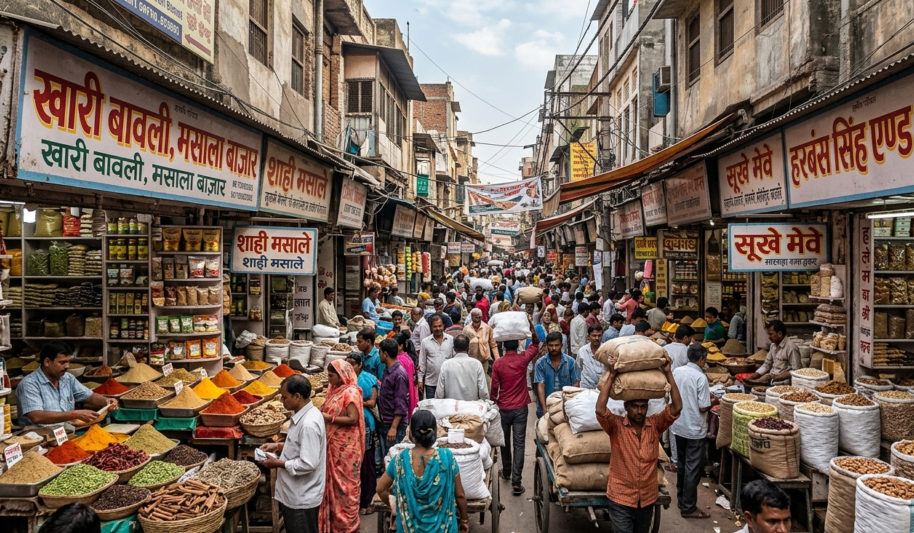
Asia’s Largest Spice Market :- Khari Baoli, Delhi
There is a strange, intoxicating allure in the air of Old Delhi—the aroma of deep-fried paranthas here, the sweet notes of traditional attar there. But located near the western end of Chandni Chowk, close to Lahore Gate, lies an area where the moment you step in, your senses will be overwhelmed by the pungent sting of red chillies, aromatic whole spices, and earthy herbs. We know this legendary place as ‘Khari Baoli’. It is not just Delhi’s pride, but officially recognized as Asia’s Largest Wholesale Spice Market. In this comprehensive blog, let us explore the history, architectural layout, and complete travel guide of this sensory wonderland.
Detailed History
The heritage of Khari Baoli is firmly rooted in Mughal architecture, trade routes, and the establishment of the historic walled city of Shahjahanabad.
- The History of the Stepwell and Etymology :– The name ‘Khari Baoli’ translates directly to a ‘Brackish Stepwell’. The stepwell (Baoli) was constructed in 1651 by Khwaja Sarad, an influential noble in the court of Mughal Emperor Shah Jahan. The water of this particular stepwell was naturally salty (Khara or brackish) and was primarily utilized for bathing royal elephants and horses and for industrial weaving. While the physical stepwell was entirely destroyed and built over during urbanization, the name remained immortalized.
- Evolution of the Market :– The trade of spices, nuts, and indigenous medicinal herbs began flourishing around this stepwell during the high Mughal era itself.
- The Fatehpuri Connection :– Standing proudly at the entrance of the market is the grand ‘Fatehpuri Masjid’, built in 1650 by Fatehpuri Begum, one of Shah Jahan’s wives. It continues to serve as the structural anchor and landmark of the market.
Detailed Market Overview & Layout
Far removed from the clinical, air-conditioned aisles of modern supermarkets, Khari Baoli is a dense, high-octane, labyrinthine trade corridor of Old Delhi.
- The Spice Empire :– Along the narrow, winding lanes sit century-old shops, where massive gunny bags overflowing with dried red chillies, vibrant turmeric heels, cinnamon sticks, green cardamom, cloves, and pure saffron filaments line the pavements.
- The Domain of Dry Fruits :– Beyond whole spices, this market is India’s largest trading terminal for premium dry fruits including cashews, almonds, pistachios, walnuts, figs, and foxnuts (makhana). The produce here is exceptionally fresh and priced significantly lower than regular retail markets.
- Historic Kattras and Warehouses :– Behind the main street lie historic commercial complexes like the ‘Gadodia Market’. Erected in the 1920s by wealthy merchants, this colossal brick structure houses deep warehouses where thousands of tons of spices are cataloged daily. Its flat rooftop offers an unmatched vantage point of the old city.
Travel Guide & Routes
If you wish to immerse yourself in this pungent, deeply historic arena, use the following travel guide।
- Tickets :– Since it is a fully functioning public commercial wholesale market, there is no entry fee or ticket required. It is completely Free.
- Market Timings :– Khari Baoli generally operates from 10:00 AM to 8:00 PM. Please note that the market is strictly Closed on Sundays.
- How to Reach :–
- By Metro :– The nearest metro station is ‘Chandni Chowk’ (Yellow Line). Alternatively, ‘Tis Hazari’ (Red Line) is also close by. From Chandni Chowk metro exit, you can hop onto an e-rickshaw heading towards Fatehpuri Masjid or simply enjoy a 15-minute walk.
- By Road :– Due to extreme vehicular congestion and narrow pathways, attempting to drive a personal car or take a standard auto deep inside is highly discouraged. Get dropped off at the main ring road near Kashmere Gate and access the interiors via traditional cycle rickshaws or on foot.
Photography Spots
For street and travel photographers, Khari Baoli offers a dramatic canvas of intense color contrasts, raw human emotion, and constant motion.
- The Gadodia Market Rooftop :– This is the ultimate photography spot in the area. From the terrace, you can capture panoramic vintage frames of the buzzing streets below, laborers maneuvering massive sacks of spices on their heads, and the weathered facades of old Havelis.
- Spicy Mountains :– Close-up shots of towering piles of crimson red chillies, golden turmeric powder, and pastel green cardamoms outside the shops make for brilliant, high-contrast cultural photographs.
- Candid Portraits :– The expressions of veteran merchants weighing precious spices on traditional scales or managing accounts on old ledgers provide timeless, narrative-driven portraits.
Local Food & Famous Markets
Navigating the sharp spice dust can work up quite an appetite; fortunately, Khari Baoli is surrounded by some of Old Delhi’s greatest food legacies.
- Local Food :–
- Giani di Hatti :– Located right on Church Mission Road near the spice market. Their iconic ‘Rabri Falooda’ (and seasonal Mango Shakes) provides a wonderfully sweet, creamy, and cooling antidote to your spicy walk.
- Kake Di Hatti :– World-famous across Delhi for serving legendary, oversized stuffed Naans and authentic, rich North Indian vegetarian curries.
- Chainaram’s Karachi Halwa :– Located right next to Fatehpuri Masjid, this legendary sweet shop is famous for its melt-in-the-mouth, ghee-laden Karachi Halwa.
- Famous Markets :–
- Katra Neel & Chandni Chowk :– The prime wholesale textile and ethnic apparel hub right across the street.
- Bhagirath Palace :– Asia’s largest wholesale hub for electrical components and medical equipment, situated nearby.
- Naya Bazar :– Adjoining Khari Baoli, this is India’s principal wholesale market for grains, wheat, and pulses.
Nearby Attractions
You can comfortably pair your expedition to Khari Baoli with these historical landmarks nearby.
- Fatehpuri Masjid :– The grand 17th-century red sandstone mosque guarding the head of the market street.
- Gurudwara Sis Ganj Sahib & Sunehri Masjid :– Revered historic religious structures situated along the main Chandni Chowk road.
- The Red Fort (Lal Qila) :– The monumental Mughal palace-fortress marking the opposite end of the Chandni Chowk stretch (approx 2 km away).
Interesting Facts
- The Sneeze Test :– First-time visitors to Khari Baoli almost always encounter an immediate spell of sneezing and coughing due to the heavy volatile oils of dried red chillies hanging in the air. Interestingly, the local merchants and laborers move around completely unfazed.
- A Global Export Nexus :– This market doesn’t just feed India; it serves as a global nerve center, exporting pure Indian spices to the United States, Europe, Australia, and the Middle East.
- Centuries of Lineage :– Several prominent trading houses here date back to the late Mughal and British periods. It is common to find the ninth or tenth generation of a family operating from the exact same wooden platforms (gaddis).
Important Questions and Answer :-
Question 1:– What is Khari Baoli most famous for?
Answer:– Khari Baoli is globally famous for being Asia’s largest wholesale market for Indian and exotic spices, premium dry fruits, medicinal herbs, unrefined teas, and traditional grocery commodities.
Question 2:– Is Khari Baoli market open on Sundays?
Answer:– No, the wholesale market of Khari Baoli is completely closed on Sundays.
Question 3:– How did Khari Baoli get its unique name?
Answer:– The area was named after a 17th-century Mughal stepwell (Baoli) built here, which possessed naturally brackish or salty (Khari) water used for livestock and trade tasks.
Question 4:- Which metro station is closest to Khari Baoli?
Answer:– The nearest metro station is ‘Chandni Chowk’ on the Yellow Line, from where the market is a short walk or rickshaw ride away.
Author’s Thoughts :-
Walking through the intense lanes of Khari Baoli is not a mere shopping trip; it is a full-throttle assault on your senses that makes you feel profoundly alive. When you ascend the dim, narrow steps of Gadodia Market and look out from its terrace over the chaotic, bustling world below, you realize where the true, unvarnished pulse of Delhi resides. The sharp sting of chilli in the air represents the fiery struggles of our history, while the underlying sweetness of dried fruits reflects the absolute richness of our culture. In an era dominated by calculated online algorithms and clinical supermarkets, Khari Baoli’s proud adherence to gunny bags, giant iron scales, and raw human interaction proves how deeply anchored India’s heritage remains. It is an unforgettable experience that every traveler must collect.
“Adorned with the fierce sting of dried chillies and the rich comfort of exotic dry fruits, Khari Baoli stands as the aromatic vault of Old Delhi, keeping a fragrance alive that has enchanted the global palate for centuries.”