
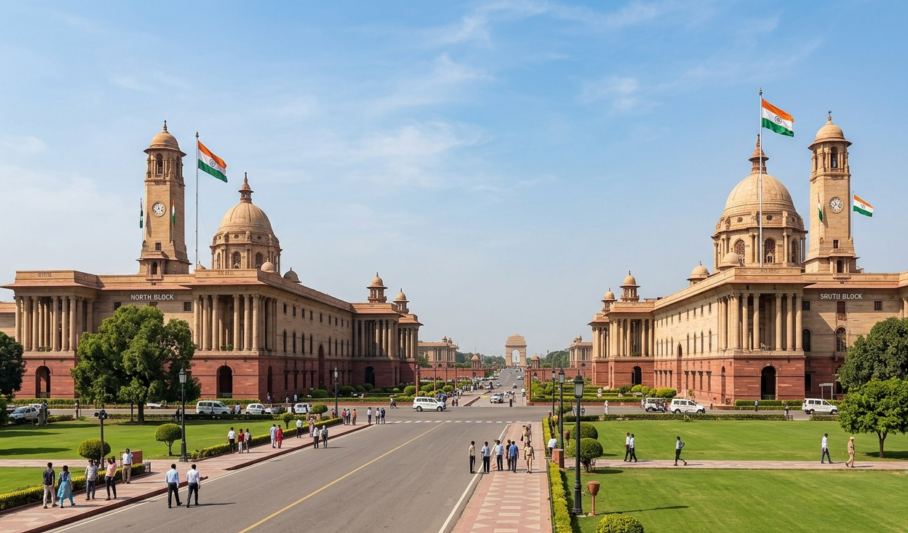
North Block and South Block, Delhi :- The Twin Fortresses of National Governance and Architectural Majesty
Detailed History
Flanking either side of the majestic Rashtrapati Bhavan atop Raisina Hill in New Delhi, the ‘North Block’ and ‘South Block’ are far more than two colossal sandstone edifices; they stand as the unyielding twin fortresses of modern India’s administrative prowess, strategic command, and national sovereignty. Collectively referred to as the ‘Secretariat Building’, these structures were conceived as the ultimate imperial administrative headquarters when the British Empire decided to shift its capital from Calcutta to Delhi in 1911. The construction of these monumental wings began in the 1910s and was successfully completed around 1930, forming the bureaucratic nerve center of Lutyens’ Delhi.
The master architect behind these twin monumental blocks was the celebrated Sir Herbert Baker, a prominent contemporary and collaborator of Sir Edwin Lutyens. Following India’s independence, these imperial halls transitioned smoothly into the supreme decision-making sanctuaries of the democratic Republic of India. Today, the North Block serves as the fortress for two of the nation’s most critical internal frameworks—the Ministry of Home Affairs and the Ministry of Finance. Directly opposite, the South Block dictates India’s external defense, global diplomacy, and executive command, housing the Prime Minister’s Office (PMO), the Ministry of Defence, and the Ministry of External Affairs. Every crucial economic policy, internal security grid, defense deployment, and international treaty is formulated within the high-security corridors of these twin monuments.
Detailed Architecture :-
The architectural profile of the North and South Blocks ranks globally among the most imposing and structurally brilliant institutional designs. The layout presents a flawless amalgamation of the grand Classical Italian Renaissance symmetry with traditional Indian (Mughal and Rajput) structural aesthetics.
- Exterior Architecture :– These twin blocks sit symmetrically directly facing one another on the rising incline of Raisina Hill. Both structures are sculpted out of the finest red and creamy yellow Dhaulpur sandstone. The defining architectural hallmark of both facades is the long, sweeping rows of stately classical pillars (Colonnades) that give the structures an air of permanent structural authority. Each block is crowned by a magnificent, high-set central dome inspired by traditional Indian structural patterns. The vast public esplanades fronting the blocks offer an unrestricted, breathtaking panoramic view down the entire stretch of Kartavya Path toward India Gate. Projecting stone eaves (Chhajjas), intricate lattice screens (Jalis), and stylized stone elephants accentuate the exterior lines, tying them beautifully to India’s architectural heritage.
- Interior Architecture :– The indoor topography of both blocks reflects immense scale, operational solemnity, and imperial grandeur. Key interior details include:
- Vaulted Corridors and Grand Staircases :– Upon crossing the thresholds, visitors are met with soaring vaulted corridors and wide marble staircases designed to handle heavy state traffic while maintaining a profound sense of regal scale.
- Central Open Courtyards :– Each block features large, open-air central courtyards designed to maximize natural light and ventilation, with inner walls adorned with fine historic reliefs, inscriptions, and institutional emblems.
- Historic Inscriptions :– The entry portals and structural pillars feature famous philosophical inscriptions in Latin and English. Heavy teak-wood doors, high ceilings, and sound-insulated conference bays emphasize the deep bureaucratic focus of these spaces.
Travel Guide & Routes :-
The North and South Blocks are located at the western termination of the Central Vista grid on Raisina Hill, directly adjacent to Rashtrapati Bhavan. Here is your essential transit and visitor layout.
- Entry Ticket & Admission :– Being the hyper-secure and sensitive operational headquarters of the Prime Minister’s Office, Defense, and Home Ministries, direct walk-in entry inside the physical corridors of the North and South Blocks is strictly prohibited for general tourists and the public. Entry is granted exclusively to authorized personnel or visitors possessing official administrative passes and confirmed government appointments. However, exploring the grand outer plazas, admiring the spectacular sandstone masonry, and viewing the structures from the public perimeters requires no tickets; it is entirely free to enjoy from Vijay Chowk.
- Visiting Timings :– Admiring the magnificent exterior masonry and taking architectural photographs from the public boundaries is best done between 09:00 AM and 05:00 PM daily. Security protocols are hyper-vigilant and active 24/7.
- How to Reach :–
- By Metro :– The absolute closest and most practical metro link is the ‘Central Secretariat’ Metro Station (a major interchange hub for the Yellow and Violet Lines). The station exits open up directly at the base of Raisina Hill, placing the twin blocks a brief 3 to 5-minute walk away.
- By Bus :– Public DTC buses heading toward Central Delhi drop passengers near the main ministerial blocks at the Central Secretariat or Krishi Bhawan bus terminals.
- By Auto/Cab :– App-based cabs and local auto-rickshaws provide direct, seamless transit to the outer barricades of Vijay Chowk from Connaught Place or New Delhi Railway Station (NDLS) within 5 to 10 minutes.
Nearby Attractions
- Rashtrapati Bhavan :– The spectacular palatial residence of the President of India, located directly between the twin blocks at the absolute crest of Raisina Hill.
- New & Old Parliament Houses (Samvidhan Sadan) :– Located right down the slope of the hill, these iconic structures form the ultimate legislative heart of the nation.
- Kartavya Path & India Gate :– The grand, newly redesigned national avenue that begins right between the twin blocks and stretches straight down to the iconic India Gate war memorial.
- National Museum :– India’s premier archival repository hosting ancient treasures and ancient arts, situated close by on Janpath Road.
- National Archives of India :– The ultimate repository of the Government of India’s permanent historical records, located right across the Central Vista axis.
Photography Spots, Local Taste, and Famous Markets :-
- Photography Spots :– Capturing the symmetrical sandstone facades and grand domes of both blocks from the center of Vijay Chowk offers one of the most iconic, powerful, and majestic architectural frames in Delhi. During national festivals like Republic Day, when these twin fortresses are washed in spectacular tricolor illumination, the view becomes an absolute paradise for night-scape photography. (Note: Due to high-level security, photography directed at the security check-posts, barricades, or main entry gates is strictly illegal. Normal landscape photography from the open public roads is perfectly fine).
- Local Taste :– There are no commercial restaurants or food stalls within this high-security zone. However, visitors and staff frequently check out the nearby State Bhavan Canteens (such as Andhra Bhavan) or the small cafeteria setups near Rail Bhawan for excellent tea, coffee, and local quick snacks.
- Famous Markets :– The elite retail arcades of Connaught Place, the vibrant handicraft stalls of Janpath Market, and the state-run emporiums on Baba Kharak Singh Marg are located within a 5-minute drive, offering world-class Indian arts, fabrics, and souvenirs.
Interesting Facts :-
- Famous philosophical maxims chosen by Baker and Lutyens are carved into the stone portals of these blocks. The main gate of the South Block features a celebrated quote by Sir Herbert Baker: “Liberty does not descend upon a people; a people must raise themselves to liberty.”
- The expansive forecourts of the twin blocks are centered by four massive stone columns known as the ‘Dominion Columns’. These were gifted to India during the colonial era by the dominions of Canada, Australia, South Africa, and New Zealand to mark the imperial administrative alignment of the time.
- The approach up Raisina Hill is designed with a fascinating architectural illusion. As a visitor moves down Kartavya Path toward the hill, the steep incline causes the North and South Blocks to dominate the horizon first, while the massive Rashtrapati Bhavan appears to slowly rise up from the ground behind them as you get closer.
- For tactical defense and emergency protocols, a secure network of underground tunnels connects these administrative blocks directly with Rashtrapati Bhavan and the Parliament complex, ensuring safe transition lines during critical national emergencies.
Important Questions and Answer :-
Question 1:– Where exactly are the North and South Blocks located and what ministries do they house?
Answer:- These twin blocks are located on Raisina Hill on either side of Rashtrapati Bhavan in New Delhi. The North Block houses the Ministries of Home Affairs and Finance, while the South Block houses the Prime Minister’s Office (PMO), Ministry of Defence, and Ministry of External Affairs.
Question 2:– Can general tourists get a pass to explore the inside of these twin blocks?
Answer:- No, due to the high-security nature of these supreme ministerial headquarters, general entry inside the buildings is strictly restricted. Access is granted only to individuals with official government identification or authorized appointment passes.
Question 3:– Who was the principal architect responsible for designing the Secretariat Building?
Answer:- The Secretariat Building, comprising both the North and South Blocks, was designed by the eminent British architect Sir Herbert Baker.
Author’s Thoughts :-
Standing at the open plaza of Vijay Chowk with the North Block towering on your right and the South Block on your left feels like standing at the absolute crossroads of national power. This is the exact geography where the heartbeat of India is regulated—where national budgets are calculated, internal security grids are monitored, and global diplomatic strategies are executed every single day. While the sandstone walls carry the heavy symmetry of imperial architecture, the soul beating within these structures today is purely democratic and sovereignly Indian. Watching these twin stone titans bathed in the vibrant saffron, white, and green lights of the national flag at dusk is an experience that fills every traveler with an overwhelming sense of national pride and security. It is the ultimate monument to India’s governance and bureaucratic majesty.
“The North and South Blocks stand as the eternal twin sentinels of Raisina Hill, where the quiet dignity of sandstone shields the supreme executive decisions shaping the destiny of India.”