
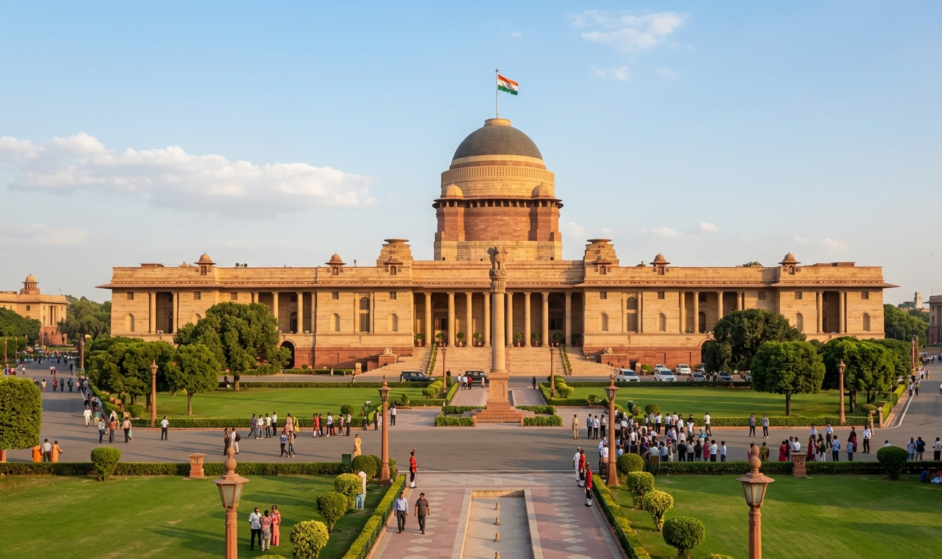
Rashtrapati Bhavan, Delhi :- The Majestic Apex of Sovereign India and Architectural Grandeur
Detailed History
Perched majestically atop the historic Raisina Hill in New Delhi, the ‘Rashtrapati Bhavan’ (President’s House) is far more than the official palatial residence of the President of India; it stands as the ultimate, awe-inspiring symbol of sovereign public power, national pride, and democratic consolidation of the world’s largest republic. During the British Raj, this monumental estate was known as the ‘Viceroy’s House’, envisioned as the crowning architectural jewel of New Delhi after the imperial government decided to shift its capital from Calcutta to Delhi in 1911. The foundation stone of this colossal palace was laid in 1912, and it took an intensive 17 years of continuous labor and geometric planning to complete, opening its gates formally in 1929. The initial occupant of this structure was Lord Irwin, the then Viceroy of India.
The master conceptual designer behind this eternal monument was the celebrated British architect Sir Edwin Lutyens, who along with his contemporary Sir Herbert Baker, mapped out the entire imperial core of New Delhi. On January 26, 1950, when the Constitution of India came into force and the nation emerged as a sovereign democratic republic, this monumental palace was beautifully rechristened as ‘Rashtrapati Bhavan’, and Dr. Rajendra Prasad took office here as India’s first President. Sprawling across an immense acreage, it ranks globally as one of the largest official territorial headquarters of any head of state, symbolizing the monumental journey of a colonized sub-continent transforming into a global democratic powerhouse.
Detailed Architecture :-
The architectural structural matrix of Rashtrapati Bhavan is a classic, timeless masterpiece of synthetic design. While it commands the formal structural authority of classical European neo-classicism, its facade and core elements are heavily infused with traditional Indian Buddhist, Hindu, and Mughal architectural idioms.
- Exterior Architecture :– This massive, structural palace is a four-story stone edifice encompassing a spectacular labyrinth of 340 rooms. While the main core building stands on an immediate plot of 5 acres, the adjoined presidential estate stretches over an astonishing 330 acres of manicured land. The exterior walls are sculpted entirely out of the finest red and creamy yellow Dhaulpur sandstone, which uniquely shift their color tones under varying angles of the Indian sun. The defining hallmark of the building is its colossal central dome, purposefully modeled after the ancient Buddhist Stupa of Sanchi, representing peace and spiritual sovereignty. In front of the building lies the massive, gravel-lined Forecourt, centered by the 145-foot-tall ‘Jaipur Column’, presented by the Maharaja of Jaipur as a structural token of friendship. Projecting stone balconies (Chhajjas), ornamental stone umbrellas (Chhatris), and beautifully sculpted stone elephants accent the exterior lines, anchoring it to traditional Indian temple architecture.
- Interior Architecture :– The indoor topography of Rashtrapati Bhavan represents the absolute pinnacle of state luxury and historic craftsmanship. Its premier ceremonial chambers include.
- The Durbar Hall :– Situated directly beneath the great central dome, this is the main ceremonial focal point of the palace. Known as the Throne Room during the British Raj, it is now used for the historic swearing-in ceremonies of Indian Cabinets and Chief Justices. The hall features massive pillars sculpted from rare Italian marble and a dramatic, ancient multi-ton crystal chandelier.
- The Ashoka Hall :– Originally designed as the imperial ballroom for the Viceroys, this hall is now utilized for grand state banquets and diplomatic credential ceremonies. The entire ceiling is an absolute masterpiece of fine art, covered in massive Persian oil-on-canvas paintings commissioned by the rulers of Iran, while the walls are flanked by expansive heritage mirrors that multiply the ambient light.
- Amrit Udyan (Formerly Mughal Garden) :– Positioned directly behind the western facade, this world-renowned public garden blends classical Persian layouts with formal English lawns. It showcases hundreds of rare varieties of roses, exotic tulips, and ornamental flora. In addition, the inner core houses an expansive state library, secure art galleries, and an interactive digital museum wing.
Travel Guide & Routes :-
The Rashtrapati Bhavan is situated at the western termination of the grand ceremonial avenue of Kartavya Path on Raisina Hill, Central Delhi. Here is your operational visitor and transit layout:
- Entry Ticket & Admission :– Due to extreme national security and VVIP protocols, casual walk-in entry inside the private operational perimeter of Rashtrapati Bhavan is forbidden. However, the complex is opened systematically for national and international tourists via specialized public circuits. To visit, travelers must register and book their entry slots in advance via the official portal (rb.nic.in). There are three primary circuits available: Circuit 1 (Main Building and Ceremonial Halls), Circuit 2 (The Rashtrapati Bhavan Museum Complex), and Circuit 3 (The Amrit Udyan, which opens primarily to the public during the spring festival of February-March). A nominal registration fee of ₹50 is charged online, and presenting a valid original government-issued photo ID (like a Passport or Aadhaar Card) at the security check-points is mandatory.
- Visiting Timings :– The historical public circuits are generally accessible from Thursday to Sunday, between 09:30 AM and 04:30 PM across pre-booked hourly slots. The complex remains strictly closed for public tours on Mondays, Tuesdays, Wednesdays, and all national gazetted holidays.
- How to Reach :–
- By Metro :– The most practical and closest transit link is the ‘Central Secretariat’ Metro Station (an interchange station for the Yellow Line and Violet Line). Alternatively, the ‘Udyog Bhawan’ station is equally near. From the station gates, visitors can walk down or hail a direct e-rickshaw to reach the designated tourist reception gates (Gate No. 2 or Gate No. 37).
- By Bus :– Public DTC buses heading toward Central Secretariat or Rajpath drop passengers near the main administrative circles of Krishi Bhawan, from where the entry gates are a brief walk.
- By Auto/Cab :– Given its central geography, app-based cabs and local auto-rickshaws provide direct transit to the outer barricades of Vijay Chowk from Connaught Place or New Delhi Railway Station (NDLS) within 5 to 10 minutes.
Nearby Attractions :-
- New & Old Parliament Houses (Samvidhan Sadan) :– Located right at the base of Raisina Hill, these architectural marvels represent the legislative heart of the Union of India.
- Kartavya Path & India Gate :– The grand, newly redesigned ceremonial boulevard that stretches straight from the gates of Rashtrapati Bhavan all the way to the iconic national war memorial arch of India Gate.
- National Museum :– India’s finest archival museum hosting thousands of years of human history, ancient Buddhist relics, and royal textiles, located close by on Janpath.
- Indira Gandhi National Centre for the Arts (IGNCA) :– A massive visual art and research facility located along the central vista grid.
- Connaught Place :– The heritage commercial, shopping, and high-end dining circle of Central Delhi, located barely 1.5 kilometers away.
Photography Spots, Local Taste, and Famous Markets :-
- Photography Spots :– Framing the great central dome of Rashtrapati Bhavan and the flanking North and South Blocks from the expansive concrete plazas of Vijay Chowk offers the most iconic, majestic, and symmetrical architectural frame in India. At dusk, when the entire hill is illuminated by thousands of golden state lights, the view becomes an absolute paradise for night-scape photographers. (Note: Interior photography inside the ceremonial halls and near security pickets is strictly prohibited. Handheld mobile photography is permitted only within authorized museum bays and designated zones of Amrit Udyan during open season).
- Local Taste :– The high-security administrative avenues do not permit commercial food stalls. However, food enthusiasts head over to the nearby State Bhavan Canteens (such as Andhra Bhavan, Goa Niwas, or Maharashtra Sadan) located just a short distance away, which are legendary across Delhi for serving highly authentic, affordable, and rich regional culinary thalis.
- Famous Markets :– For cultural souvenirs and retail exploration, the adjoined Janpath Market, the state-run handicraft emporiums on Baba Kharak Singh Marg, and the retail corridors of Connaught Place offer the best collections of ethnic silver jewelry, Indian textiles, and literary books.
Interesting Facts :-
- In terms of raw spatial volume, Rashtrapati Bhavan ranks as the second-largest official residential palace of any head of state in the world, surpassed only by the Quirinal Palace in Rome, Italy. Over 700 million bricks and 3 million cubic feet of heavy stone went into its masonry—remarkably, no structural steel was used anywhere in its core framing.
- Throughout the stone corridors and pillars, Lutyens uniquely carved stylized stone bells into the capitals, structurally known as the ‘Lutyens Bells’. The psychological theory behind this colonial design was a belief that as long as these stone bells remained silent, the British Empire would never fall in India.
- The spectacular ceiling of the Ashoka Hall features a massive central oil painting depicting the Persian King Fath-Ali Shah. This hall also features a hidden, state-of-the-art heritage hydraulic orchestra stage that can be mechanically raised from beneath the heavy carpets during state galas.
- The presidential estate functions virtually as a self-contained, highly organized sustainable township. It features its own dedicated residential quarters for hundreds of staff members, an advanced public school, a multi-specialty hospital, an independent post office, a golf course, and an organic dairy farm.
Important Questions and Answer :-
Question 1:- Where exactly is the Rashtrapati Bhavan located and who was its head architect?
Answer:- Rashtrapati Bhavan is positioned atop Raisina Hill at the western axis of Kartavya Path in New Delhi. The principal conceptual mastermind and head architect of this historic palace was the legendary British architect Sir Edwyn Lutyens.
Question 2:- Can international tourists explore the internal ceremonial halls of the building?
Answer:- Yes, absolutely. International and domestic tourists can explore the interior historic halls and the multi-tier museum complex by registering and securing an advance hourly slot ticket on the official Rashtrapati Bhavan web portal.
Question 3:– What is the new official name of the famous presidential gardens and when can the public visit them?
Answer:- The world-famous gardens have been officially renamed ‘Amrit Udyan’. These spectacular floral grounds are opened to the general public every year during the prime spring bloom season, typically stretching across the months of February and March.
Author’s Thoughts :-
Driving up toward the grand stone horizons of Vijay Chowk as the massive Sanchi dome of Rashtrapati Bhavan emerges against the Delhi sky is a moment that fills every heart with deep historical awe. This monument is far more than a gorgeous colonial remnant; it is a profound testament to democratic reclamation—a palace built to showcase the ultimate power of an empire, smoothly repurposed by a free republic to house its highest constitutional servant. Walking through the intense, quiet dignity of the Durbar Hall or looking up at the poetic Persian canvases of the Ashoka Hall makes you feel the sheer weight of India’s sovereign journey. Booking an advance ticket to step inside this epic stone archive is not just a tourist outing; it is an enriching journey into the very heart of India’s constitutional majesty.
“Seated like a grand stone crown atop Raisina Hill, Rashtrapati Bhavan remains the ultimate architectural sanctuary of the Indian Republic, where the structural echoes of our past unite with the democratic destiny of our future.”