
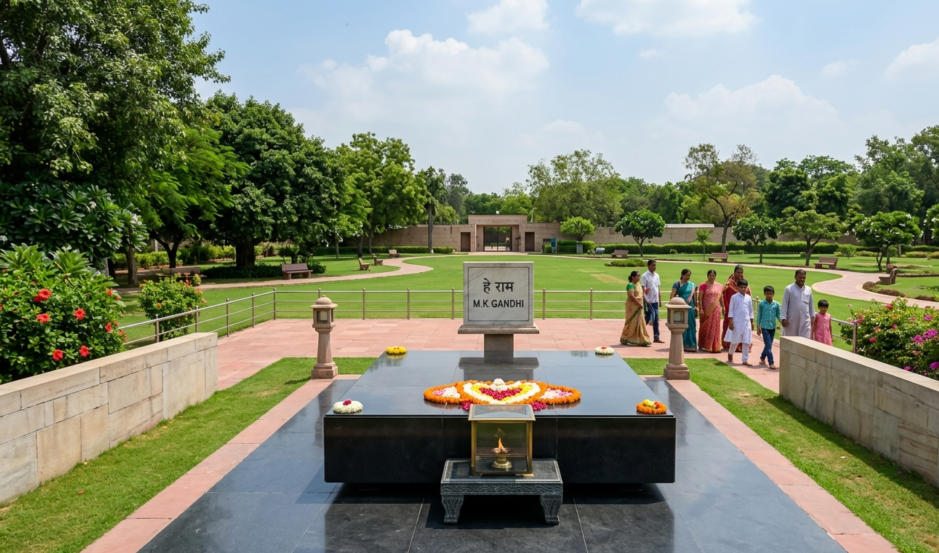
Raj Ghat, Delhi :- The Sacred Memorial of Mahatma Gandhi and the Global Sanctuary of Peace
Detailed History
Tranquilly situated along the scenic western banks of the Yamuna River in New Delhi, ‘Raj Ghat’ is one of the most sacred, revered, and deeply spiritual national monuments of independent India. This historic sanctuary serves as the official memorial (Samadhi) of the Father of the Nation, Mahatma Gandhi (Mohandas Karamchand Gandhi). Following his tragic assassination on January 30, 1948, at Birla House by Nathuram Godse, Bapu’s mortal remains were brought to this very clearing, where his final funeral rites were performed on January 31, 1948, amidst a weeping nation. Mahatma Gandhi’s eternal philosophies of Satyagraha (truth-force) and Ahimsa (non-violence) not only shattered the shackles of British colonial rule in India but also permanently transformed global civil rights movements.
In the years following independence, this historic landscape was meticulously sculpted into a deeply minimalist, serene, and profoundly evocative park ecosystem. The master architectural layout of Raj Ghat was conceptualized and drafted by the acclaimed Indian architect Agha Mohammad Mostafa. Purposefully, the design avoids grand monumental towers or ornate imperial architecture, choosing instead an unvarnished simplicity that mirrors the clean, ascetic, and humble life principles championed by Mahatma Gandhi. Today, every visiting global head of state—be it the President of the United States, the Prime Minister of the United Kingdom, or the Secretary-General of the United Nations—commences their official diplomatic itinerary in India by traveling to Raj Ghat to lay a wreath, reflecting the immense moral authority this peaceful sanctuary holds across the globe.
Detailed Architecture :-
The architectural essence of Raj Ghat is rooted in its absolute simplicity and organic harmony with nature. It is a structure designed to whisper peace rather than shout for attention, making it a profound masterclass in conceptual landscaping.
- Exterior Architecture :– The core memorial is framed within an expansive, masterfully manicured landscape of rolling green lawns and ancient trees. The immediate sanctuary is structured as a sunken square courtyard, protected from the urban sounds of Delhi by high, sloping earthen embankments covered in grass. Smooth pathways carved from traditional red sandstone cut through the lawns, directing visitors toward the inner perimeter. To maintain the profound sanctity and spiritual cleanliness of the zone, all visitors are required to remove their footwear before stepping onto the brick-lined approach to the inner courtyard—a ritual that establishes a shared sense of humility and reverence.
- Interior Architecture :– At the geometric center of the sunken stone courtyard sits an open-air, unadorned square platform sculpted from premium polished black marble. This stark, elegant block marks the exact geographical spot of Mahatma Gandhi’s cremation.
- The Final Inscription ‘He Ram’ :– Engraved into the front face of the black marble plinth are Mahatma Gandhi’s historic poignant final words, “He Ram” (Oh God), beautifully rendered in golden Devanagari script.
- The Eternal Flame (Akhand Jyoti) :– Directly adjacent to the marble plinth, a heavy brass oil lamp houses a continuous, never-dying eternal flame, shielded within a protective glass casing. This flame burns 24/7, symbolizing the immortal light of truth and peaceful coexistence that Gandhi left behind. The inner courtyard is enclosed by clean stone retaining walls that act as a natural barrier against wind and external clutter, forming a serene, silent meditation zone.
Travel Guide & Routes :-
Raj Ghat is situated along the main Ring Road axis on the western banks of the Yamuna River, marking the boundary zone between Old Delhi and New Delhi. Here is your essential transit and visitor layout:
- Entry Ticket & Admission :– Access to Raj Ghat is completely Free of Charge for both domestic and international tourists. There are no entry fees or registration requirements. To enter the immediate stone perimeter enclosing the black marble samadhi, visitors must deposit their shoes at the designated official footwear counter near the entrance, which operates entirely free of charge.
- Visiting Timings :– The gates of Raj Ghat are open to the public seven days a week (Monday to Sunday) from 06:30 AM to 06:00 PM. A highly spiritual, multi-faith public prayer service (Sarva Dharma Prarthana Sabha) is held at the memorial every Friday morning at 05:30 AM, commemorating the specific day of the week when Mahatma Gandhi passed away.
- How to Reach :–
- By Metro :– The absolute closest and most practical metro link is the ‘Delhi Gate’ Metro Station located on the Violet Line. Additionally, the ‘Indraprastha’ and ‘Supreme Court’ (Pragati Maidan) stations on the Blue Line are nearby. Raj Ghat is roughly 1.5 kilometers from the Delhi Gate exit, a distance easily covered via a brief 5-minute electric rickshaw ride or a peaceful walk.
- By Bus :– Positioned directly on Delhi’s primary Ring Road highway, Raj Ghat enjoys unparalleled public bus connectivity. Delit Transport Corporation (DTC) bus routes such as 419, 423, 502, and 729 drop passengers directly at the ‘Raj Ghat’ public bus terminal.
- By Auto/Cab :– App-based cabs, local auto-rickshaws, and e-rickshaws provide swift transit lines to the gates from the New Delhi Railway Station (NDLS), Old Delhi Railway Station, or Kashmiri Gate within 10 to 15 minutes.
Nearby Attractions :-
- National Gandhi Museum :– Located directly across the road from the memorial gates, this invaluable museum archives an extensive collection of rare photographs, personal artifacts (including Gandhi’s authentic walking stick, spectacles, and pocket watch), and his original handwritten correspondences.
- The Royal Memorial Belt :– Branching immediately north of the Raj Ghat lawns are the designated green memorials of other iconic Indian Prime Ministers, including Shanti Vana (Pandit Jawaharlal Nehru), Vijay Ghat (Lal Bahadur Shastri), Shakti Sthal (Indira Gandhi), and Veer Bhumi (Rajiv Gandhi).
- The Red Fort (Lal Qila) :– The majestic seventeenth-century UNESCO World Heritage palace fortress of the Mughal Empire, located just 2 kilometers away.
- Jama Masjid :– One of the grandest and largest historic active mosques in India, located close by in the heart of Old Delhi.
- Purana Qila (Old Fort) & Pragati Maidan :– Ancient architectural ruins and modern cultural exhibition grounds, situated a short drive down the river road.
Photography Spots, Local Taste, and Famous Markets :-
- Photography Spots :– The sweeping, symmetric expanses of the sunken stone courtyard, the glowing reflections of the Eternal Flame against the dark marble, and the deep green framing of the surrounding lawns provide deeply evocative, artistic frames. (Note: Given the solemn nature of this national shrine, loud talking, boisterous posing, and the filming of commercial social media videos or reels are strictly prohibited. Photography must be handled with quiet, dignified decorum).
- Local Taste :– There are no commercial eateries or food stalls permitted inside the peaceful perimeters of Raj Ghat. However, a brief 5-minute transit leads directly into the sensory heart of Old Delhi (Chandni Chowk and Daryaganj), world-famous for heritage street foods such as hot stuffed paranthas, spicy chaat, historical Mughlai kababs at Karim’s, and traditional Indian sweets.
- Famous Markets :– For shopping and historic exploration, the nearby Daryaganj Sunday Book Market, the endless wholesale bazaars of Chandni Chowk, and the bustling lanes of Meena Bazar offer unparalleled options for vintage books, silver crafts, and traditional textiles.
Interesting Facts :-
- The landscape architecture of Raj Ghat is conceptualized with a brilliant subtle detail: the entrance pathways slope gently downward as you approach the core monument. This layout forces every visitor to look down and walk with a slightly bowed posture, ensuring that one approaches Gandhi’s memorial with instinctive humility.
- The adjacent National Gandhi Museum houses a specialized acoustic archive library where visitors can listen to the original, remastered audio recordings of Mahatma Gandhi’s historic radio broadcasts and public speeches.
- Following a revered diplomatic protocol, every foreign dignitary planting a sapling in the commemorative lawns of Raj Ghat leaves a living piece of history behind. The vast woods surrounding the complex are composed of historic trees planted by iconic global leaders over the decades.
- Every year on October 2 (Gandhi Jayanti) and January 30 (Martyrs’ Day), the President, Prime Minister, and top leaders of India gather at Raj Ghat for an elaborate, televised inter-faith bhajan and prayer meeting to honor his living legacy.
Important Questions and Answer :-
Question 1:– Where exactly is Raj Ghat located in Delhi and what does it represent?
Answer:- Raj Ghat is positioned along the Ring Road on the western banks of the Yamuna River in New Delhi. It is the sacred national memorial and final resting site (Samadhi) of Mahatma Gandhi, the Father of the Nation.
Question 2:– What is the significance of the inscription carved on the black marble monument?
Answer:- The words “He Ram” (Oh God) are engraved into the black marble in golden letters. These represent the famous poignant final words uttered by Mahatma Gandhi at the moment of his passing.
Question 3:– Is there an entrance fee or camera ticket required to explore Raj Ghat?
Answer:- No, entry into the entire park estate and core memorial courtyard of Raj Ghat is completely Free of Charge for all domestic and international visitors. There are no camera fees.
Author’s Thoughts
Stepping through the stone gates of Raj Ghat is like crossing an invisible threshold from the chaotic roar of Delhi’s traffic into a world of absolute, profound silence. The brilliant, flickering light of the Akhand Jyoti against the smooth, dark marble plinth serves as a silent reminder that while dynamic leaders pass away, the foundational truths of peace, love, and human dignity can never be extinguished. Standing before the simple words ‘He Ram’, one feels a wave of pure humility that no golden palace or ivory tower could ever evoke. Raj Ghat is far more than a tourist destination; it is an open-air sanctuary for the soul, urging each of us to pause, look inward, and ask if we are living up to the ideals of harmony that Bapu died for. Spending an hour sitting quietly on these grassy embankments is a deeply centering experience that leaves your spirit completely refreshed.</blockquote>
“Enveloped in the timeless whisper of the Yamuna, Raj Ghat remains the ultimate sanctuary of peace, where a single eternal flame keeps the luminous soul of Mahatma Gandhi alive for the entire world.”