
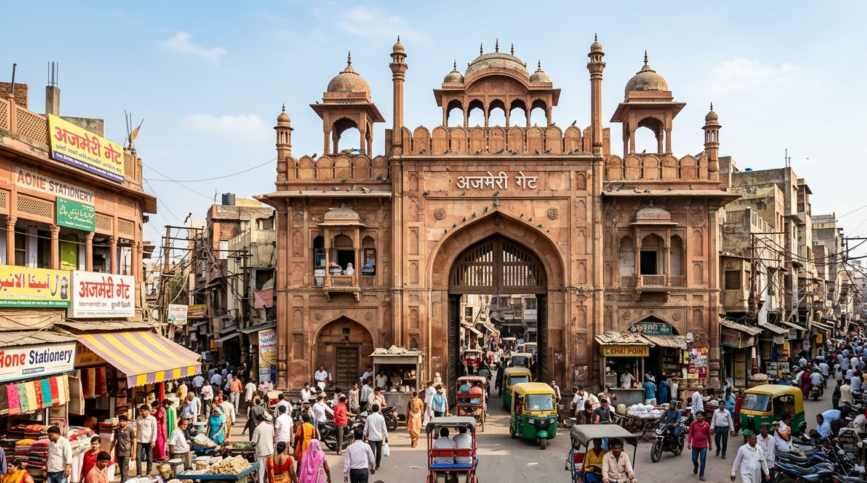
Ajmeri Gate
Ajmeri Gate is one of the surviving historic gateways of the walled city of Old Delhi (originally known as Shahjahanabad). Standing as a monumental witness to the glorious Mughal era, it currently serves as a bustling transit focal point seamlessly linking the chaotic charm of Old Delhi with the New Delhi Railway Station network. Here is a brief yet complete guide to this heritage landmark.
Detailed History :-
Commissioned by the Mughal Emperor Shah Jahan in 1644, Ajmeri Gate was constructed as part of the massive high-walled fortifications guarding his newly founded capital, Shahjahanabad. The gateway was named ‘Ajmeri Gate’ because it faced southwest, directly pointing towards the historic city of Ajmer in Rajasthan, marking the starting point of the ancient highway connecting the two imperial cities.
Detailed Architecture :-
The gateway is a classic specimen of military Mughal architecture. Built using robust red sandstone and local quartzite, it features a grand high-arched portal flanked by semicircular defensive bastions and loopholed battlements designed for guards. The elegant symmetry, heavy stone brackets, and surviving rampart fragments showcase the tactical and artistic engineering of the 17th century. It stands adjacent to the historic Ghaziuddin Madrasa (now Anglo-Arabic School).
Travel Guide & Routes :-
- How to Reach :– Positioned directly outside the secondary entry terminal of the New Delhi Railway Station. The most efficient way to reach is via the ‘New Delhi Metro Station’ (interconnecting the Yellow Line and the Airport Express Line), located just a short walk away.
- Timings & Tickets :– Being a prominent public roadside heritage structure, it is accessible 24/7. There are no entry timings or tickets required to view the monument from the outside.
- Local Flavors & Markets :– The historic wholesale hubs of Chawri Bazar and Khari Baoli (Asia’s largest spice market) are situated nearby. Visitors can immerse themselves in traditional Old Delhi street flavors like Mughlai cuisine, stuffed kachoris, and local sweets.
- Photography Spots :– The striking architectural contrast of the ancient red sandstone gateway standing tall against the backdrop of modern city traffic and contemporary commercial lifelines.
Interesting Facts :-
- Out of the original 14 massive gates that secured Shahjahanabad, Ajmeri Gate is among the few rare structures that successfully survived the British demolitions post-1857.
- During the Revolt of 1857, the surrounding walls of Ajmeri Gate became a fierce battleground between Indian freedom fighters and British colonial forces.
Important Questions and Answer :-
Question 1:- Why was this specific monument named Ajmeri Gate?
Answer:- It was named Ajmeri Gate because the path leading out of this fort gate historically pointed towards and connected Delhi to the city of Ajmer in Rajasthan.
Question 2:- Which major transport hub is immediately adjacent to Ajmeri Gate?
Answer:- The New Delhi Railway Station (NDLS) is located right next to it, with its western entrance formally designated as the Ajmeri Gate side.
“Bridging the architectural grandeur of Shahjahanabad with the non-stop hustle of a modern metropolis, Ajmeri Gate remains a timeless portal into Delhi’s historic core.”