
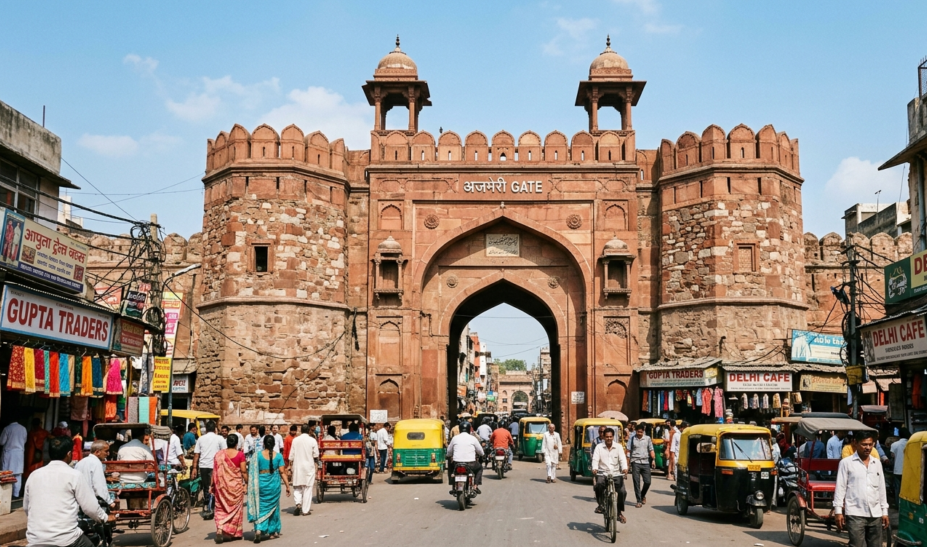
History of Ajmeri Gate :
Ajmeri Gate is one of the surviving historic entryways to the seventh city of Delhi, known as ‘Shahjahanabad‘ (now Old Delhi). It was constructed by the Mughal Emperor Shah Jahan in 1644 AD. The gate derived its name ‘Ajmeri Gate‘ because the grand road passing through it led directly toward the historic city of Ajmer in Rajasthan. During the Mughal era, this gate served as the primary route for royal caravans, merchants, and travelers heading toward the Rajpूतana region. It also played a significant strategic and military role during the Uprising of 1857.
Architecture of Ajmeri Gate :–
Architecturally, Ajmeri Gate is a fine and robust example of Mughal military and civic engineering. The gate is primarily constructed using local red sandstone and heavy rubble masonry to withstand military assaults. It features a high, impressive semi-circular central archway. The structure is flanked by massive, sturdy bastions on both sides, which were utilized by guards for surveillance. The top of the gate is adorned with defensive battlements (kanguras), giving it a fortress-like appearance. While the surrounding defensive city walls crumbled over time, the main gateway still stands strong and well-preserved.
Travel Guide & Routes :-
- Ticket :– There is no entry fee or ticket required to visit Ajmeri Gate. It is an open public historical monument.
- Visiting Time :– The monument is visible 24/7 from the outside. However, the best time to visit and explore the surroundings is between 09:00 AM and 06:00 PM.
- How to Reach :–
- By Metro :– The nearest metro station is the ‘New Delhi Metro Station’ (Yellow Line and Airport Express Line). The gate is located right outside the metro station exit.
- By Railway :– It is situated directly adjacent to the New Delhi Railway Station (Ajmeri Gate Side), making it easily accessible on foot from the platforms.
- By Road :– Cabs, auto-rickshaws, e-rickshaws, and DTC buses are readily available from all parts of Delhi to reach Ajmeri Gate or New Delhi Station.
- Photography Spots :– The grand central arch of the gateway and its historic red sandstone walls beautifully contrasted against the evening city traffic.
- Local Food :– Being close to Old Delhi, visitors can relish iconic street food like chaat, kachori, chole bhature, as well as authentic Mughlai delicacies like korma and kebabs nearby.
- Famous Markets :– The historic Hauz Qazi and Chawri Bazar (famous for wedding cards, brassware, and hardware) are located nearby. The commercial hub of Connaught Place (CP) is also very close.
Interesting Facts :-
- The gateway was named ‘Ajmeri Gate‘ simply because it faced the geographic direction of the city of Ajmer in Rajasthan.
- It is one of the few surviving historical gates out of the original 14 gates built into the protective city walls of Shahjahanabad.
- A park located right opposite the gate houses the final resting place (Mazar) of the legendary freedom fighter, Maulana Abul Kalam Azad.
Important Questions and Answer :-
Question 1:– Who built Ajmeri Gate and when?
Answer:- Ajmeri Gate was built by the Mughal Emperor Shah Jahan in the year 1644 AD as part of the walled city of Shahjahanabad.
Question 2:– Which is the nearest metro station to Ajmeri Gate?
Answer:- The nearest metro station is the ‘New Delhi Metro Station‘ (Ajmeri Gate side exit).
Author’s Thoughts :-
Ajmeri Gate stands as a beautiful bridge between the chaotic pace of modern Delhi and the grandeur of the Mughal era. On one side, you experience the modern hustle of the New Delhi Railway Station, and on the other, this serene gateway reminds us of Shah Jahan’s glorious past. Witnessing this heritage structure up close is a wonderful way to experience the living history of Old Delhi.
“Where the tracks of modernity meet the gates of the past, Ajmeri Gate is where Delhi’s heritage lasts!”