
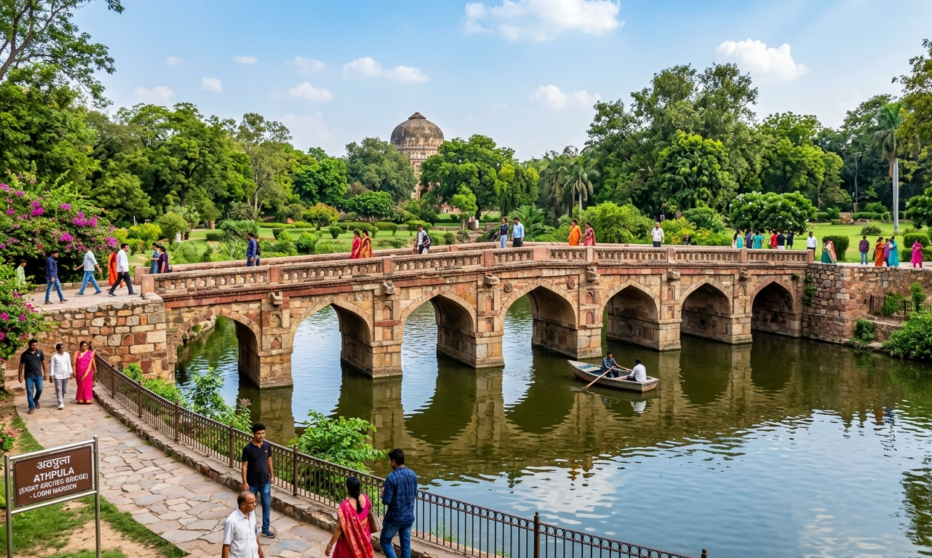
The Hidden Historical Gem of Delhi :- Athpula Bridge
When we talk about Delhi’s history and architecture, grand structures like the Red Fort, Qutub Minar, or Humayun’s Tomb instantly come to mind. However, nestled right in the heart of Delhi’s lush ‘Lodhi Garden‘ lies a hidden historic bridge that stands as a magnificent testament to Mughal engineering and aesthetics. It is known as ‘Athpula’ or ‘Kh his-Pula‘. In this blog, let’s take a closer look at the history, architecture, and every essential detail of this beautiful bridge.
Detailed History
The history of Athpula is intrinsically linked to the golden era of the Mughal Empire in Delhi. This bridge belongs to a completely different era compared to the other tombs located within Lodhi Garden.
- Construction Era and Ruler :– Athpula was constructed in the 16th century during the reign of the Mughal Emperor Akbar the Great. While most of the monuments in Lodhi Garden date back to the Lodhi Dynasty (15th century), this bridge is purely Mughal.
- The Builder :– The bridge was built under the supervision of Nawab Bahadur Khan, who held a prestigious position in Emperor Akbar’s court. Consequently, in its early days, the bridge was also famously known as ‘Kh his-Pula’.
- Historical Significance :– In ancient times, this bridge was not merely an ornamental feature; it was built to span a perennial stream or river channel that eventually flowed into the Yamuna River. The bridge served as a crucial medium for ancient water management and connectivity in Delhi.
Detailed Architecture :-
Athpula is widely celebrated for its unique architectural symmetry and the beautiful alignment of its arches.
- The Secret Behind the Name (Eight Pillars) :– The name ‘Athpula’ directly correlates with its structural design. The bridge features eight pillars (piers) that support seven beautiful arches. Since it stands on eight primary pillars or bases, it was colloquially named ‘Athpula’ (derived from ‘Aath’ meaning eight in Hindi).
- The Sizing of the Arches :– Architectural gravity and grace are beautifully balanced here; the central arch is the largest and highest. As you move from the center towards either bank, the size of the arches gradually decreases. This design lends the bridge a graceful slope and perfect equilibrium.
- Construction Material :– The bridge was primarily constructed using local grey quartzite stones bound together with lime mortar. Its durability is evident from the fact that even after centuries, its pillars and arches remain fully intact.
- Minarets and Finials :– Small decorative minaret-like structures adorn both ends of the bridge, which are classic signatures of Mughal architecture, enhancing its visual grandeur.
Travel Guide & Routes :-
If you are planning to explore Lodhi Garden, spotting the Athpula Bridge is incredibly easy.
- Tickets :– Athpula is located inside Lodhi Garden, and entry to the entire park is completely Free.
- Visiting Time :– Lodhi Garden remains open from 5:00 AM to 8:00 PM (6:00 AM to 8:00 PM during winters). The best time to experience Athpula is during the early morning or late evening when the sunlight is soft.
- How to Reach :–
- By Metro :– The nearest metro stations are ‘Jor Bagh’ (Yellow Line) and ‘Jawaharlal Nehru Stadium’ (Violet Line). From either station, you can walk or take an auto-rickshaw to enter through Gate No. 1 or 3 of Lodhi Garden.
- By Road :– Located on Lodhi Road, the park is exceptionally well-connected to the rest of Delhi via cabs, autos, and local buses.
Photography Spots :-
Athpula is a paradise for photographers, offering a seamless blend of historical heritage and raw nature.
- The Frontal Reflection View :– An artificial water body has been curated right in front of the bridge. When the calm water reflects the seven symmetrical arches of Athpula, it creates a picture-perfect postcard frame.
- Sunset Through the Arches :– During the golden hour, capturing the twilight filtering through the hollow components of the arches makes for an exquisite landscape shot.
- Avian Species and Greenery :– The dense foliage surrounding the bridge serves as a habitat for ducks, herons, and various birds, making it a hotspot for wildlife and nature photography enthusiasts.
Local Food & Famous Markets :-
The perimeter of Lodhi Garden features some of Delhi’s premium culinary hotspots and shopping hubs.
- Local Food :–
- Situated right at the edge of the gardens, ‘The Lodhi – The Garden Restaurant’ is famous for its gorgeous open-air ambiance.
- The nearby Khan Market offers legendary kebabs, premium Italian pastas, exquisite bakery items, and a booming cafe culture.
- Famous Markets :–
- Khan Market :– Recognized as one of Delhi’s most upscale shopping districts, it is renowned for independent bookstores, branded apparel, and designer boutiques.
- INA Market & Dilli Haat :– Located just a short drive away, this open-air food and craft bazaar lets you shop for authentic handicrafts from different Indian states and relish their traditional cuisines.
Nearby Attractions
Lodhi Garden itself is a treasure trove of historical monuments. Along with Athpula, you can explore.
- Bara Gumbad & Shisha Gumbad :– Monumental Lodhi-era structures located just a few steps away from the bridge.
- Tomb of Sikandar Lodi :– A beautifully fortified walled tomb located within the northern boundary of the garden.
- Safdarjung Tomb :– A magnificent late-Mughal mausoleum located barely 1-2 kilometers away from Lodhi Garden.
Interesting Facts :-
- A Mughal Vintage in Lodhi Grounds :– Even though the entire park is named after the Lodhi Dynasty, Athpula is the only major structure inside the garden that belongs purely to the Mughal era (reign of Akbar).
- Eight Pillars, Seven Openings :– Visitors often mistake the name to mean it has eight arches, but in reality, it features 8 pillars that partition the water channel into exactly 7 arched waterways.
- Witness to a Living Stream :– Where a peaceful artificial lake rests today, centuries ago, a natural, rushing stream used to flow, making this bridge an essential transport lifeline.
Important Questions and Answer :-
Question 1:– Who built Athpula and during whose reign?
Answer:– Athpula was constructed during the reign of Mughal Emperor Akbar by his influential courtier, Nawab Bahadur Khan.
Question 2:– Where is Athpula located and is there any entry ticket?
Answer:– Athpula is located inside the famous Lodhi Garden in New Delhi, and there is absolutely no entry fee or ticket required to visit it.
Question 3:– Why was it named ‘Athpula’?
Answer:– It was named ‘Athpula’ because the bridge stands firmly supported on eight massive stone pillars (piers), creating seven distinct arches.
Question 4:– Which is the nearest metro station to reach Athpula?
Answer:– The nearest metro stations are ‘Jor Bagh’ (Yellow Line) and ‘Jawaharlal Nehru Stadium’ (Violet Line).
Author’s Thoughts
Standing amidst the ancient, sprawling trees of Lodhi Garden and gazing at Athpula, I often realize that history doesn’t just breathe inside colossal forts or crowded museums; it thrives quietly in serene corners like this. Athpula reminds me of the beautiful continuity of time—where a gushing natural stream once flowed centuries ago, today citizens of Delhi stroll by for their morning peace. In a fast-paced city like Delhi, sitting on the weathered stones of Athpula is a meditative experience, connecting us to our glorious past without any chaotic noise. This bridge is not just a skeleton of stone; it is a beautiful chord struck between nature and history.
“Amidst the velvety green fabrics of Lodhi Garden, the seven arches of Athpula resonate like seven musical notes, seamlessly connecting the silence of yesterday with the serenity of today.”