
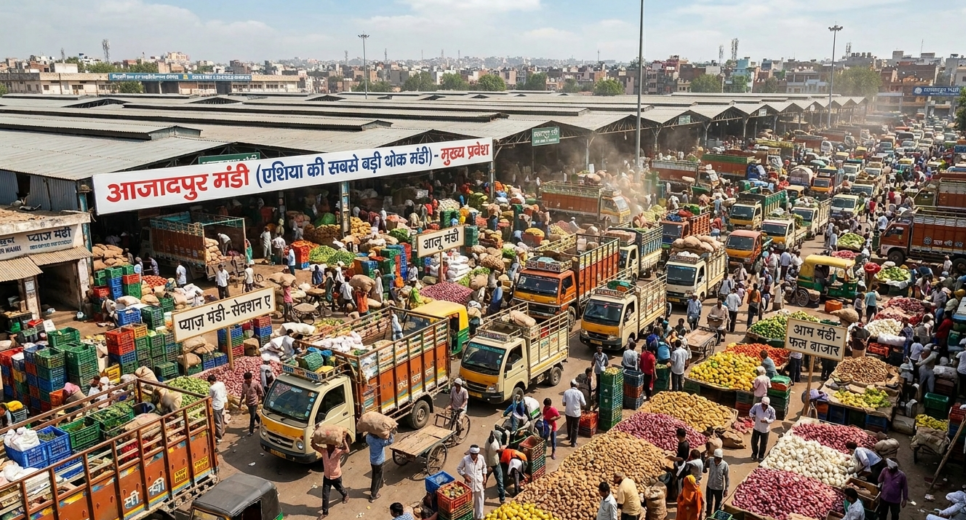
Azadpur Mandi, Delhi :- The Mega Agricultural and Commercial Pulse of Asia
Detailed History
Azadpur Mandi, positioned sprawlingly in the Azadpur zone of North Delhi, holds the unmatched international status of being Asia’s largest wholesale market for fruits and vegetables. It stands as the definitive central nerve center for India’s agricultural economy, fresh food logistics, and the national commodity supply chain.
This historic and massive market complex was formally established in the year 1977 by the Delhi Agricultural Marketing Board (DAMB). Prior to its inception, the capital’s wholesale produce operations were concentrated within the highly congested and suffocating corridors of Daryaganj and the old Subzi Mandi near Ghantaghar in Old Delhi. Recognizing the rapid population expansion and the staggering inflation of inter-state trade, the Government planned this massive industrial township. In 2004, the Government of the National Capital Territory (NCT) of Delhi officially accorded it the elite status of a ‘Market of National Importance’. Today, spanning an astronomical acreage of over 80 acres, it connects millions of farmers from every corner of the Indian subcontinent directly with bulk buyers, acting as a major distribution springboard that routes fresh goods not only across India but to international markets across the Gulf, Europe, and South Asia.
Detailed Architecture :-
The overall design architecture of Azadpur Mandi is structured on a high-utility, industrial complex blueprint explicitly engineered to process tens of thousands of metric tons of perishable inventory and sustain the movement of hundreds of thousands of daily operators.
- The Massive Sheds and Concrete Blocks :– The vast trade ecosystem is divided into extensive alphabetical zones—namely Blocks A, B, C, and D—housing thousands of covered concrete distribution sheds. Within these sectors operate over 4,000 registered ‘Arhats’ (Commission Agents and Wholesalers). The shop units are systematically raised on high-load concrete plinths designed to level precisely with commercial truck platforms, guaranteeing seamless, non-stop loading and unloading sequences around the clock.
- The Specialized Zoning Framework :– The most remarkable architectural attribute of Azadpur Mandi is its strict segregation based on specific agricultural produce. Dedicated sub-markets are constructed exclusively for primary volume crops; there is an exclusive New Apple Market, specialized Mango yards, highly regulated Potato-Onion plazas, and separate lanes for delicate leafy greens. During peak harvest seasons, individual zones like the apple section function practically as self-sustaining industrial townships.
- Integrated Logistical Infrastructure :– The complex integrates advanced agro-infrastructure including high-capacity cold storage units, commercial packaging terminals, state-of-the-art weighbridges, and dedicated banking zones designed to clear high-velocity cash and digital transactions instantaneously.
- Photography Spots :– Being a raw, heavy-duty industrial trade yard, it lacks classical manicured gardens or structural monuments. However, it is globally celebrated as a spectacular canvas for documentary, high-contrast, and industrial street photography. The pre-dawn hours offer cinematic frames as thousands of halogen lamps illuminate towering hills of vibrant fresh produce—from golden mangoes and deep red apples to fresh mountain greens. The kinetic energy of specialized manual loaders (Palledars) moving with intense speed, the dramatic expressions of auctioneers, and the endless structural geometry of transport trucks provide a raw, powerful narrative of human labor and economic spirit.
Travel Guide & Routes :-
- Ticket :– As Azadpur Mandi operates as an open, state-regulated public commercial yard for national agricultural trade, there is absolutely no entry fee or ticketing structure. It is entirely free and accessible to the general public.
- Visiting Time :– While the market layout functions non-stop 24 hours a day, 365 days a year, its true cultural and economic intensity peaks explicitly between 02:00 AM and 08:00 AM. This window hosts the arrival of heavy inter-state freight trucks, quality grading, and high-decibel wholesale auctions. For private household consumers looking for bulk sorting, navigating between 06:00 AM and 09:00 AM is optimal.
- How to Reach :–
- By Metro :– The absolute most efficient and traffic-free transit medium is the Delhi Metro network. The closest transit hub is the Azadpur Metro Station, positioned smoothly on the Yellow Line and acting as an interchange for the Pink Line. Additionally, the Adarsh Nagar Metro Station (also on the Yellow Line) sits right outside the primary market entrance. From either exit, local e-rickshaws or short walks bring you directly into the trading blocks.
- By Train :– The market complex sits in immediate structural alignment with the Adarsh Nagar Delhi local railway station, which services numerous regional passenger lines.
- By Road :– Azadpur Mandi is situated right at the major intersection of the Ring Road and the Grand Trunk Karnal Road (GT Karnal Road/NH-44). (Crucial Traffic Warning: The entry channels encounter extreme heavy-vehicle transit congestion due to the simultaneous influx of over 10,000 transport trucks daily; driving a private passenger car directly into the core market during peak morning hours is highly discouraged. Relying on the metro grid is strongly advised).
- Nearby Attractions :– The cultural enclave of Majnu ka Tilla (Tibetan Colony), the historical Coronation Park, and the North Campus of Delhi University.
- Local Flavors & Famous Markets :– The inner streets of the market host legendary 24-hour rustic dhabas and tea kiosks engineered for the overnight workforce. Visitors can experience intensely robust, authentic Indian street flavors—including piping hot stuffed paranthas, rich Chole-Puri, and slow-cooked Dal-Chawal paired with strong, spice-infused milk tea. In terms of commerce, buying from the wholesale blocks guarantees access to top-grade farm produce at pricing slabs 50% to 60% lower than standard retail hypermarkets, provided purchases are executed in standardized wholesale lots (crates, boxes, or sacks).
Interesting Facts :-
- Azadpur Mandi processes an astronomical daily incoming trade volume exceeding 15,000 to 20,000 metric tons of fresh fruits and vegetables, cementing its position as the ultimate food distribution titan of Asia.
- The market acts as the supreme price-discovery index for the entire Indian agricultural sector; the daily pricing variables established during the pre-dawn auctions here serve as the benchmark market rates that directly dictate the retail inflation indices of food items nationwide.
- The human mechanics of the local ‘Palledars’ (manual loaders) are legendary. Operating with unmatched physical endurance, individual loaders routinely carry individual loads ranging from 50 to 80 kilograms balanced on their backs and heads, clearing massive freight carriers in matter of minutes.
Important Questions and Answer :-
Question 1:- Can a standard retail shopper purchase minor quantities like 1 or 2 kilograms of vegetables inside Azadpur Mandi?
Answer:- The core trading sheds of Azadpur Mandi enforce a strict wholesale transaction protocol where items are sold exclusively by whole crates, boxes, or a minimum weight unit of 5 kilograms (a Dhari). However, a large contingent of sub-vendors set up retail sorting tables near the peripheral gate networks during the morning hours to accommodate standard household shoppers.
Question 2:– Which agricultural commodities command the highest trading volumes inside the market?
Answer:- While the market logs heavy volumes across all seasonal produce, its global trade dominance peaks spectacularly during the winter arrival of Apples from Kashmir and Himachal Pradesh, and the summer influx of regional Mango varieties.
Question 3:- Is the Azadpur agricultural market closed on Sundays?
Answer:- No. To guarantee a completely uninterrupted, seamless flow of food resources to the millions of citizens in the capital and surrounding states, Azadpur Mandi operates continuously across all 7 days of the week, observing zero weekly closures.
Author’s Thoughts :-
Azadpur Mandi is not merely a center for food commerce; it is an incredible, living monument to the raw physical labor and untiring grit that fuels the Indian nation. While the metropolis rests, this city within a city works under harsh industrial lights to ensure that fresh sustenance reaches every household table by dawn. The deafening roar of auctions, the rhythmic movement of freight, and the intense determination of the trade community reveal the true, unfiltered backbone of India’s agrarian supply chain. To look past the manicured corporate spaces of New Delhi and witness the genuine kinetic engine that feeds the country, an early morning exploration of Azadpur Mandi is an absolute necessity.
“Piercing the midnight silence with the roar of freight engines and the intense energy of dawn auctions, Azadpur Mandi stands as the undisputed sovereign of Asia’s agricultural trade, nourishment, and human perseverance.”