
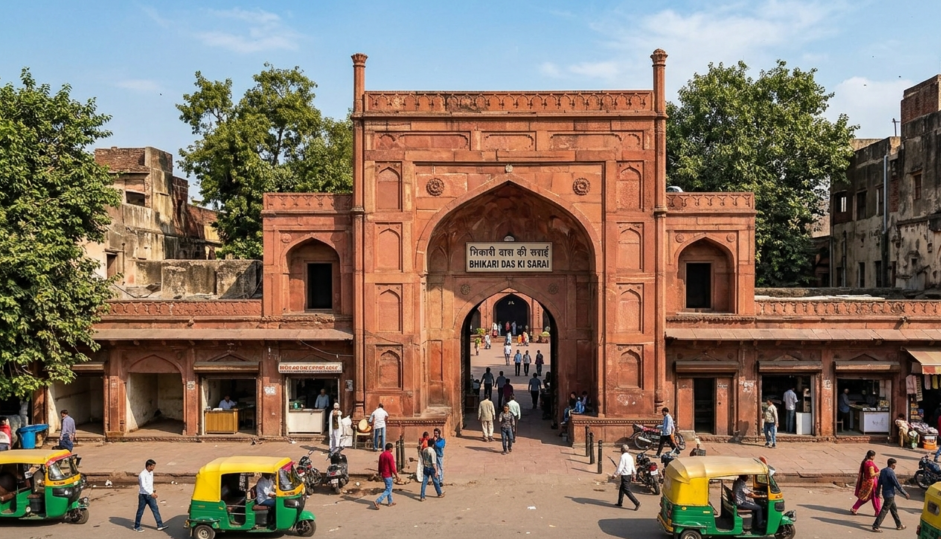
Bhikari Das ki Sarai, Delhi :- A Forgotten Chapter of the Mughal Era
Detailed History
In the glorious history of Delhi, while magnificent monuments like the Red Fort and Humayun’s Tomb garnered global fame, there remain several obscure structures that showcase the everyday life, commerce, and culture of ordinary people. ‘Bhikari Das ki Sarai‘ is one such historical treasure that stands as a living emblem of the social and commercial ecosystem of Mughal Delhi (Shahjahanabad). This transit inn is situated near the historic trade routes adjoining Kashmere Gate, Tis Hazari, and the Old Subzi Mandi in North Delhi.
During the Mughal era, when Delhi flourished as a massive global hub for commerce, a network of sarais (inns) was constructed all around the walled city to accommodate merchants, caravans, travelers, and royal messengers coming from distant lands. These sarais were far more than just night shelters; they operated as secure complexes featuring warehouses for storing trade merchandise, stables for horses and camels, a continuous water supply, and dining facilities. This particular inn was named after ‘Bhikari Das’, who, according to historians, was an exceedingly wealthy merchant or a high-ranking official associated with the Mughal court (in the medieval period, ‘Bhikari’ was often a formal personal name and carried no connotation of poverty). Driven by philanthropy and community welfare, he funded the construction of this grand sarai.
During the British colonial era and post-independence, rapid urbanization, intense population pressure, and unplanned construction completely enveloped this historical inn within a bustling, dense residential-cum-commercial labyrinth. Due to the ravages of time and a lack of timely preservation, the original unified structure has mostly vanished; however, fragmented Mughal arches and walls embedded within modern houses still bear witness to the era of Shahjahanabad.
Detailed Architecture :-
The architectural layout of Bhikari Das ki Sarai conformed to the classic Mughal sarai design, which perfectly integrated robust security with functional utility.
- The Grand Gateway :– The entrance to the sarai featured a monumental, recessed archway. It was constructed using traditional Lakhori bricks (small kiln-fired bricks typical of the Mughal era), lime-mortar plaster, and sturdy red sandstone. The gateway was deliberately scaled to allow heavily laden camels, elephants, and horse carriages to pass through safely. For security, it was fitted with massive wooden doors reinforced with iron studs, which were securely bolted at sunset to protect the inhabitants inside.
- The Central Courtyard & Rooms :– Originally, the gateway opened into a vast, expansive open-air central courtyard. Flanking all sides of this courtyard was a continuous row of small, secure chambers or cells where travelers rested and kept their valuable merchandise safe. The center of the courtyard featured a large water well for domestic use, while the rear portion housed expansive stables for the travelers’ animals.
- Current Architectural State :– Today, contemporary multi-storied houses, concrete buildings, and bustling shops stand directly on the ancient foundations. The original walls of the sarai built with Lakhori bricks are no longer independently visible; instead, they have been absorbed into the modern brick walls, basements, and corners of residential quarters.
- Photography Spots :– Tucked away inside the narrow, winding alleys of Old Delhi, the remaining structural fragments of Mughal architecture, ancient lime plaster contours, vintage wooden windows, and patterns of exposed Lakhori brickwork offer a fascinating subject for heritage photography. Visiting early in the morning when the alleys are relatively quiet allows photographers to capture the authentic, vintage historical essence of the area.
Travel Guide & Routes :-
- Ticket :– Entry to the Bhikari Das ki Sarai neighborhood is completely Free for all visitors, as it is currently a public residential and commercial locality.
- Visiting Time :– The ideal time to explore this area is between 09:00 AM and 05:00 PM. The lanes become heavily congested and poorly lit after dark, making daytime the best window for a clear heritage exploration.
- How to Reach :–
- By Metro :– The nearest metro station is Kashmere Gate (an interchange station for Red, Yellow, and Violet Lines). Another close option is the Tis Hazari metro station on the Red Line. From the station, you can easily hire an e-rickshaw or an auto-rickshaw heading toward Old Subzi Mandi or Malka Ganj. Once there, the specific inner lane can be easily found with the assistance of local residents.
- By Bus :– All Delhi Transport Corporation (DTC) buses plying towards Kashmere Gate ISBT or Old Delhi Railway Station pass through the peripheral roads adjoining this neighborhood.
- By Road :– The streets of this historic part of Delhi are incredibly narrow and crowded. Therefore, driving a personal car or any four-wheeled vehicle to the site is highly discouraged. Relying on the Delhi Metro, local e-rickshaws, or walking is the most practical way to travel.
- Nearby Attractions :– The historic Kashmere Gate city wall, St. James’ Church (Delhi’s oldest church), Roshanara Bagh, Qudsia Bagh, National Gandhi Museum, and the iconic Red Fort.
- Local Flavors & Famous Markets :– The locality is highly accessible to Old Delhi’s legendary culinary spots. Visitors can explore nearby Kashmere Gate or Chandni Chowk to relish famous Delhi chaat, crispy Bedmi Pooris, Chole Bhature, and rich Mughlai delicacies. For shopping, the Kashmere Gate auto-parts market, Chandni Chowk textile markets, and Nai Sarak (famous for books) are located in close proximity.
Interesting Facts :-
- During the Mughal period, sarais did not merely function as resting inns; they also served as critical transit hubs for the imperial postal system, undercover operational bases for state spies, and fortified security checkposts.
- Despite the literal meaning of the word ‘Bhikari’ (beggar), the patron Bhikari Das was actually an incredibly wealthy elite of Delhi who dedicated his immense fortunes to constructing this public welfare facility.
- It stands as a prime example of Delhi’s true ‘hidden history’. While detailed accounts of this sarai are preserved in Mughal records and British colonial gazetteers, it has been reduced to an anonymous, unnamed lane on modern tourist maps.
Important Questions and Answer :-
Question 1:– Where exactly is Bhikari Das ki Sarai located in Delhi?
Answer:- This historical sarai is located within the dense, residential inner lanes near the Old Subzi Mandi and Kashmere Gate areas in North/Old Delhi.
Question 2:– Can the original building of the sarai be seen intact today?
Answer:- No, due to centuries of neglect, continuous modifications, and intense urban encroachment, the original unified structure has been lost. Today, only fragmented patches of Lakhori brick walls and ancient arched contours survive.
Question 3:– Is this site recommended for casual tourists?
Answer:- This site is not suited for casual sightseers or family picnics. However, it is highly recommended for history students, offbeat explorers, heritage walkers, and photographers interested in unearthing the raw, unedited history of Old Delhi.
Author’s Thoughts :-
When discussing the history of Delhi, our attention naturally gravitates toward grand royal palaces. However, obscure and forgotten heritages like Bhikari Das ki Sarai connect us to the genuine, everyday lives of medieval citizens, travelers, and merchants. It is indeed disheartening to witness such an invaluable slice of Mughal history structurally suffocating under modern concrete developments. Yet, catching a glimpse of a centuries-old Lakhori brick arch peeking through a modern home front offers a surreal experience. It is crucial for our archaeological departments and society to collectively document and preserve these hidden architectural remnants before this layered social history fades away forever.
“Swallowed by the relentless march of modern urbanization, the fragmented arches of Bhikari Das ki Sarai remain a poignant reminder of Mughal trade, weary travelers, and Delhi’s forgotten hospitality.”