
Bijwasan Railway Station Delhi :- The Futuristic Mega Transport Hub and Lifeline of Delhi-NCR
Strategically positioned right on the intersection of Delhi and Gurugram, Bijwasan Railway Station is an incredibly vital transit asset under the Delhi Division of the Northern Railway zone. Located on the high-frequency Delhi-Rewari-Jaipur rail corridor, this station commands immense regional importance. While it has traditionally served as a critical everyday transit lifeline for thousands of suburban commuters shuffling between Delhi and Haryana, it is currently undergoing a massive transformation under the ‘Amrit Bharat Station Scheme’ to emerge as one of the largest world-class Integrated Multi-Modal Transport Hubs in the Delhi-NCR zone. In this detailed blog, we deep dive into the history, architectural framework, travel guide, and the magnificent future blueprint of Bijwasan Railway Station.
Detailed History :-
The history of Bijwasan Railway Station mirrors the dramatic evolution of South-West Delhi from a quiet countryside agrarian block into one of India’s most high-tech corporate corridors. Originally, Bijwasan was a prominent, traditional village on the peripheral boundary of Delhi. During the British colonial era, when the landmark Rajputana-Malwa Railway mapped out a meter-gauge line to connect Delhi with the princely states of Rajputana (Rajasthan), this station was set up to cater to local farmers, traders, and rural travelers.
For decades, it remained a tranquil, low-key suburban halt primary servicing local passenger shuttles. However, the dawn of the 21st century triggered a massive geospatial revolution around it. The unprecedented rise of Gurugram into a global cyber city right next to it, combined with the phenomenal residential expansion of the Dwarka Sub-City, completely rewrote Bijwasan’s strategic value. Its unmatched proximity to the Indira Gandhi International (IGI) Airport further escalated its geographical premium. Today, it is no longer just a local boarding stop, but the epicenter of Indian Railways’ most ambitious modernization project aimed at majorly offloading passenger congestion from New Delhi and Old Delhi terminal stations.
Detailed Architecture :-
The architecture of Bijwasan Railway Station is currently in a state of dynamic transition, rapidly converting a standard vintage suburban terminal into a state-of-the-art, airport-like mega-complex.
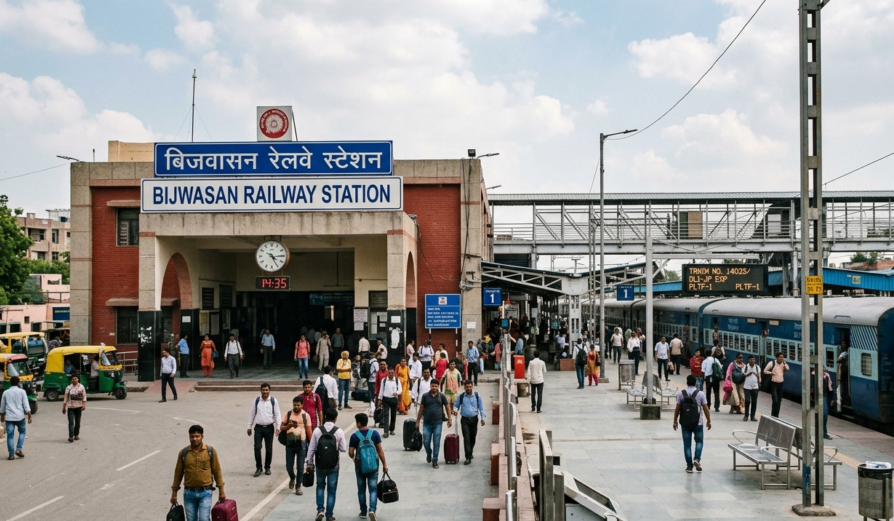
- Exterior :– The original exterior setup comprised a simple, functional brick structure fronted by open spaces. Under the ongoing world-class redevelopment project, a magnificent, futuristic station complex draped in glass facade and heavy structural steel has taken clear shape. It boasts a massive, systematically organized circulating area with designated multi-lane entry, exit, and drop-off points for private and public vehicles. The exterior is flanked by a robust network of broad roads linking it directly to the Dwarka Expressway and the Delhi-Jaipur Highway (NH-48).
- Interior :– The station currently hosts 2 to 3 operational platforms, which are being heavily scaled up in number to support future high-speed passenger rakes. The platforms are comprehensively linked via wide, newly reinforced Footover Bridges (FOBs) and are being systematically integrated with automated escalators and high-capacity elevators. The upgraded interiors feature an expansive computerized ticketing lobby, interactive digital train info displays, secure unreserved and PRS counters, high-speed Wi-Fi connectivity, air-conditioned passenger waiting lounges, and an advanced CCTV security monitoring grid. The track geometry is precisely optimized to facilitate the flawless movement of semi-high-speed express trains.
Travel Guide & Routes :-
Special Note :– Bijwasan Railway Station is a primary scheduled halt for all local EMU and MEMU suburban trains plying the Delhi-Gurugram-Rewari corridor, along with several key regional mail and express trains.
- Tickets and Entry Fee :– Accessing the platform coordinates requires a standard mandatory platform ticket priced at ₹10. For regular suburban transit, commuters can purchase tickets via the physical booking counters or seamlessly bypass lines using the Indian Railways ‘UTS Mobile App’. Advanced long-distance booking service is also available at the PRS window.
- Operating Time :– The station is fully operational 24/7. Due to a tight schedule of passenger shuttles and the massive influx of the corporate working class traversing between Delhi and Gurugram, the terminal remains packed with commuters from dawn until late midnight.
- How to Reach :–
- By Metro :– The closest major metro terminal is the Dwarka Sector-21 Metro Station, which is a primary interchange node for the Delhi Metro Blue Line and the high-speed Airport Express Line. Located roughly 3-4 kilometers away from the railway terminal, commuters can take a 10-minute auto, e-rickshaw, or local feeder bus to cover the gap. (A dedicated direct metro connection to the railway station is also under active layout plans).
- By Road/Bus :– The station enjoys direct logistical access via the newly operational Dwarka Expressway and the Palam-Bijwasan link road. Extensive DTC and Haryana Uday bus routes ply frequently, stopping right at the Bijwasan village and station junctions.
- By Rail :– Passengers can easily board any Gurugram or Rewari-bound suburban EMU from Delhi Sarai Rohilla (DEE), Old Delhi (DLI), or New Delhi (NDLS) stations and land at Bijwasan within a comfortable 25 to 35 minutes.
Photography Spots :-
- The Futuristic Station Facade :– The dramatic glass-and-steel architecture of the redeveloped terminal structure, especially when shot against the backdrop of the massive Roof Plaza, offers spectacular frames for contemporary architectural photography.
- The Inter-State Track Curve :– Positioned slightly ahead of the platforms where the railway tracks gracefully curve past the Delhi state border into the high-rise silhouette of Gurugram, this spot offers brilliant vantage frames to shoot moving trains at twilight.
Local Flavors & Famous Markets :-
- Local Flavors :– The immediate street market perimeter outside the station and near the Bijwasan main crossing serves raw, authentic North Indian and Haryanvi street treats. Local kiosks are highly popular for their large, crispy samosas, deep-fried bread pakoras, spicy kachoris, and thick, boiling hot milk tea served in clay kulhads. Conversely, the nearby Cyber Hub in Gurugram offers world-class gourmet restaurants, upscale microbreweries, and premium global cafes.
- Famous Markets :–
- Bijwasan Local Bazaar :– A bustling, budget-friendly rural-urban market famous for lifestyle commodities, wholesale groceries, and fresh green vegetables sourced straight from peripheral farmlands.
- Pacific Mall (Dwarka Sector-21) :– Positioned a brief drive away from the station compound, this premium shopping complex is highly popular for global apparel brands, a multi-screen multiplex, and a widespread food court.
Interesting Facts :-
- Future Mega World-Class Terminal :– Bijwasan is explicitly designated to be developed into a colossal sub-terminal on the lines of Anand Vihar, allowing trains bound for western and southern India to originate directly from this point, vastly relief-loading central Delhi stations.
- The Corporate Transit Bridge :– Acting as a highly critical physical and economic transit link between old Delhi settlements and India’s corporate capital ‘Gurugram’, it carries thousands of corporate executives and IT professionals daily.
- The Dwarka Expressway Advantage :– Its strategic location immediately adjacent to the newly constructed Dwarka Expressway has resulted in an exponential boom in the micro-market real estate value and connectivity matrix of the entire Bijwasan sector.
Important Questions and Answer :-
Question 1:– Can travelers directly reach IGI Airport from Bijwasan Railway Station via public transit?
Answer:- The physical distance to the IGI Airport Terminal 3 is roughly 6-7 kilometers. You can hop into a direct auto-rickshaw or cab outside the station to reach T3 in under 15 minutes. Alternatively, you can head to the nearby Dwarka Sector-21 Metro Station and catch the Airport Express Line to reach T3 in just one metro stop.
Question 2:- What world-class features are being introduced in the comprehensive Bijwasan Station Redevelopment Project?
Answer:- The mega-redevelopment features a massive central Roof Plaza segregating arrival and departure crowds, upscale retail spaces, modern food courts, multiple escalators, digital touchpoints, high-capacity parking zones, and an integrated terminal layout seamlessly mapping into future bus and metro terminals.
Question 3:- Are secure overnight parking zones operational at Bijwasan Station?
Answer:- Yes, a dedicated, 24/7 monitored paid parking yard operates directly near the primary entrance of Bijwasan Station to securely accommodate two-wheelers as well as four-wheelers. This area is being further expanded under the new terminal project.
“Straddling the glittering high-rises of global Gurugram and the historic railway corridors of Delhi, Bijwasan Railway Station stands as the magnificent, fast-paced face of tomorrow’s modernized Indian transit.”