
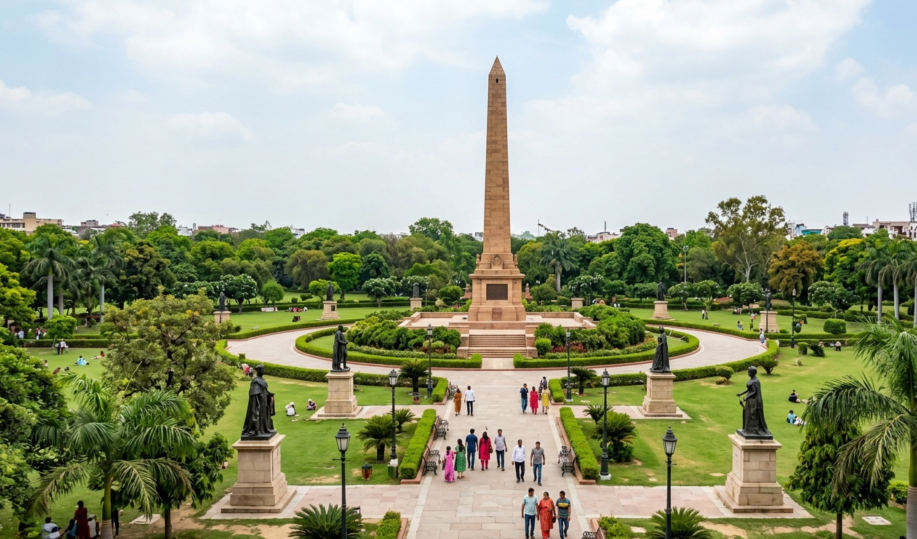
Coronation Park, Delhi :- The Silent Witness to Delhi Durbars and the Epic Shift of British Imperial Power
Situated along Burari Road near the historic Kingsway Camp area in North Delhi, Coronation Park stands as a profoundly significant, reflective, and serene monument to India’s colonial history, royal pageantry, and the inevitable turning of time’s wheel. Far outgrowing the definitions of a standard municipal park, this expansive open ground is the very site where three monumental and staggeringly lavish ‘Delhi Durbars’ were staged during the British Raj. Most importantly, it was from this exact coordinate that King George V proclaimed the historic relocation of the capital of British India from Calcutta to Delhi in 1911, effectively paving the way for the architectural birth of modern New Delhi. Today, it operates as an offbeat heritage park where the echoes of empire intersect with nature, and where massive, weathered colonial-era stone statues stand in solemn solitude. For those seeking an uncrowded, thought-provoking destination in the capital that seamlessly weaves together political history, monumental art, and vast green spaces, Coronation Park is an absolute hidden gem.
Detailed History
The chronological trajectory of Coronation Park chronicles both the absolute zenith of British imperial ostentation and its ultimate, quiet twilight in post-independence India. This historic field hosted three successive “Delhi Durbars“—grand assemblies convened to mark the coronation of British monarchs as sovereigns of India:
- The First Delhi Durbar (1877) :– Orchestrated by Viceroy Lord Lytton, this assembly formally proclaimed Queen Victoria as the ‘Kaiser-i-Hind’ or the Empress of India. It was a calculated political move to integrate Indian princely states into the formal structure of the British Crown.
- The Second Delhi Durbar (1903) :– Commanded by Viceroy Lord Curzon to celebrate the ascension of King Edward VII and Queen Alexandra, this durbar remains etched in history as the most lavish, opulent, and visually spectacular theatrical display of colonial power, characterized by massive elephant processions and unmatched royal styling.
- The Third Delhi Durbar (1911) :– This stands as the ultimate and most high-consequence Durbar in Indian history, being the only assembly personally attended by the ruling British monarch, King George V, and Queen Mary. On December 12, 1911, from his imperial podium on this field, King George V made the earth-shattering announcement shifting the administrative capital of the empire from Calcutta to Delhi.
- Post-Independence Relocation Sanctuary :– Following India’s independence in 1947, the state systematically removed statues of British kings, queens, and viceroys from prominent public roundabouts (most notably from the canopy facing India Gate) during the 1960s. These monolithic stone remnants were transported and permanently anchored within Coronation Park, rendering it a symbolic retirement home or a historical graveyard for colonial statuary.
Detailed Architecture
The spatial layouts and architectural structures of Coronation Park present a masterful blend of open-air landscape engineering and heavy monumental masonry. The primary structural highlights include.
- The Central Commemorative Obelisk :– Positioned at the absolute geometric center of the park is a massive, towering obelisk constructed from premium red sandstone. This towering pillar was erected to mark the exact geographic spot where the imperial dais stood during the 1911 Durbar, from which the shifting of the capital was formally decreed.
- The Monolithic Statue of King George V :– The crowning architectural artifact of the park is the 15-meter-tall white marble statue of King George V. Exquisitely sculpted by the celebrated British artist Charles Sargeant Jagger, this imposing marble effigy originally stood underneath the grand sandstone canopy opposite India Gate before being systematically displaced. Resting atop its towering, intricately carved sandstone pedestal, it retains an imposing royal presence amid the surrounding wilderness.
- The Semicircular Viceroy Courtyard :– Radiating around the principal statue of King George V in a broad semicircular configuration are the historical statues of various prominent Viceroys of India (including Lord Hardinge, Lord Chelmsford, Lord Irwin, and Lord Willingdon) alongside high-ranking colonial administrators. While weathered by decades of isolation and environmental elements, their fine carvings beautifully preserve the technical mastery of mid-century Western realism.
- Modern Amphitheater and Landscaping Restoration :– Under systematic revitalization projects executed by the Delhi Development Authority (DDA), the park has been upgraded with a grand, red sandstone open-air amphitheater, vast beautifully manicured lawns, central fountains, and paved stone walkways designed for heritage walk enthusiasts.
Travel Guide & Routes
To plan an exceptionally structured, trouble-free, and intellectually engaging excursion to Coronation Park, refer to this detailed operational index.
- Park Operational Hours :–
- The park is open to the public seven days a week.
- The standard entry timings are from 06:00 AM to 07:00 PM.
- Strategic Travel Note :– Given the expansive, open-to-sky layout of the heritage grounds, the winter season spanning from October to March is the definitive best time to visit to comfortably explore the monuments.
- Admission Tariff :–
- Admission to Coronation Park is entirely FREE of cost. There are no entrance tickets or hidden levies applied to any demographic category.
- How to Reach :–
- By Metro :– The most efficient public transport terminal is the GTB Nagar Metro Station (Guru Teg Bahadur Nagar), situated on the Yellow Line of the Delhi Metro network. The park is located roughly 2 to 2.5 kilometers from the station exits. Upon arriving at the station, you can quickly hire a local e-rickshaw, auto-rickshaw, or cycle rickshaw to transit directly to the park gates within 5 to 7 minutes.
- By Road/Private Vehicle :– Nestled along Burari Road near Nirankari Colony in North Delhi, the park can be seamlessly reached via the Outer Ring Road. The venue is fully accessible via app-based cabs (Uber/Ola) and personal vehicles, offering a spacious, dedicated parking bay right outside the primary gates. The closest primary bus terminal is the ‘Nirankari Depot’ bay.
- Distance from Prime Railway Terminals :– Situated roughly 11 kilometers from New Delhi Railway Station (NDLS) and 8 kilometers from Old Delhi Railway Station.
- Photography Guidelines :–
- Personal photography via smartphones and standard digital cameras is completely permitted without any associated fees. (Heavy commercial shoots, feature films, or elaborate pre-wedding visual productions require prior formal administrative approval from the DDA).
- Top Visual Backdrops :– The sweeping base platform of the white marble King George V statue, the central red sandstone obelisk, and the linear alignment of the weathered viceregal statues provide unparalleled dramatic framing for portrait, historical, and landscape photography.
- Culinary Options Around (Local Flavors) :–
- Majnu ka Tila (MKT) :– Situated barely 3.5 kilometers away, this vibrant enclave is affectionately known as Delhi’s ‘Little Tibet’. It features highly popular bohemian dining landmarks like AMA Cafe and Laughing Corner, celebrated nationwide for serving authentic Tibetan and East Asian street food delicacies including specialized steamed Momos, comforting Thukpa noodle soups, Tibetan butter tea, and spicy Korean Ramen.
- Hudson Lane & GTB Nagar Food Hub :– Being a primary residential satellite to the Delhi University North Campus, this immediate neighborhood is packed with exceptionally high-quality, budget-friendly student cafes serving phenomenal artisanal pastas, thick shakes, quick chaat platters, and classic North Indian dishes.
- Famous Shopping Hubs Around :–
- Kamla Nagar Market :– Located 4 kilometers south, this iconic retail avenue serves as the ultimate shopping precinct of North Delhi. It is highly famous for its vast collections of fast-fashion apparel, trendy street footwear, designer bags, and legendary local street food stalls selling crisp Chole Bhature and rich sweets.
Nearby Attractions
Optimize your heritage tour across North Delhi by effortlessly pairing Coronation Park with these highly compelling nearby points of interest:
- Majnu ka Tila Tibetan Monastery :– Explore the peaceful, incense-scented Buddhist temples and immersive cultural alleys of this riverside settlement.
- The Northern Ridge (Kamala Nehru Ridge) :– A deeply historical, forested ecosystem housing critical remnants of the 1857 Uprising, including the towering Mutiny Memorial (Ajitgarh) and ancient Ashokan Pillar fragments.
- Nirankari Sarovar Complex :– Positioned in immediate geographic proximity, this tranquil spiritual park features a massive, beautifully engineered water reservoir and pristine landscaped walking paths.
- Delhi University North Campus :– Walk through the historic, red-brick institutional structures of one of India’s most prestigious academic zones.
Interesting Facts
- The Paradox of Power :– There is a profound historical irony embedded in these fields. The very same ground that was chosen by the British Empire to aggressively flex its ultimate sovereignty, absolute wealth, and structural permanence across three global durbars now acts as a silent, overgrown graveyard where the stone statues of those very emperors stand powerless in absolute isolation.
- The Genesis of Kingsway Camp :– To facilitate the arrival of King George V and his massive royal entente during the 1911 Durbar, the British administration constructed a staggeringly vast, fully electrified ‘Tent City’ over these open plains. This grand royal encampment directly inspired the permanent name of the entire municipal district, which continues to be proudly called ‘Kingsway Camp’.
- The Solitary Crown Exception :– The Delhi Durbar of 1911 stands as the absolute and only event in the entire history of colonial India where the actual, reigning British Monarch flew across the oceans to personally attend and preside over Indian state matters. The previous durbars were managed completely via proxies (the ruling Viceroys).
Important Questions and Answer :-
Question 1:– Where is Coronation Park located, and what remains its primary historical significance?
Answer:– The park is located along Burari Road near Nirankari Colony in North Delhi. Its defining historical significance rests on being the structural venue for the three historic Delhi Durbars (1877, 1903, and 1911) and the precise location where the shifting of India’s capital from Calcutta to Delhi was formally proclaimed.
Question 2:– Is there a dynamic entry ticket required to access the heritage statues?
Answer:– No, access to Coronation Park is completely FREE of charge for all Indian and international visitors. The public is welcome to walk the heritage trails anytime between 06:00 AM and 07:00 PM without requiring any formal pass.
Question 3:– Which iconic statue from India Gate was relocated to this park?
Answer:– The monumental 15-meter-tall white marble statue of King George V, which occupied the grand imperial sandstone canopy facing India Gate up until the decolonization aesthetic changes of the 1960s, is permanently preserved here.
Question 4:– What is the most practical Delhi Metro route to access the park?
Answer:– The absolute closest metro transit link is the GTB Nagar Metro Station, operating on the Yellow Line. The park gates sit roughly 2 kilometers from the station exits, a short distance smoothly covered via local auto-rickshaws or e-rickshaws.
Question 5:- Is the venue suitable for family weekend outings and landscape photography?
Answer:– Yes, due to its exceptionally vast open green lawns, massive uncrowded perimeters, deep quietude, and dramatic collection of vintage colonial sculptures, it serves as a brilliant offbeat destination for family picnics and specialized heritage photography.
Author’s Thoughts
From a philosophical and historical vantage point, Delhi’s Coronation Park is the ultimate open-air monument demonstrating the impermanence of human empires. Standing near the towering central obelisk, looking at the silent, stained marble statues of men who once commanded the destiny of millions, one is struck by a profound sense of cosmic humility. The very space that once echoed with royal artillery fire, the trumpets of imperial cavalry, and the orchestrated bows of wealthy Maharajas is now dominated entirely by the rustling of leaves and the quiet chatter of morning walkers. The deliberate removal of King George V and his Viceroys from the center of Lutyens’ Delhi to this quiet northern exile beautifully visualizes the triumph of Indian democracy over imperial subjugation. Unlike the crowded corridors of the Red Fort or Qutub Minar, Coronation Park offers a rare, slow-paced atmosphere of isolation. For any true student of history or a quiet thinker looking to reflect on the rise and fall of political powers, this offbeat park offers a deeply poetic and unforgettable perspective.
“Archiving the monumental echoes of imperial pageantry and the ultimate triumph of democratic sovereignty, Delhi’s historic Coronation Park stands as a silent, profound monument to the passing of empires and the changing tides of time.”