
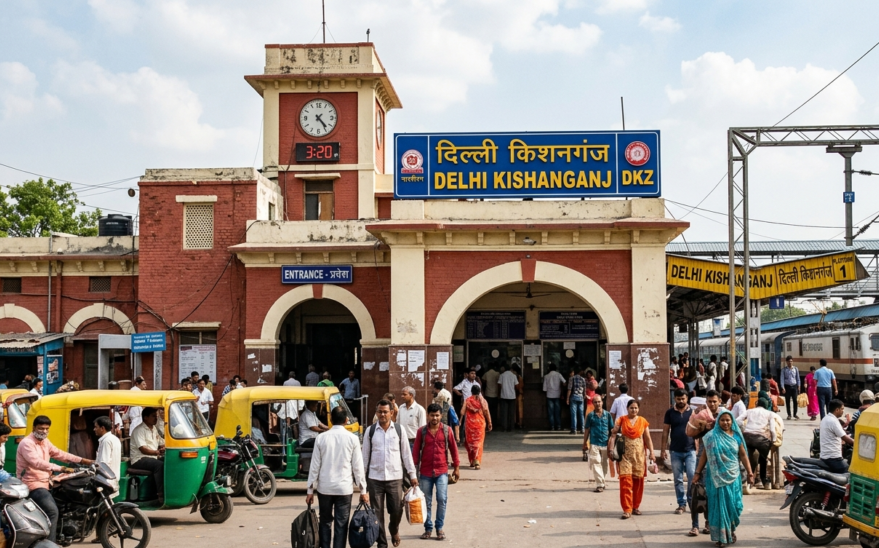
The Strategic and Historic Railway Node :- Delhi Kishanganj Railway Station (DKZ)
Situated in the north-western district of India’s capital city, the Delhi Kishanganj Railway Station (DKZ) stands as a highly historic, deeply rooted, and strategically vital rail node of the Northern Railway zone. Positioned neatly between the bustling rail tracks of Delhi Sarai Rohilla and Old Delhi, this station serves as a crucial transit halt for passengers traveling along the high-density Delhi-Rohtak-Bhatinda and Delhi-Rewari-Jaipur rail corridors, effectively balancing the immense commuter load off central terminals like New Delhi (NDLS) and Delhi Junction (DLI).
Detailed History :-
The historical origins and operational growth of the Delhi Kishanganj Railway Station are profoundly intertwined with the early industrial and colonial evolution of Delhi.
- Dawn of the Colonial Rail :– The station was conceptualized and set up under the British Raj in the late 1890s, marking the structural expansion of the railway lines branching out from Delhi toward the North-Western frontier. Initially, it functioned heavily as a strategic freight and logistics hub, designed to assist nearby textile mills, industrial warehouses, and the sprawling railway colonies established for colonial rail officers.
- Passenger Transformation :– Following India’s independence, the exponential residential and commercial expansion of North-West Delhi necessitated its transformation into a full-fledged passenger station. Today, it hosts a consistent schedule of regional passenger fleets, cross-country express lines, and high-frequency intercity trains servicing Haryana, Punjab, and Rajasthan.
Detailed Architecture :-
The structural blueprint of Delhi Kishanganj Railway Station beautifully reflects the minimalism of classic Indian railway engineering layered over subtle remnants of its old colonial-era footprint.
- Platforms and Spatial Layout :– The terminal operates systematically via 2 active platforms. The architectural layout features a simplified, linear configuration that allows passengers to navigate from the entrance gates to the train coaches with speed and minimal stress.
- Heritage Fabric and Modernization :– Constructed with traditional concrete structures and old-style iron platform sheds, the station exudes an unmistakable old-world charm. To meet modern transit demands, recent infrastructure upgrades under the Amrit Bharat Station Scheme have integrated digital train advisory systems, optimized ticketing enclosures, and streamlined Foot-Over Bridges (FOBs) to assist commuters.
Travel Guide & Routes :-
- Ticket :– Entering the active tracking platforms requires a mandatory, valid Platform Ticket (accessible via automated on-site machines or UTS mobile apps). Passengers can secure unreserved or express transit tickets directly through the primary UTS ticketing windows located at the main entry lobby.
- Timings :– Delhi Kishanganj Station functions continuously 24 Hours a day, 7 Days a week, handling a relentless cycle of local suburban trains and long-distance overnight expresses.
- How to Reach :– Strategically nested in North-West Delhi, closely bordering Sarai Rohilla, Shakti Nagar, and the Kishanganj Railway Colony.
- By Metro :– The most effective and popular mode of commute is via the Delhi Metro. The ‘Pratap Nagar’ Metro Station (Red Line) and the ‘Shastri Nagar’ Metro Station (Red Line) are located within the immediate vicinity, with immediate e-rickshaws bridging the short distance in under 5 minutes.
- By Road :– Benefiting from close access to the major Rohtak Road (NH-10) network, the station is highly accessible. Public DTC buses, local auto-rickshaws, and app-based cab fleets (Ola/Uber) service the drop-off points seamlessly at all hours.
- Photography Spots :– The sweeping vistas of the long curved rail tracks from the central Foot-Over Bridge, the iconic old-style station signage blocks, and the visual aesthetics of passing intercity fleets pulling against the backdrop of the historic railway quarters make for great photography. Tracking areas are strictly restricted for safety.
- Local Flavors & Famous Markets :– Savor authentic local street snacks like piping hot samosas, bread pakoras, and traditional sweets right outside the station lanes. For retail therapy, Asia’s premier ready-made garment hub – Tank Road Market, the famous commercial hub of Karol Bagh (including Gaffar Market), and Kamla Nagar Market are located a short distance away.
Nearby Attractions :-
- Karol Bagh & Gaffar Market :- One of Delhi’s most legendary shopping districts, globally famous for its diverse wedding apparel showrooms, gold jewelry houses, and Gaffar Market (the ultimate electronic goods hub).
- Jhandewalan Devi Temple :- Located about 3 km from the station, this is one of Delhi’s oldest and most sacred temples dedicated to Goddess Durga, heavily visited for its towering, iconic deity statue.
- Kamla Nehru Ridge Forest :- A massive, dense forest reserve protecting crucial chapters of colonial history, including the iconic British-era Mutiny Memorial. It is a haven for nature walks and birdwatching.
- Roshanara Bagh :- A spectacular, sprawling Mughal-era garden constructed by Princess Roshanara Begum, the daughter of Emperor Shah Jahan. The complex encloses her historic architectural mausoleum and a tranquil natural lake.
- University of Delhi – North Campus :- Located a short 10-15 minute drive away, this is the historic academic heart of India, housing legendary institutions amidst lush green avenues and red-brick structures.
Interesting Facts :-
- Delhi Kishanganj is uniquely celebrated for being embedded right in the center of one of the oldest colonial-era Railway Colonies in the capital, preserving a distinct, traditional railway lifestyle and community feel.
- The station acts as a crucial strategic diversion junction for Indian Railways, bridging the high-frequency tracks heading toward Rohtak-Bhatinda and Jaipur-Ahmedabad, helping manage train traffic fluidly.
- Owing to its organized layout and less chaotic nature, the station serves as a primary daily transit lifesaver for local wholesale merchants and daily commuters traveling between Delhi and Haryana.
Important Questions and Answer :-
Question 1:- What is the official Indian Railways station booking code for Delhi Kishanganj?
Answer:- The official IRCTC booking code for this station is DKZ.
Question 2:– Which metro line provides the closest direct access to Delhi Kishanganj Station?
Answer:- The Red Line of the Delhi Metro provides the closest direct access via the Pratap Nagar and Shastri Nagar Metro Stations.
Question 3:- Which major geographic destinations are heavily connected via this terminal?
Answer:- This station serves as a high-frequency gateway toward the Western and North-Western regions of India, connecting commuters directly to key cities across Haryana (Rohtak, Jind, Sirsa), Punjab (Bhatinda), and Rajasthan.
Author’s Thoughts :-
The Delhi Kishanganj Railway Station stands as a beautiful, nostalgic anchor within Delhi’s rapidly transforming urban landscape. It might lack the architectural glass facades of Anand Vihar or the massive commercial scale of New Delhi, but it rewards travelers with an authentic, unhurried old-world charm that tells stories of a bygone industrial era. The peaceful atmosphere mixed with the diligent schedules of local daily commuters infuses this historic complex with a unique, comforting warmth. If you are positioned across Western or Northern Delhi and your travel charts a path toward the plains of Haryana or Punjab, departing from Delhi Kishanganj Station guarantees an exceptionally smooth, highly practical, and stress-free journey.
“Stay connected with us on this journey through the depths of history and spirituality.”