
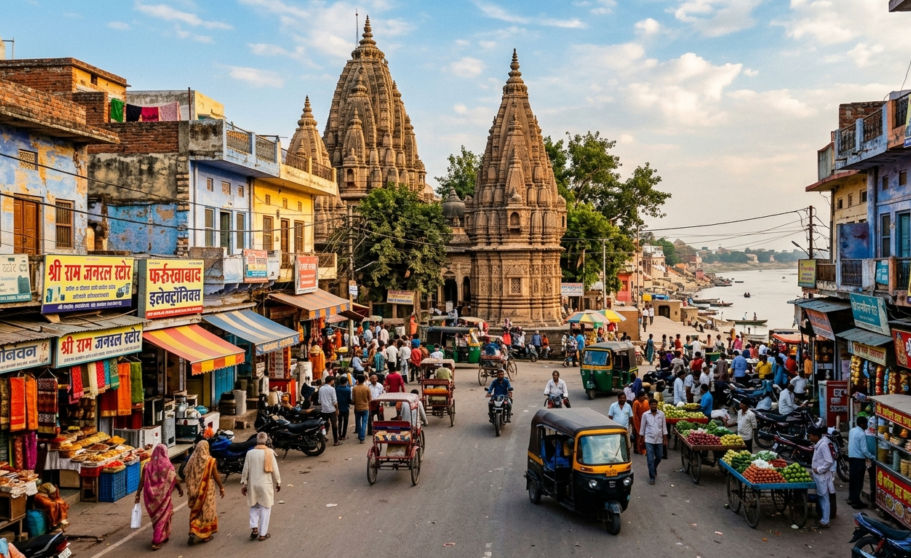
Detailed History (English)
Farrukhabad is a historically and culturally rich city located in the state of Uttar Pradesh, India. The city was founded in 1714 by Nawab Mohammad Khan Bangash, who named it ‘Farrukhabad’ after the then Mughal Emperor Farrukhsiyar. Situated on the banks of the Ganga and Ramganga rivers, it has been a major center for trade and agriculture since ancient times. According to mythological beliefs, during the Mahabharata era, this region was part of King Drupada’s Panchala capital (Kampilya), where Draupadi’s Swayamvar took place. The city’s historical forts, tombs of Nawabs, and ancient temples still tell the stories of its glorious past.
Detailed Architecture :-
The architecture of Farrukhabad reflects a beautiful blend of Mughal, Afghan, and Hindu architectural styles.
- Exterior Architecture :– The older parts of the city feature grand entrance gates, high bastions, and carved walls built by the Nawabs. The exterior walls of the main historical monuments showcase a brilliant use of sandstone and traditional lime mortar. The ancient temples of Kampilya clearly bear the imprint of Gupta and medieval art on their exterior designs.
- Interior Architecture :– Inside the buildings, there are large courtyards, airy balconies (jharokhas), beautifully carved pillars, and arches. The interiors of Nawab Mohammad Khan Bangash’s tomb and other old mosques reflect a strong Sufi and Islamic artistic influence, featuring geometric patterns and floral carvings on the walls.
Travel Guide & Routes :-
- Ticket :– Entry to most public and historical sites in Farrukhabad (such as Kampilya, Nawab’s Tomb) is completely free. A nominal fee may apply to certain specially protected monuments.
- Timing :– The best time to visit is from 6:00 AM to 6:00 PM.
- Opening and Closing Time :– Temples and open monuments remain open from sunrise to sunset.
- How to Reach :–
- By Road :– Farrukhabad is well-connected by road to major cities of Uttar Pradesh like Lucknow, Kanpur, Agra, and Bareilly. Regular bus services are available.
- By Rail :– Farrukhabad Junction (FBD) is the main railway station of the city, directly connected to several major cities across the country.
- By Air :– The nearest airports are in Kanpur (approx. 140 km) and Lucknow (approx. 180 km), from where you can take a taxi or bus.
- Photography Spots :– The ghats of the Ganges (Ghatiaghat), ancient Jain and Hindu temples of Kampilya, and the Tomb of Nawab Mohammad Khan Bangash.
- Local Taste :– Farrukhabad is known for its delicious samosas, khasta kachoris, and its famous potato dishes (as it is a major hub for potato production).
- Famous Markets :– Chowk Bazar and Ghumna Bazar, which are primarily famous for Zari-Zardozi work, hand block-printed textiles, and brass utensils.
- Nearby Attractions :– Kampilya (historical mythological site), Sankisa (famous Buddhist pilgrimage site), and the ancestral birthplace of Neem Karoli Baba.
Interesting Facts :-
- Farrukhabad is also known as the ‘Potato Capital’ of India, as it boasts some of the highest potato production and trade in Asia.
- The city is world-renowned for its exquisite textile Hand Block Printing and intricate Zari-Zardozi embroidery, with its garments being exported worldwide.
- The ancient Mahabharata-era town of Kampilya is located in this district, which is revered as the birthplace of Draupadi.
Important Questions and Answer :-
Question 1:– Who founded Farrukhabad and when?
Answer:- Farrukhabad was founded by Nawab Mohammad Khan Bangash in 1714 in honor of the Mughal Emperor Farrukhsiyar.
Question 2:– What business is Farrukhabad most famous for?
Answer:- Farrukhabad is primarily famous for its bumper potato production and its traditional textile arts of hand block printing and Zari-Zardozi work.
“Blending the fragrance of history, the vibrant colors of art, and the sweetness of its land, Farrukhabad stands as a unique and living heritage of Uttar Pradesh!”