
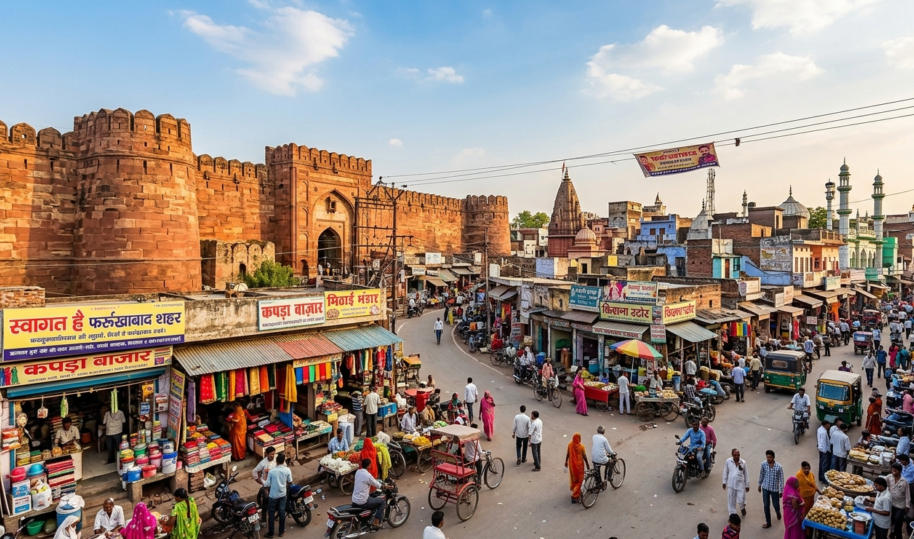
The Historical Journey of Farrukhabad
Situated along the banks of the sacred Ganges River in the western part of Uttar Pradesh, the city of Farrukhabad is widely recognized today for its massive potato production, exquisite Zardozi embroidery, and traditional block printing. However, did you know that the history of this modern district dates back thousands of years, holding profound roots in the epic era of the Mahabharata? Let’s explore the ancient names, legendary identity, and glorious history of Farrukhabad.
Detailed History :-
According to rich historical and mythological beliefs, the entire region of modern-day Farrukhabad was known as ‘Panchal Pradesh’ (the Kingdom of Panchala) during ancient times. In the Mahabharata era, this land was the majestic capital of King Drupada, and it is the sacred birthplace of Queen Draupadi (also known as Panchali). The town of ‘Kampil’ (anciently known as Kampilya), which falls within the Farrukhabad district, served as the primary socio-political hub and is revered as the ancient heartland of this entire territory.
As eras shifted, the region received a new administrative identity during the Mughal period. In the year 1714, the first Bangash Nawab, Mohammad Khan, founded the modern city and named it ‘Farrukhabad’ to honor the reigning Mughal Emperor, Farrukhsiyar. In this way, the land that was immortalized in ancient history as Panchal and Kampilya transitioned into modern Farrukhabad.
Detailed Architecture :-
Since the foundations of the modern city were systematically laid during the Mughal era, its older quarters vividly showcase traditional Mughal architecture. Nawab Mohammad Khan originally developed Farrukhabad as a fortified township secured by 12 monumental gateways (Darwazas). The historic bazaars, narrow winding lanes, and aging Havelis beautifully preserve this historical urban layout. On the other hand, the ancient temples and revered Jain pilgrimage sites located across the district (especially in Kampil) are celebrated for their classical Indian style, intricate stone carvings, and spiritual architecture.
Travel Guide & Routes :-
- Ticket and Timings :– There is no entry fee to explore the city or its prominent historical sites like Kampil. The ancient temples and monuments are generally open to visitors from 6:00 AM to 8:00 PM daily.
- How to Reach :– Farrukhabad is exceptionally well-connected by both road and rail networks to major cities in Uttar Pradesh, including Kanpur, Lucknow, and Bareilly. Farrukhabad Junction (FBD) is the central railway station. For local commuting within the city, autos and e-rickshaws are readily available.
- Photography Spots :– The ancient Jain and Hindu temples of Kampil, the scenic banks of the Ganges River (Ghatia Ghat), and the historical architectural remnants from the era of the Nawabs.
- Local Flavors & Famous Markets :– When visiting, do not miss out on tasting the famous local ‘Khasta Kachori’ and traditional halwa. For shopping, Nehru Road Bazaar and Chowk Bazaar are highly popular, offering a splendid collection of hand-crafted block-printed textiles and authentic Zardozi sarees.
Interesting Facts :-
- The famous Swayamvar (marriage alliance ceremony) of Draupadi from the Mahabharata took place at Kampilya (modern Kampil) in this district, where Arjuna successfully pierced the eye of the rotating fish with his arrow.
- In contemporary times, Farrukhabad is fondly called the “City of Potatoes,” as it hosts one of the largest potato wholesale markets in Asia.
Important Questions and Answer :-
Question 1:- Who founded the city of Farrukhabad and when?
Answer:- The city was founded by Nawab Mohammad Khan Bangash in the year 1714.
Question 1:– After which Mughal ruler was Farrukhabad named?
Answer:- The city was named after the Mughal Emperor Farrukhsiyar.
“From the epic Panchal of the Mahabharata to the Farrukhabad of the Nawabs—every corner breathes a timeless tale of history.”