
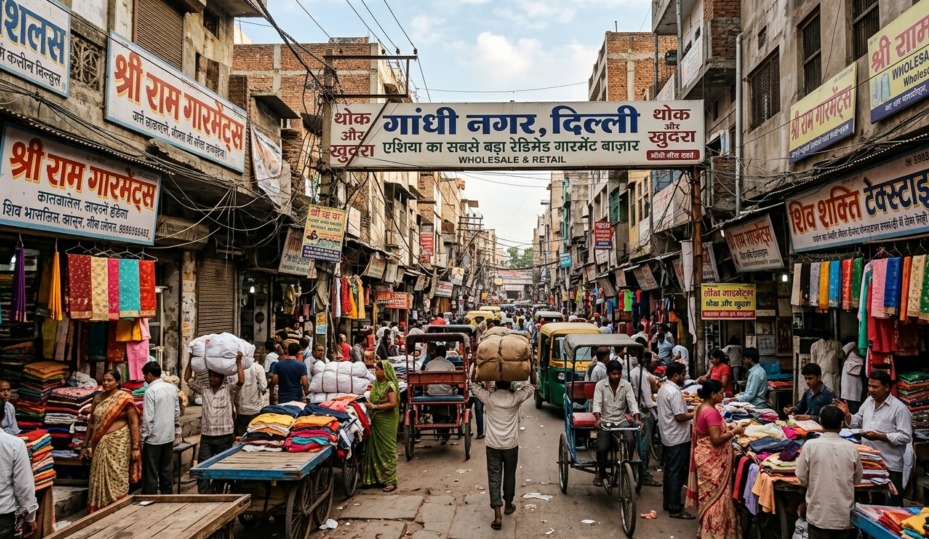
Gandhi Nagar, Delhi :- The Mega Wholesale Apparel Hub of Asia
Detailed History
Gandhi Nagar, situated in the Shahdara district of East Delhi, is not merely a residential or local commercial locality; it is internationally recognized as Asia’s largest wholesale ready-made garment and textile market. Spanning over a high-density commercial grid, this marketplace serves as a foundational pillar of India’s domestic textile economy, supplying finished apparel to every state across the nation and exporting directly to international territories.
The commercial evolution of Gandhi Nagar began in the decades following India’s independence. Initially a modest residential settlement, the area underwent a massive structural transformation during the 1970s and 1980s. Local entrepreneurs, master tailors, and weavers established small-scale cottage manufacturing units and stitching workshops within their households. Due to exceptionally low production overheads, highly skilled labor, and strategic proximity to Delhi’s major railway terminals, Gandhi Nagar rapidly became the ultimate destination for textile traders. Today, the district houses more than 15,000 retail-wholesale shops and thousands of small-scale manufacturing units, operating as the undisputed powerhouse of India’s budget fashion industry.
Detailed Architecture :-
The architectural landscape of the Gandhi Nagar market represents the dense, organic, and historical ‘bazaar typography‘ characteristic of classic commercial centers in Delhi. It is defined by an intricate labyrinth of ultra-narrow lanes, high-density trade blocks, and multi-tiered functional structures.
- The Alleyway Networks and Katra Configurations :– The marketplace is divided into massive specialized commercial sectors and tight corridors locally referred to as ‘Galis‘ or ‘Kuchas‘. Prominent commercial quadrants include the ‘Ashok Bazar‘, ‘Mahavir Bazar’, and ‘Nehru Gali’. The typical building design features a retail storefront or wholesale display room on the ground floor, while the upper vertical stories are comprehensively utilized as high-capacity textile storehouses (warehouses) or active stitching and finishing workshops.
- Functional Commercial Aesthetic :– Unlike contemporary premium shopping malls, the architecture here is strictly utilitarian. The shop floors and entrance steps are constantly stacked with massive, securely bound fabric bales and finished garment packages. Each specific alleyway is structurally dedicated to a single specialized clothing segment—such as exclusive denim corridors, formal shirt zones, or children’s wear blocks.
- Photography Spots :– Being a hyper-active, industrial wholesale hub, Gandhi Nagar lacks conventional ornamental monuments or pastoral landscaping. However, it is a highly sought-after canvas for urban documentary photography. The compelling visuals of specialized manual laborers carrying massive fabric loads overhead, geometric rows of fashion mannequins lining rustic corridors, and the sheer, unfiltered energy of non-stop trade offer raw, powerful frames for street photographers capturing the essence of India’s commercial spirit.
Travel Guide & Routes :-
- Ticket :– As Gandhi Nagar is a fully integrated, open-air public wholesale commercial district, there is absolutely no entry fee or ticket requirement. It is completely free and accessible to the public.
- Visiting Time :– The wholesale units and retail outlets operate at maximum capacity from 10:00 AM to 08:00 PM. The Gandhi Nagar textile market remains officially closed on Mondays. For business sourcing or general viewing, the optimal hours to navigate are between 11:00 AM and 04:00 PM.
- How to Reach :–
- By Metro :– The closest transit access points are the Seelampur Metro Station and the Shahdara Metro Station, both located on the Red Line. Furthermore, the Welcome Metro Station on the Pink Line provides excellent connectivity. From any of these exits, commuters can effortlessly secure an e-rickshaw or auto-rickshaw straight into the heart of the market.
- By Train :– The market is located within walking distance of the Delhi Shahdara Junction railway station, making it immensely accessible for bulk buyers traveling from neighboring northern states.
- By Road :– Gandhi Nagar is directly accessible via the Grand Trunk Road (GT Road) and the marginal Pushta Road. (Crucial Travel Advice: Due to severe structural congestion and the extreme narrowness of the commercial lanes, driving a private four-wheeler inside the market is highly impractical; securing parking is virtually impossible. Utilizing the Delhi Metro network is strongly recommended).
- Nearby Attractions :– Yamuna Sports Complex, Shahdara Local Market, and the iconic Akshardham Temple (accessible via a short metro commute).
- Local Flavors & Famous Markets :– The peripheral culinary lanes of Gandhi Nagar, expanding into Shahdara and Seelampur, are highly famous for authentic Delhi street food. Visitors can enjoy sizzling hot Chole Bhature, crisp kachoris, traditional samosas, and Mughlai Mughlai-style grilled kebabs. For buyers, Gandhi Nagar is a treasure trove where premium-grade denims, casual shirts, t-shirts, festive sherwanis, and children’s apparel can be acquired at less than half of their standard market retail rates.
Interesting Facts :-
- Gandhi Nagar stands globally recognized as Asia’s single largest wholesale ready-made garment market, facilitating the movement of millions of meters of stitched apparel daily.
- A substantial percentage of high-street fashion apparel, trendy denims, and casual wear sold inside elite premium malls and branded corporate outlets are originally manufactured within the intense micro-workshops of Gandhi Nagar, before being branded with corporate tags.
- The economies of scale achieved here are unmatched; high-quality basic shirts and apparel pieces can be sourced here starting at incredibly nominal prices, making it the financial backbone of affordable fashion for India’s masses.
Important Questions and Answer :-
Question 1:– Can an individual retail buyer purchase single garments at Gandhi Nagar?
Answer:- Gandhi Nagar operates primarily as a strict bulk wholesale market where products are legally and commercially traded in pre-packaged sets or bundles. However, certain multi-story showrooms flanking the primary peripheral roads do entertain retail buyers with single-piece sales, though the deep interior lanes deal exclusively in bulk trade.
Question 2:- What is the official weekly holiday for the Gandhi Nagar apparel market?
Answer:- The entire commercial layout of the Gandhi Nagar clothing market is strictly closed on Mondays. The market remains fully functional from Tuesday through Sunday.
Question 3:- What key factors should commercial buyers keep in mind while sourcing from Gandhi Nagar?
Answer:- Bulk buyers must closely inspect the stitching consistency, fabric elasticity, and standard sizing charts of the apparel lots. Since wholesale transactions involve massive volumes, there is ample room for strategic bargaining, and establishing an official invoice with clear terms is highly recommended.
Author’s Thoughts :-
Gandhi Nagar is the relentless commercial heartbeat of Delhi, single-handedly balancing the clothing needs and economic budgets of millions. Walking through its vibrant, packed corridors amidst the endless whirring of heavy-duty industrial sewing machines and the systematic packing of freight packages reveals the true structural power of India’s micro-enterprises. It may lack the manicured luxury of high-end corporate districts, but its sheer commercial volume and operational efficiency can easily rival global supply chains. To understand the raw industrial pulse and the true democratic spirit of Indian commerce, an exploration of Gandhi Nagar’s historic alleys is absolutely essential.
“Thriving dynamically amidst narrow corridors and untiring human spirit, Gandhi Nagar stands as the undisputed titan of Asia’s apparel trade, dressing the nation with affordable fashion and industrious pride.”