
Detailed History
Gautam Buddh Nagar district is an extremely important and modern district in the state of Uttar Pradesh, India. Due to its proximity to Delhi, it forms a major part of the National Capital Region (NCR). The history of this region is highly glorious and ancient, carrying direct connections to the eras of the Mahabharata and the Ramayana.
Old Name and History
- Old Name of Gautam Buddh Nagar :– Before being administratively declared a district, this entire region was primarily recognized by its most prominent city, ‘NOIDA’, and the surrounding areas of the historical towns of ‘Dadri’ and ‘Secunderabad’. In terms of ancient and cultural history, the primary mythological identity of this region is deeply associated with ‘Dankaur’ (Dronakaur) and ‘Bisrakh’.
- How and Why the Names Were Given :–
- Bisrakh (Birthplace of Ravana) :– The village of ‘Bisrakh’ located in this district is traditionally believed to be the birthplace of Ravana. The place was originally named ‘Vishrava’ after the sage Vishrava (Ravana’s father), which over time transformed into ‘Bisrakh’.
- Dankaur (The Town of Guru Dronacharya) :– The town of ‘Dankaur’ in this district served as the ashram site of Guru Dronacharya during the Dwapara Yuga. The Kauravas and Pandavas received their education here, which is why it was called ‘Dronakaur’, later corrupting into ‘Dankaur’. This is also the legendary site where Eklavya sacrificed his thumb as Guru Dakshina.
- When and Why it was Named ‘Gautam Buddh Nagar’ :– This district was officially created on April 6, 1997, by the then Chief Minister of Uttar Pradesh. It was carved out by merging parts of Ghaziabad and Bulandshahr districts (such as the Dadri and Secunderabad tehsils). The new administrative district was named ‘Gautam Buddh Nagar’ to honor the sacred memory, message of peace, and global spiritual legacy of Lord Gautama Buddha. Its administrative headquarters was established in ‘Greater Noida’.
Detailed Architecture :-
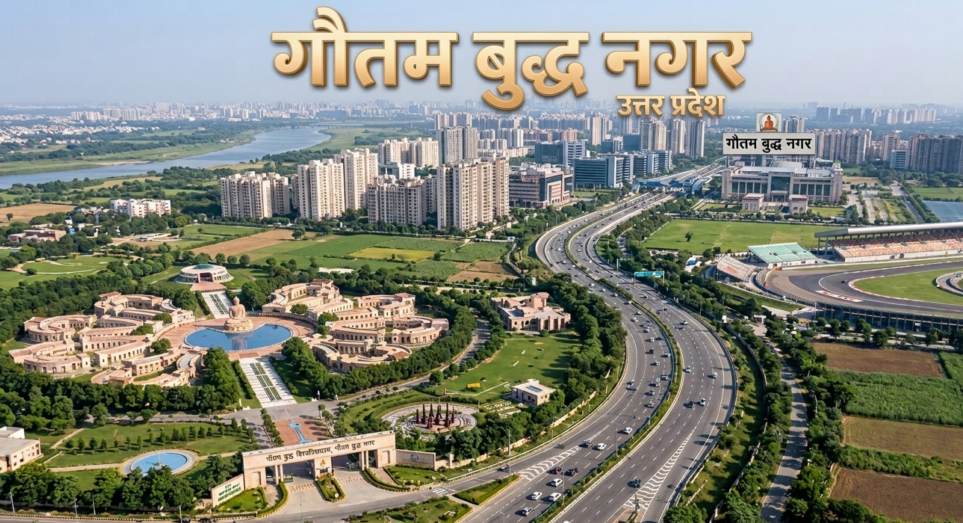
Gautam Buddh Nagar district is widely renowned for its unique amalgamation of ancient heritage structures and cutting-edge Modern Architecture.
- Exterior Architecture :– The external layout of the district mirrors a state-of-the-art ‘Global City’. It is characterized by towering skyscrapers, wide six-to-eight-lane expressways, and massive corporate hubs. Symbols of modern architectural design include the ‘Noida Authority Building’ and the ‘Greater Noida Authority Main Office’, celebrated for their grand glass-and-concrete facades. On the heritage side, the ancient temple of Guru Dronacharya in Dankaur and the historical Shiva temple in Bisrakh display traditional Indian architectural layouts crafted from stone and brick. Additionally, the main campus of ‘Gautam Buddha University’ (GBU) features an exterior layout completely inspired by Buddhist stupas and classical monastic frameworks, presenting a magnificent sight.
- Interior Architecture :– The interiors of modern buildings and premium commercial spaces (like the Mall of India) adhere strictly to international standards, incorporating massive glass domes, escalators, and automated climate-and-lighting systems. In stark contrast, the inner sanctums (Garbhagriha) of the ancient temples are highly traditional and serene. The temple at Bisrakh houses a highly unique octagonal (eight-sided) ancient Shiva Lingam, which is structurally famous across the country.
Travel Guide & Routes
If you plan to tour the prominent attractions of Gautam Buddh Nagar (such as the Rashtriya Dalit Prerna Sthal, Bisrakh, Dankaur, or the Okhla Bird Sanctuary), the complete travel logistics are detailed below:
- Ticket and Entry Fee :– Entry to most of the historical sites and ancient temples (like Bisrakh and Dankaur) is completely free of charge. However, designated tourist complexes like the ‘Rashtriya Dalit Prerna Sthal’ charge a nominal entry ticket of around INR 15 to 20. Similarly, the entry ticket for the Okhla Bird Sanctuary is fixed at INR 30 for Indian nationals.
- Visiting Time :– The ancient temples remain accessible to devotees from 6:00 AM to 8:30 PM. Protected tourist zones like the Prerna Sthal and the Bird Sanctuary remain open from 9:00 AM to 5:30 PM or 6:00 PM. The winter season is considered the most pleasant period to explore this region.
- Photography Spots :– Prime photography locations include the grand stupa-style structures and main gate of Gautam Buddha University in Greater Noida, the skyline of skyscrapers along the Noida Expressway, sunset vistas at the Okhla Bird Sanctuary, and the colossal stone elephants and statues inside the Rashtriya Dalit Prerna Sthal.
- Local Tastes :– The food scene here caters to all preferences, offering everything from traditional North Indian street food (like Kachoris, Samosas, and Chole Bhature) to high-end global cuisines. The food courts and markets in Sector-18 (Atta Market) in Noida and Jagat Farm in Greater Noida are immensely popular for their diverse Chaat, stuffed Paranthas, and Mughlai delicacies.
- Famous Markets :– The most iconic and oldest shopping hub in the district is ‘Atta Market’ (Sector-27, Noida), known for offering clothing, footwear, and electronic goods at highly competitive prices. Furthermore, ‘Brahmaputra Market’ (Sector-29) is a legendary evening hotspot for street food lovers, while ‘Jagat Farm Market’ remains a central hub for students and tourists in Greater Noida.
How to Reach :-
- By Air :– The nearest airport is the ‘Indira Gandhi International Airport, Delhi’ (DEL), located roughly 30 to 35 kilometers away from Noida. From the airport, commuters can easily access the district via direct app-based taxis or the Delhi Metro network (Blue and Magenta Lines). (The upcoming Noida International Airport in Jewar is located right within this district).
- By Rail :– The district does not house a massive central railway terminal of its own, but it sits in close proximity to major stations like ‘New Delhi’ (NDLS), ‘Old Delhi’, and ‘Anand विहार Terminal’ (ANVT). Anand Vihar is just 10 to 15 kilometers away from Noida, from where auto-rickshaws, cabs, or local metro connectivity are instantly available.
- By Road and Metro :– This district boasts some of the finest road connectivity networks in the nation. Regular interstate buses and taxis ply directly from Delhi, Ghaziabad, and Agra (via the Yamuna Expressway). The most seamless and efficient way to travel internally is via the ‘Delhi Metro’ and the ‘Noida-Greater Noida Aqua Line Metro’, which completely interlink the entire district.
Interesting Facts
- The Village of Ravana :– While the effigy of Ravana is traditionally set on fire across India during Dussehra, the residents of Bisrakh village in Gautam Buddh Nagar do not burn his effigy. Instead, they perform solemn prayers for the peace of his soul, as it is revered as his ancestral home.
- Largest Industrial Hub in Asia :– The twin zones of Noida and Greater Noida falling inside this district are ranked among the largest meticulously planned industrial and residential townships across the entire Asian continent.
- The Full Form of NOIDA :– It is a lesser-known fact that ‘NOIDA’ is not an arbitrary name but an acronym that stands for “New Okhla Industrial Development Authority”.
- Formula One Racing Track :– India’s premier and only Formula One racing venue, the Buddh International Circuit (BIC), is situated right here in the Greater Noida region of the district.
Important Questions and Answer :-
Question 1:- When was Gautam Buddh Nagar district created, and which districts was it carved out from?
Answer:– Gautam Buddh Nagar district was officially formed on April 6, 1997, by separating the rapidly developing industrial and rural pockets of Ghaziabad and Bulandshahr districts.
Question 2:– Where is the administrative headquarters of this district located?
Answer:– The administrative headquarters of the district is located centrally within the planned city of ‘Greater Noida’, rather than any of the older towns.
Question 3:- Why is the town of Dankaur, associated with Guru Dronacharya, famous?
Answer:– Dankaur is famous for housing the ancient ashram site of Guru Dronacharya. According to deep mythological beliefs, this is the very region where the tribal prince Eklavya carved a clay idol of Dronacharya, mastered archery independently, and sacrificed his right thumb as Guru Dakshina.
Question 4:- Why is Gautam Buddh Nagar frequently referred to as ‘NOIDA’?
Answer:– To develop the expansive region near Okhla into a massive commercial zone, the ‘NOIDA Authority’ was constituted under the UP Industrial Area Development Act, 1976. Because this authority manages the prime urban layout, the region became synonymous with the name Noida.
Author’s Perspective :-
“In my perspective, Gautam Buddh Nagar is not merely an industrial or concrete extension of Delhi; rather, it stands as a living testament to how India is stepping into a futuristic tomorrow while keeping its glorious past intact. On one hand, the rustic lanes of Bisrakh and Dankaur deeply connect us to the ancient cultural roots of the Ramayana and Mahabharata eras. On the other hand, the soaring skyscrapers of Noida and Greater Noida script the story of global economic progress. Naming this district after Lord Buddha feels profoundly meaningful; amidst today’s chaotic corporate lifestyle, the wide expressways, beautifully landscaped green lungs, and serene educational hubs (like GBU) offer a sense of calm and mindfulness. This district strikes an impeccable balance for heritage enthusiasts and modern lifestyle seekers alike.”
“Preserving the deep roots of ancient history, Gautam Buddh Nagar stands today as the most shining face of modern India’s industrial progress.”