
Detailed History (English) :-
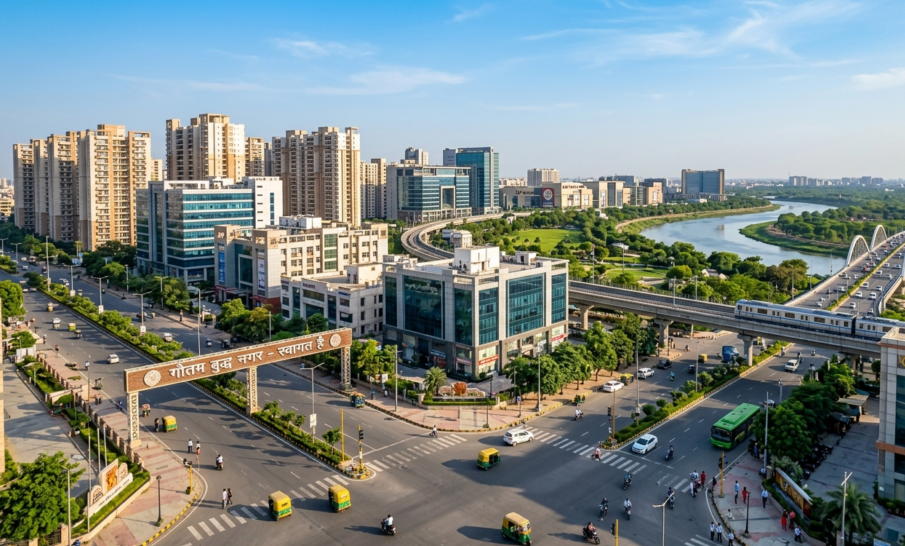
Gautam Buddha Nagar, a highly prominent and ultra-modern district in Uttar Pradesh, is globally recognized today for its industrial revolution, glittering skyscrapers, and futuristic twin cities—Noida and Greater Noida. The history of this region is deeply rooted in antiquity. On September 6, 1997, the Government of Uttar Pradesh carved out this new district by separating portions of the Bulandshahr and Ghaziabad districts, naming it ‘Gautam Buddha Nagar‘ in honor of Mahatma Buddha.
When exploring its old name and historical background, the region did not possess a single standalone district name; rather, it was historically referred to as ‘Oyal’, ‘Sakri’, and predominantly known as the ‘rural hinterlands of Noida and Greater Noida’. Administratively, this entire belt fell under the jurisdiction of the ‘Sikandrabad and Dankaur tehsils’ or was collectively referred to as the ‘border zone of Bulandshahr-Ghaziabad’.
In mythological contexts, the district’s history dates back to the Mahabharata era. The Greater Noida territory of the district was the ancient hermitage of ‘Sage Vishrava’. A prominent village named ‘Bisrakh’ stands there today, derived from his name. Bisrakh is widely revered as the birthplace of Ravana, which is why in ancient times this entire belt was alternatively called the ‘Land of Vishrava’ or considered a part of the ancient Panchala Kingdom. Over the centuries, the region remained a part of the Mughal Empire and later transitioned under British rule as a segment of the Sikandrabad tehsil of the Bulandshahr district.
Detailed Architecture :-
The architecture of Gautam Buddha Nagar presents a fascinating contrast and convergence of ancient rural heritage and hyper-modern urban infrastructure.
- Exterior Architecture :– Today, the exterior identity of the district is defined by massive six-lane and eight-lane expressways, towering commercial and residential skyscrapers, and sprawling corporate tech parks. Conversely, the historical and rural pockets of the district (such as Dankaur and Bisrakh) retain an exterior aesthetic of vintage brick and mud houses, remnants of old Havelis, and the layout of traditional Indian villages.
- Interior Architecture :– The modern sectors of Noida and Greater Noida feature highly planned interior layouts structured on a ‘grid system‘, incorporating underground drainage, dedicated green belts, and wide sector lanes. On the other hand, the interiors of historical sites like the ancient Shiva Temple in Bisrakh or the Dronacharya Temple in Dankaur exhibit classic Hindu temple architecture, featuring old stone pillars, traditional lime-mortar bindings, and serene sanctum sanctorums (Garbhagriha).
Travel Guide & Routes :-
- Ticket :– Entry into the district or visits to its historical villages and temples (such as the Bisrakh Temple and Dronacharya Temple) are completely free of charge. A nominal entry ticket (around ₹10-₹20) may apply to specific modern recreational arenas like the Rashtriya Dalit Prerna Sthal.
- Timing :– The ideal time to explore the tourist spots and historical locations across the district is from 7:00 AM to 7:00 PM.
- Opening and Closing Time :– Historical and religious monuments generally remain open from sunrise to sunset, whereas commercial hubs and malls remain operational late into the evening.
- How to Reach :–
- By Road :– Gautam Buddha Nagar boasts one of the finest road networks in the country. It is seamlessly connected via the Delhi-Noida-Direct (DND) Flyway, the Noida-Greater Noida Expressway, and the Yamuna Expressway, linking it directly to Delhi, Agra, and Mathura.
- By Metro :– The Delhi Metro ‘Blue Line‘ and the Noida Metro ‘Aqua Line’ cut across the district, making the metro the most accessible and affordable transit medium to navigate the region.
- By Rail :– The district does not house a massive central railway station of its own; however, the nearest major railheads are ‘New Delhi (NDLS)’, ‘Old Delhi (DLI)’, and ‘Ghaziabad (GZB)’, from where quick metro or cab rides are available.
- By Air :– The nearest active airport is the ‘Indira Gandhi International Airport (IGI), Delhi’, located approximately 35-40 km away. (Additionally, the mega ‘Noida International Airport’ is under active construction in the Jewar region of the district).
- Photography Spots :– The ancient Ravana/Shiva Temple at Bisrakh, the historic Dronacharya Pond in Dankaur, the scenic Surajpur Wetland (ideal for bird watching), and the futuristic skyline along the Noida Expressway.
- Local Taste :– The culinary palette spans from traditional rural North Indian cuisine (such as Kadhi-Chawal and Saag-Roti) in the villages to global international cuisines and famous street foods (like Momos, Chaap, and Chaat) across the urban sectors.
- Famous Markets :– Atta Market (Sector 18), Indira Market, and the Jagat Farm Market in Greater Noida, highly popular for garments, electronics, and local merchandise.
- Nearby Attractions :– Buddh International Circuit (India’s F1 Race Track), Okhla Bird Sanctuary, and the scenic banks of the Yamuna River.
Interesting Facts :-
- In the Bisrakh village of Gautam Buddha Nagar, Dussehra is never celebrated, and effigies of Ravana are never burnt. The locals revere Ravana as a son of their village (being the son of Sage Vishrava).
- The district does not have its administrative headquarters in a town named ‘Gautam Buddha Nagar’; instead, its administrative machinery functions out of the twin cities of Noida and Greater Noida.
- Prior to the formation of the district, its most famous city, ‘NOIDA’, was created as an acronym for the ‘New Okhla Industrial Development Authority’, developed as an industrial extension of Delhi’s Okhla region.
Important Questions and Answer :-
Question 1:– When was Gautam Buddha Nagar district formed and which districts were divided to create it?
Answer:- Gautam Buddha Nagar district was officially formed on September 6, 1997, by separating the industrial and rural clusters of the Bulandshahr and Ghaziabad districts.
Question 2:– What is the historical or mythological significance of Bisrakh village in this district?
Answer:- Bisrakh village is revered as the ancient hermitage of Sage Vishrava and the birthplace of his son, Ravana, making it a place of immense mythological antiquity.
“Spanning from the mythological antiquity of Bisrakh to the high-tech expressways of modern India, Gautam Buddha Nagar stands as a living testament to the spectacular wheels of time!”