
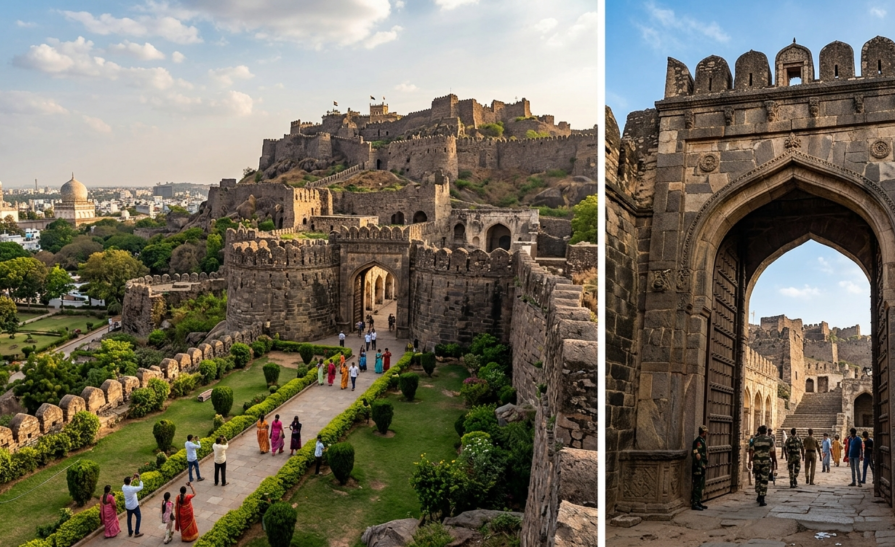
Golconda Fort, Hyderabad :- A Complete Guide
Following the golden sands of Jaisalmer’s Sonar Qila, let us direct our journey toward the historical and enigmatic heart of South India-the citadel that gifted the world the priceless Koh-i-Noor diamond. Situated in Hyderabad, the capital city of Telangana, Golconda Fort stands proud as one of India’s most magnificent, sprawling, and structurally advanced military fortresses. Erected on an isolated granite hill, this fort is celebrated globally for its unparalleled military engineering, acoustical marvels, and a legendary heritage rooted in the diamond trade. This perfect blend of history and ancient technology continues to leave travelers and scholars utterly spellbound.
Detailed History :-
The historical lineage of Golconda Fort is ancient, rich, and marked by dramatic geopolitical shifts. Originally constructed as a humble mud fortress (Mud Fort) during the 12th century (around 1143 AD) by the rulers of the Kakatiya Dynasty, the site’s origin is tied to an intriguing local legend. A shepherd boy discovered a sacred idol on this hilltop, prompting the king to ordain a defensive clay structure. Consequently, the site was named ‘Golla Konda‘, which translates to ‘Shepherd’s Hill‘ in the regional Telugu language.
The bastion subsequently transitioned under the control of the Bahmani Sultanate, but its true architectural and political golden era dawned in the 16th century (1518 AD) when Sultan Quli Qutb Shah, the founder of the Qutb Shahi Dynasty, declared Golconda his imperial capital. Over a span of 62 years, successive Qutb Shahi sultans systematically fortified the mud ramparts into a massive, impenetrable granite stronghold. Beyond its military prowess, Golconda emerged as the premier global diamond trading hub, processing legendary gems extracted from the nearby Kollur mines. In 1687, following an exhaustive eight-month siege and strategic betrayal, Mughal Emperor Aurangzeb breached the fort, charting the eventual decline of this majestic citadel.
Detailed Architecture :-
Spanning an expansive perimeter of roughly 11 kilometers, the structural layout of Golconda Fort stands as a masterclass in Indo-Islamic architecture. The fort is seamlessly integrated into a massive granite hill that rises 120 meters (400 feet) above the surrounding plains.
- Defensive Ramparts and Bastions :– The fort complex is enclosed within three successive rings of formidable stone walls. Its outermost defensive boundary features 87 massive semi-circular bastions, which were historically mounted with heavy artillery. The famous ‘Fateh Rahbar’ cannon remains stationed on the ramparts today.
- The Acoustical System :– The most groundbreaking architectural feature rests at the primary entry gate, known as ‘Fateh Darwaza’ (Victory Gate). A clap struck directly beneath the central dome of this grand archway echoes perfectly up to the highest point of the fort-the ‘Bala Hissar’ (The King’s Palace)-located nearly a kilometer away. This functioned as a sophisticated acoustic alarm system to alert the royal guards of incoming enemy ambushes.
- Royal Palaces and Courts :– Perched at the summit, the Bala Hissar served as the central court and royal residence. Lower sections of the fort house architectural treasures such as the Taramati Baradari, the Shamshir Kotha (The Royal Armoury), and beautifully designed imperial zenana (harems).
- Advanced Water Management :– Qutb Shahi engineers achieved a brilliant feat of hydraulics without modern machinery. Utilizing a complex system of Persian wheels, overhead clay conduits, and distribution cisterns, they effortlessly pushed fresh water up the 400-foot incline to satisfy the requirements of the high palaces.
Travel Guide & Routes :-
Tickets & Entry :–
- For Indian Citizens :– ₹25 per individual (Cash) or ₹20 (Digital/Online booking).
- For Foreign Nationals :– ₹300 per individual.
- Camera/Photography Fee :– Standard photography using smartphones or digital cameras is completely free. Handheld video cameras incur a separate nominal fee of ₹25.
Timings :–
- Visiting Hours :– Open daily from 09:00 AM to 05:30 PM.
- Operational Days :– The fort remains open to the public 365 days a year. A spectacular Sound and Light Show detailing the history of the fort is hosted on the grounds in the evening.
How to Reach :–
- By Railway :– Secunderabad Junction and Hyderabad Deccan (Nampally) stations are well connected to all prime cities across India. The fort is situated roughly 11 to 14 kilometers away from these stations, from where travelers can easily secure prepaid taxis or auto-rickshaws.
- By Metro :– The most convenient metro terminals are ‘Peddamma Gudi’ or ‘Jubilee Hills Checkpost’ on the Blue Line. Located about 5-6 kilometers away from the fort, these stations offer easy connectivity via local autos waiting at the exit gates.
- By Road/E-rikshaw :– Commuters moving from prime tech-hubs like Gachibowli or cultural centers like Charminar can seamlessly hop onto local public buses or app-based cabs. Eco-friendly e-rickshaws operate smoothly near the outer parking lot to drop visitors right at the main entrance ticket booth.
Photography Spots :–
- The Grand Archway of Fateh Darwaza :– Capturing the symmetry of the heavy wooden gates studded with protective iron spikes makes for an incredible historical shot.
- Bala Hissar Summit :– Offering panoramic views of the entire Hyderabad cityscape framed against ancient ruins, especially striking during the golden sunset hours.
- Nagina Bagh and Court Arches :– The green lawns contrasted against ancient granite ruins offer textured frameworks ideal for lifestyle portraits.
Local Food & Shopping :–
- Local Cuisines :– A culinary trip to Hyderabad is entirely incomplete without tasting the iconic ‘Hyderabadi Dum Biryani’. The surrounding dining lanes near Toli Chowki are famous for authentic Biryani, slow-cooked Haleem (during Ramadan), and traditional desserts like ‘Khubani ka Meetha’ (apricot compote).
- Famous Markets :– From the fort base heading towards Charminar lies the iconic ‘Laad Bazaar’. Famous across the globe for its lacquer bangles and authentic Hyderabadi Pearls, it is an excellent shopping zone for traditional perfumes (Attar), hand-woven textiles, and Kalamkari prints.
Interesting Facts :-
- The Cradle of the Koh-i-Noor :– The world-famous Koh-i-Noor diamond, which currently rests within the British Crown Jewels, was traded and kept safe inside the secure vaults of Golconda. Other historic gems like the Hope Diamond and Daria-i-Noor were also extracted from mines under Golconda’s jurisdiction.
- The Whispering Galleries :– The precision of the acoustics is so refined that even a soft whisper or the rustle of paper at the base gateway echoes with distinct clarity up at the king’s private court chamber.
- Aurangzeb’s Eight-Month Standoff :– Despite commanding a massive imperial army, Mughal Emperor Aurangzeb failed to breach the fort walls through direct combat. The siege stretched over 8 agonizing months, succeeding only when a treacherous insider named Abdullah Khan Panni was bribed to unlock a secret gateway at night.
Important Questions and Answer :-
Question 1:– Why are the massive wooden doors at ‘Fateh Darwaza’ studded with sharp iron spikes?
Answer:- During medieval warfare, opposing armies deployed war elephants to ram and break through the main gates of fortresses. These heavy, sharp iron spikes were systematically engineered to inflict severe injury upon the elephants, preventing them from mounting a direct head-on attack.
Question 2:- How much physical trek is required to reach the top of Golconda Fort?
Answer:- Reaching the highest palace point of Bala Hissar requires climbing a flight of roughly 360 stone steps up a steep incline. To comprehensively explore the vast ruins, defensive walls, and architectural structures, travelers should reserve at least 2 to 3 hours.
Question 3:– Are there other notable historical tourist spots located near the fort complex?
Answer:- Yes, located just 1 kilometer from the main boundary of the fort are the majestic ‘Qutb Shahi Tombs’. This structural park contains the beautifully domed, elevated granite mausoleums of the founding sultans of the dynasty, making it a highly recommended extension to your tour.
“Etched onto the rugged granite cliffs of the Deccan, the impregnable bastions of Golconda Fort stand as a timeless testament to the brilliance of ancient acoustics, the legend of the Koh-i-Noor, and the imperial majesty of the Qutb Shahi era.”