
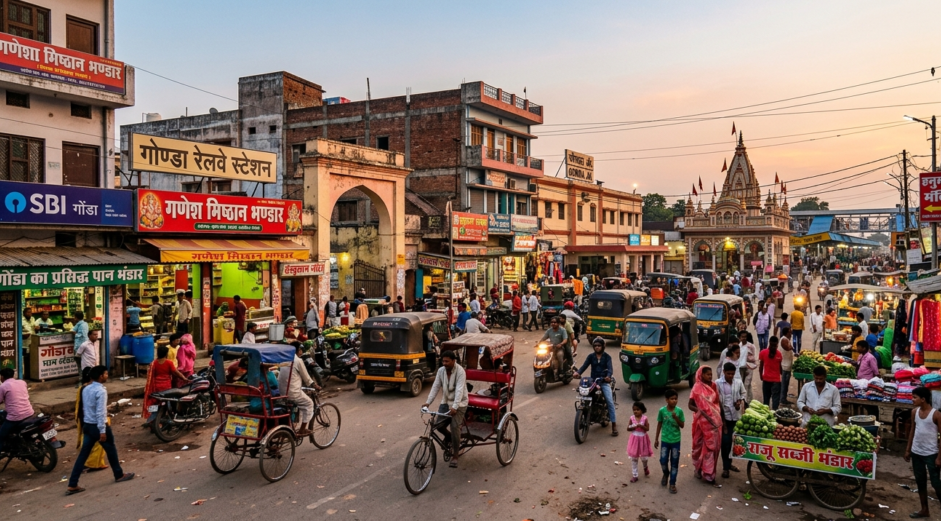
Gonda District :- The Tapobhoomi and Cultural Heritage of Awadh
Detailed History
Gonda district, situated in the Devipatan Division of Uttar Pradesh, is a region of immense historical and mythological importance. Ancient lore suggests that the name ‘Gonda’ is derived from ‘Goshala‘ (cow sheds) that existed here during the reign of the Koshal Empire. This land is the prestigious birthplace of Maharishi Patanjali, the father of Yoga Sutras. During the medieval period, it was part of the Awadh province, and in the 1857 freedom struggle, King Devi Bakhsh Singh of Gonda played a heroic role against British rule.
Detailed Architecture
Exterior Description :–
The geographical layout of Gonda is typical of the Terai region, characterized by lush greenery, fertile plains, and a humid climate. The district is bordered by rivers like Saryu and Terhi. The exterior skyline is marked by the tall chimneys of large sugar mills, while rural areas still preserve traditional high-plinth houses and ancient temple structures.
Interior Description :–
The interiors of religious sites like the Swaminarayan Temple (Chhapia) and Dukhharan Nath Temple are architecturally stunning, featuring marble carvings, tall spires (Shikharas), and serene sanctums. Traditional mansions (Havelis) of old zamindars boast large courtyards, heavy wooden doors, and ventilated high ceilings, reflecting the classic Awadhi style.
Nearby Attractions
- Chhapia (Swaminarayan Temple) :– The birthplace of Lord Swaminarayan, featuring a magnificent marble temple.
- Dukhharan Nath Temple :– An ancient Shiva temple believed to be highly auspicious.
- Parasar (Patanjali Birthplace) :– Located in the Kondar area, dedicated to the legendary Yoga guru.
- Prithvinath Temple :– Houses a massive Shivling dating back to the Dwapara Yuga.
- Parvati Arga Bird Sanctuary :– A vast lake area that hosts migratory birds during winters.
Travel Guide & Routes
- How to Reach :–
- By Rail :– Gonda Junction (GD) is a major railhead connecting Delhi, Lucknow, and Bihar.
- By Road :– Easily accessible via Gonda-Lucknow and Gonda-Ayodhya highways.
- By Air :– Nearest airports are Ayodhya International Airport and Lucknow Airport.
- Tickets & Timings :– Entry to temples is free. Sanctuary timings are 8:00 AM to 5:30 PM.
- Photography Spots :– Chhapia Temple complex and sunset at Parvati Arga Lake.
- Local Taste :– Try the local ‘Khurma‘ (sweet) and spicy Kachoris.
- Famous Markets :– Chowk Bazaar for traditional apparel and local goods.
Interesting Facts
- Gonda houses one of the largest sugar mills in Asia.
- Maharishi Patanjali, the pioneer of Yoga, was born in the ‘Gonarda‘ region of this district.
- The district was a strategic center for revolutionaries during the 1857 uprising.
Important Questions and Answer :-
Question No 1:– What was the ancient name of Gonda?
Answer:- It was part of the Koshal region and historically referred to as Gonarda.
Question No 2:– What is the distance between Gonda and Ayodhya?
Answer:- It is approximately 45 to 50 km by road.
Question No 3:– Which famous bird sanctuary is located in Gonda?
Answer:- The Parvati Arga Bird Sanctuary is located here.
Question No 4:– Why is Gonda significant for the Swaminarayan sect?
Answer:- Because Lord Swaminarayan was born in the Chhapia village of Gonda district.
Question No 5:– What are the main crops of Gonda?
Answer:- Sugarcane, Paddy, Wheat, and Maize are the primary crops.
Author’s Thoughts
Gonda is a blend of spirituality and simplicity. While its temples evoke deep devotion, its connection to Maharishi Patanjali makes it a hub of ancient wisdom. In my view, Gonda offers a peaceful escape for those looking to experience the authentic culture of Awadh. The mix of historical landmarks and natural retreats makes it a unique destination in Eastern UP.
“The land of Gonda preserves the ancient pulse of Yoga and the eternal flame of devotion.”