
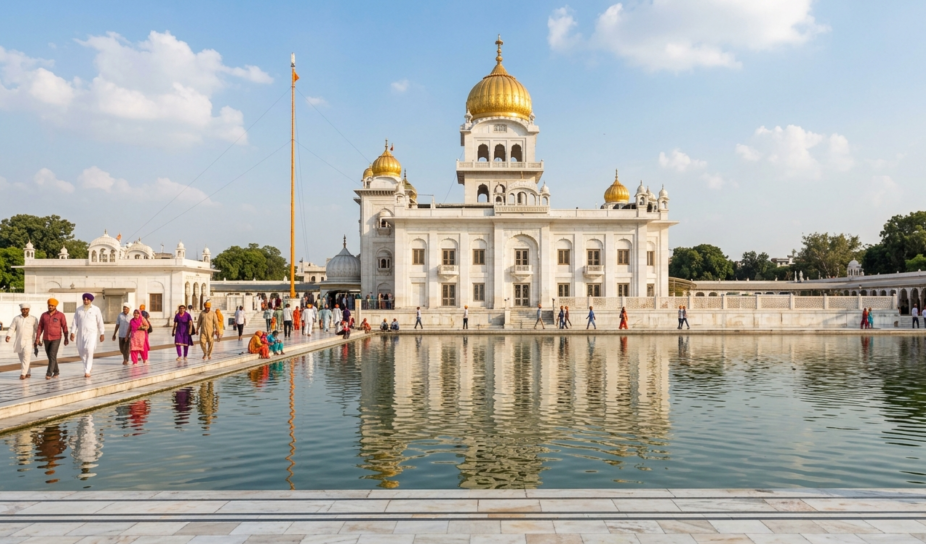
Gurudwara Bangla Sahib :- The Sanctuary of Eternal Peace, Utmost Devotion, and Humanitarian Service
Situated prominently on Baba Kharak Singh Marg, right adjacent to the hyper-commercial avenues of Connaught Place in New Delhi, ‘Gurudwara Bangla Sahib’ is far more than a religious shrine; it is the spiritual heart of the capital, embodying universal brotherhood, absolute serenity, and selfless human service (‘Seva’). The majestic golden glow of its domes, the tranquil expanse of its holy pool, and the continuous lyrical chanting of Gurbani hymns create an aura of profound psychological solace. Welcoming millions of global travelers regardless of religion, caste, or nationality, this sacred complex stands as a timeless monument to human compassion. In this comprehensive blog, we will walk through its glorious history, palatial architecture, the legendary community kitchen, and complete visitor roadmap.
Detailed History
The historical roots of Gurudwara Bangla Sahib date back to the mid-17th century, deeply intertwined with the compassionate legacy of the eighth Sikh Guru.
- The Royal Origin (Raja Jai Singh’s Bungalow) :– The site originally housed a magnificent, sprawling palace belonging to the illustrative ruler of Jaipur, Mirza Raja Jai Singh, during the Mughal era. Known as ‘Jaisinghpura Palace’, this grand royal bungalow eventually gave the shrine its iconic modern name—’Bangla Sahib’.
- The Advent of Guru Har Krishan Sahib Ji :– In the year 1664, the eighth spiritual master of the Sikhs, Guru Har Krishan Sahib Ji, traveled to Delhi and stayed as an honored guest at Raja Jai Singh’s palace. During this exact period, Delhi was ravaged by deadly epidemics of smallpox (chechak) and cholera (haija).
- Selfless Sacrifice and Epiphany :– The young child-Guru, moved by the immense suffering of the citizens, began stepping out into the affected areas, treating and serving the destitute. He blessed the fresh water well inside the palace compound, distributing it to the sick, which miraculously cured thousands. In the process of healing the masses, Guru Sahib voluntarily absorbed the illness and breathed his last (attained ‘Jyoti Jot’) at this very site on March 30, 1664, at the tender age of eight.
- Structural Evolution :– To honor the ultimate sacrifice of the Guru, Raja Jai Singh dedicated the palace to the Sikh community. In 1783, the legendary Sikh General Baba Baghel Singh constructed a formal Gurudwara structure on the site, which over the centuries expanded into the magnificent marble complex seen today.
Detailed Architecture
The structural design of Gurudwara Bangla Sahib is a spectacular masterclass in classic Sikh Architecture, distinguished by its gleaming white masonry and majestic symmetric proportions.
- Exterior Architecture :–
- The Golden Domes :– The topmost roof of the central sanctum is crowned by an imposing, massive onion dome fully plated in pure, shimmering 24-karat gold, creating a visual beacon visible from miles around Central Delhi.
- Nishan Sahib :– Towering high into the sky within the main courtyard is the saffron flagpost, the ‘Nishan Sahib’, which continuously flutters as a universal symbol of shelter and freedom for all weary travelers.
- The Marble Facade :– The entire multi-story facade is clad in premium, ultra-polished Makrana white marble, featuring elaborate stone-carved chhatris, pointed multi-foil arches, and ornamental balustrades.
- Interior Architecture :–
- The Darbar Sahib (The Holy Inner Sanctum) :– The central prayer hall is a vision of spiritual opulence. At its focal center sits the grand, intricately carved golden pavilion, the ‘Palki Sahib’, which houses the eternal living Guru of the Sikhs, the ‘Guru Granth Sahib’. The walls and high ceilings are adorned with breathtaking gold leaf stenciling, delicate frescoes, and semi-precious stone inlay work (Pietra Dura).
- The Amrit Sarovar (The Holy Pool) :– A massive, rectangular holy pool sits within the heart of the complex, framed by wide, reflective white-and-black marble perambulation paths (parikrama). The crystal-clear holy waters house thousands of colorful, thriving koi fish.
- The Langar Hall :– A vast, industrial-scale community dining hall engineered logistically to seat thousands of people simultaneously on the floor in neat rows, eliminating all social hierarchies.
Travel Guide & Routes
For international tourists, spiritual seekers, and architecture photographers planning an itinerary to experience this oasis of peace, the complete practical sequence is broken down below.
- Ticket :– Entry into Gurudwara Bangla Sahib, including participating in the prayers, visiting the museum, and eating at the community kitchen, is completely Free of charge. No tickets or booking passes exist.
- Visiting Time :– The spiritual gates remain open 24 hours a day, 7 days a week (24/7). The absolute finest hours to experience its ethereal beauty are during ‘Amrit Vela’ (04:00 AM to 06:00 AM) for morning hymns, or exactly at sunset when advanced LED projector systems illuminate the gold domes against the dark night sky.
- Code of Conduct & Etiquette :– To respect the sanctum’s religious protocols, all visitors must follow these guidelines:
- Deposit all shoes and socks at the designated ‘Joda Ghar’ (a managed, free-of-charge cloakroom facility) near the entrances.
- Walk through the shallow, flowing foot-washing water channels (‘Charan Ganga’) to cleanse your feet before stepping onto the marble platforms.
- Keep your head fully covered at all times inside the perimeter. (Free headscarves/bandanas are provided in large wicker baskets right at the entrance gates for those traveling without handkerchieves).
- Possession or consumption of any form of tobacco, alcohol, or narcotics is strictly illegal and prohibited around the sacred zone.
- How to Reach :–
- By Metro :– The absolute closest transit point is the ‘Shivaji Stadium’ Metro Station on the Airport Express Line, located just a 2-minute walk away. Alternatively, the ‘Patel Chowk’ Station (Yellow Line) and the mega-interchange ‘Rajiv Chowk’ Station (Blue/Yellow Lines) are within an easy 5 to 10-minute walking distance.
- By Bus :– Central Delhi is thoroughly serviced by DTC buses. Any transit line routing through Connaught Place, Gole Dak Khana, or Baba Kharak Singh Marg will drop you right outside the Gurudwara gates.
- By Road/Cab :– Visitors can drive down or hail app-based cabs directly to ‘Gurudwara Bangla Sahib, New Delhi’. The complex features an incredibly efficient, state-of-the-art multi-level automated car parking building right next to its boundary wall.
Photography Spots, Local Flavors, and Famous Markets
- Photography Spots :–
- The Eastern Corner of the Amrit Sarovar :– This vantage point captures the flawless, crystal symmetry of the white marble structural arc, topped by the gold dome reflecting entirely into the still waters of the pool.
- The Grand Corridors :– Capturing the clean geometry of the repetitive marble multi-foil arches against the sun-drenched courtyards.
- The Night View :– Setting up long-exposures from the outer courtyard to frame the illuminated main building complex.
- (Crucial Note:– Photography, videography, and live-streaming are strictly prohibited inside the main prayer hall of the Darbar Sabha and the Langar dining rooms to preserve spiritual privacy and peace).
- Local Flavors :–
- Karah Prasad :– Upon completing your prayer round, you will be blessed with a warm, rich portion of ‘Karah Prasad’—a sacred pudding crafted entirely out of whole wheat flour, pure clarified butter (desi ghee), and sugar. It is a transcendent culinary experience.
- The Guru Ka Langar :– Sitting down on the long mats to consume a simple, remarkably delicious, and nutritious meal consisting of slow-cooked lentils (dal), fresh flatbreads (roti), seasonal vegetables, and rice pudding.
- External Cafes :– Directly across the road on Baba Kharak Singh Marg sits the state-run ‘Coffee Home’, alongside hundreds of trendy continental cafes and global dining chains inside Connaught Place.
- Famous Market :– The avenue immediately adjacent to the shrine houses the famous strip of State Handloom Emporiums, showcasing authentic Indian arts, textiles, and wood carvings from across different provinces. The historic Connaught Place (CP) circles are also within immediate walking distance.
Nearby Attractions
You can effortlessly weave your visit to Bangla Sahib into a comprehensive tour of central Delhi’s landmarks.
- Connaught Place (CP) :– Delhi’s premier colonial-era ringed architecture containing upscale boutiques, global brands, and restaurants.
- Jantar Mantar :– The 18th-century geometric open-air astronomy observatory designed by Maharaja Jai Singh II, located 1 kilometer down the road.
- The Ancient Hanuman Temple :– One of the oldest temples in Delhi, historically linked to the Mahabharata period, located further up the same street.
- Agrasen ki Baoli :– The stunning, multi-tiered hidden historic stepwell tucked inside Hailey Road, accessible within a 10-minute auto-rickshaw ride.
Interesting Facts
- The mega community kitchen (‘Langar’) at Bangla Sahib runs entirely on voluntary donations and community service. It prepares and serves free hot meals to 35,000 to 50,000 individuals every single day, a figure that expands over 100,000 during major religious celebrations and Gurpurabs.
- The complex houses an advanced, highly specialized charitable diagnostic center and hospital right inside its walls. It offers life-saving services, including MRI, CT scans, and dialysis, to the economically underprivileged at a mere fraction of market costs (often starting at just ₹10 to ₹20 for basic consultations).
- The site features the immersive ‘Baba Baghel Singh Sikh Heritage Museum’, which uses advanced multimedia exhibits, ancient weapons, and historical oil paintings to educate visitors on the rich history of the Sikh martial arts and philosophy.
Important Questions and Answer :-
Question 1:– Can non-Sikhs, foreigners, or secular travelers sit down to eat in the Langar hall?
Answer:- Yes, absolutely. The core pillar of Sikh philosophy is equality. The Langar hall makes no distinction based on wealth, race, religion, or orientation. Everyone sits together on the exact same floor level to enjoy the freshly prepared vegetarian meals.
Question 2:– Is there a specific dress code required to enter the Gurudwara?
Answer:- There is no rigid costume code, but visitors are expected to dress modestly (covering shoulders and knees). Most importantly, your head must remain completely covered while inside the sacred premises. If you do not have a scarf, you can pick up a clean, reusable cotton bandana from the baskets at the gates for free.
Question 3:- How much time should a traveler allocate to thoroughly experience Bangla Sahib?
Answer:- To fully appreciate the prayers inside the Darbar Sahib, sit quietly by the serene Amrit Sarovar, tour the heritage museum, and experience the community kitchen, you should ideally budget around 1.5 to 2 hours.
Author’s Perspective :-
From my perspective, Gurudwara Bangla Sahib is not merely an architectural landmark of white marble and gold leaf; it is an active powerhouse of human empathy and spiritual healing. Stepping inside from the hyper-paced commercial chaos of Connaught Place feels like entering a completely different dimension. The absolute quietude by the holy pool, combined with the distant, soulful acoustic echoes of the stringed instruments accompanying the Gurbani, has a way of dissolving all mental stress instantly. The most moving sight is observing a wealthy corporate executive and a homeless laborer sitting shoulder-to-shoulder, washing dishes or eating a meal together in absolute humility. If you wish to witness the living, beating soul of Delhi’s cultural harmony, Bangla Sahib is an absolute, non-negotiable pilgrimage.
“Standing as a serene white palace amidst the commercial roar of the capital, this sacred shrine remains an infinite ocean of spiritual peace, deep devotion, and unparalleled human compassion.”