
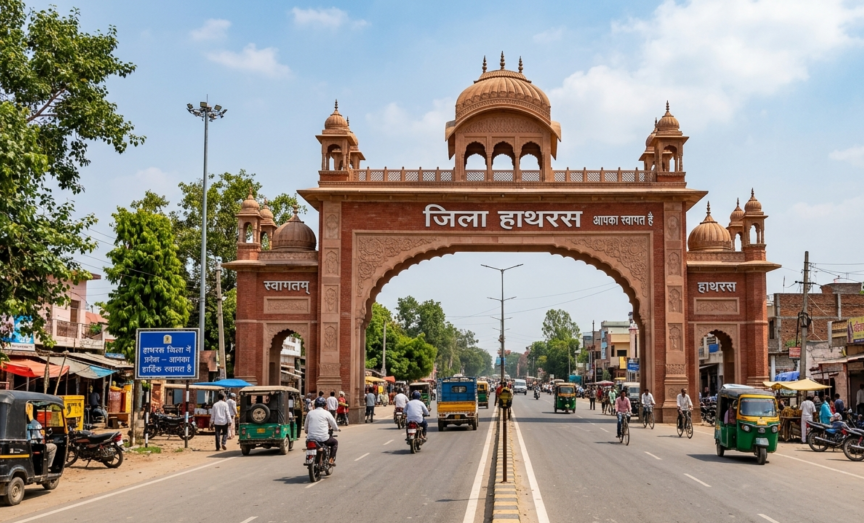
Hathras District :- A Confluence of Braj Culture and Aroma of Hing
Detailed History
Hathras district, situated in the western part of Uttar Pradesh, is a significant part of the ‘Braj Mandal‘. Historically, it has been renowned for its valor, literature, and commerce. Established in 1997 by combining parts of Aligarh, Mathura, and Agra, it was initially named ‘Mahamaya Nagar‘ before being renamed back to ‘Hathras‘. Legends tell of King Dayaram, who bravely resisted British rule from his fort. Known as the “City of Literature and Culture,” it has a deep-rooted tradition of ‘Hathrasi Holi‘ and folk theatre (Nautanki). Industrially, Hathras is globally famous for its high-quality Asafoetida (Hing) processing.
Detailed Architecture
Exterior Description :–
The exterior of Hathras reflects a blend of traditional Braj villages and emerging modern industries. The skyline is marked by the chimneys of Hing processing units and lush green fields. The main historical highlight is Fort Dayaram, a sturdy structure made of mud and stone, whose ruins still bear witness to its ancient might. Old Mughal and Colonial-style facades can still be spotted in the various towns of the district.
Interior Description :–
The interiors of religious and private sites are artistically crafted. Shri Dauji Temple features a classic Braj architectural style with carved pillars and high ceilings. The traditional havelis of old Hathras boast large courtyards and murals reflecting local folk art. The interiors of Hing factories are specifically designed for processing and storage, following methods that are decades old.
Nearby Attractions
- Shri Dauji Temple :– The most famous shrine dedicated to Lord Balaram (Dauji), the elder brother of Lord Krishna.
- Fort Dayaram :– An iconic historical site representing the glorious past of the local kings.
- Mursan Fort :– Located near Hathras, it is associated with the history of Raja Mahendra Pratap Singh.
- Sasni Fort :– A point of interest for history enthusiasts exploring local fortifications.
- Lady Fatma Lake :– A serene natural spot popular for evening retreats.
Travel Guide & Routes
- How to Reach :–
- By Rail :– Well-connected via four stations—Hathras Junction (HRS), Hathras City (HTC), Hathras Fort (HRK), and Hathras Road.
- By Road :– Situated on NH-509, it is easily accessible from Agra (55 km), Mathura (40 km), and Aligarh (35 km).
- By Air :– Nearest airports are Agra (Kheria) and Delhi (IGI).
- Tickets & Timings :– Entry to temples and historical ruins is free. Temples generally open from 6:00 AM – 12:00 PM and 4:30 PM – 9:00 PM.
- Photography Spots :– Architecture of Shri Dauji Temple, historical ruins of Fort Dayaram, and local spice markets.
- Local Taste :– Don’t miss the ‘Hing-infused snacks’, local spices, and the famous ‘Bedmi-Kachori’.
- Famous Markets :– ‘Naya Ganj‘ and ‘Mirch Bazaar‘ for authentic Hing and local handicrafts.
Interesting Facts
- Hathras is the largest hub for Hing (Asafoetida) processing and export in India.
- The legendary satirist and poet Kaka Hathrasi belonged to this district.
- The Sasni region is also known for its glasswork and various small-scale industries.
Important Questions and Answer :-
Question 1:– For which product is Hathras world-famous?
Answer:- Hathras is world-famous for its processing and trade of high-quality Asafoetida (Hing).
Question 2:– Which is the most prominent temple in Hathras?
Answer:- Shri Dauji Temple is the most prominent and revered religious site in the district.
Question 3:- What is the geographical location of Hathras?
Answer:- It is located in western Uttar Pradesh, sandwiched between Agra, Aligarh, and Mathura.
Question 4:– Who is the famous poet associated with Hathras?
Answer:- The renowned satirical poet Kaka Hathrasi hailed from this district.
Question 5:– What is the distance between Mathura and Hathras?
Answer:- It is approximately 40 kilometers by road.
Author’s Thoughts
Hathras is a unique blend of simplicity and entrepreneurial spirit. Being on the edge of the Braj region, the air here carries a sense of spirituality and sweetness. The streets, fragrant with the aroma of Hing, and the witty nature of the locals (the legacy of Kaka Hathrasi) set it apart. In my view, if you want to witness the authentic culture of Braj and India’s traditional industries, Hathras is a must-visit.
“The aroma of Hing in the streets of Hathras and the devotion of Braj define the true soul of India.”