
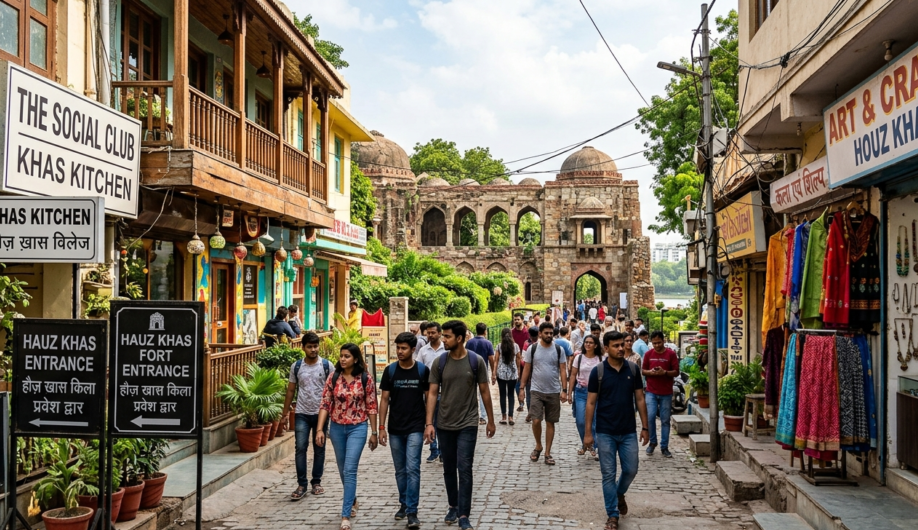
Hauz Khas Village, Delhi – A Historical and Modern Confluence
Hauz Khas Village, located in South Delhi, is a unique destination where history and modernity blend seamlessly. On one side, it houses the 14th-century historical monuments, a serene lake, and a madrasa from the Tughlaq and Slave dynasties, while on the other side, it boasts trendy contemporary cafes, art galleries, and boutiques. In Persian, ‘Hauz Khas’ translates to the “Royal Tank.” It stands as one of the most popular tourist and hangout destinations in Delhi.
Detailed History
The history of Hauz Khas is deeply intertwined with the golden era of the Delhi Sultanate. This complex was originally commissioned during the reign of Alauddin Khalji (1296–1316). He constructed a massive water reservoir, initially known as ‘Hauz-i-Alai‘, to supply water to the inhabitants of the Siri Fort (the second city of Delhi).
Over time, the reservoir dried up and fell into neglect. Later, Emperor Firoz Shah Tughlaq (1351–1388) of the Tughlaq dynasty cleared the silt from the dry tank, refilled it with water, and renamed it ‘Hauz Khas’ (The Royal Tank). Firoz Shah Tughlaq also built a grand Madrasa (an Islamic institution of learning), a mosque, and his own tomb along the banks of this lake. In the 14th century, this madrasa was regarded as one of the largest and most prosperous centers of Islamic education in the world, attracting scholars and students from far and wide.
Detailed Architecture
The architecture of the Hauz Khas complex reflects the finest elements of the Tughlaq style, characterized by its simplicity, robustness, and functionality.
- Exterior :– The entire complex is constructed using locally quarried quartz and red stones. Upon entering, one is greeted by an L-shaped two-story madrasa structure, whose stone steps lead down to the beautiful lake. The pillars and arches of the mosque and madrasa represent a synchronized blend of traditional Islamic and indigenous Indian architectural patterns. Adjacent to the monument lies the lush green Deer Park, providing a vibrant natural backdrop to the ancient stone structures.
- Interior :– The Tomb of Firoz Shah Tughlaq, located at the junction of the complex, is the architectural highlight of the interiors. The tomb is square-shaped, topped with an impressive dome. Inside the tomb, the ceiling features exquisite carvings, inscriptions of Quranic verses, and delicate geometric designs etched onto the plaster. The madrasa features rows of small study chambers (classrooms) with stone-carved windows that offer a tranquil view of the vast lake outside.
Travel Guide & Routes
If you are planning to explore Hauz Khas Village and its historical ruins, here is the complete travel guide structured sequentially.
- Entry Ticket :– Entry to the historical Hauz Khas complex, fort, and the adjoining Deer Park is completely Free. There are no ticket charges.
- Visiting Time :– The historical monument complex remains open from 10:00 AM to 6:00 PM. However, the cafes and restaurants in the village area stay active until 11:00 PM.
- Closing Day :– The historical monument complex officially remains closed on Sundays (while the monuments are shut, the village cafes and lifestyle markets remain fully operational).
- Photography Spots :– The arched windows of the madrasa overlooking the lake, the stunning sunset view from the lake embankments, the massive dome of Firoz Shah’s tomb, and the vibrant graffiti and street art across Hauz Khas Village serve as exceptional backdrops for photography.
- Local Food :– The village area is a haven for food enthusiasts, offering global cuisines. Visitors can indulge in Italian pasta, continental delicacies, artisanal shakes, Mughlai kebabs, and dine at various rooftop cafes overlooking the historic lake.
- Famous Market :– Hauz Khas Village is renowned for its independent designer boutiques, vintage Bollywood poster shops, authentic Indian handicrafts, antique jewelry stores, and contemporary art galleries. It is considered one of Delhi’s premier fashion and art hubs.
- How to Reach :–
- By Metro :– The nearest metro stations are Hauz Khas Metro Station (Yellow and Magenta Lines) and IIT Delhi Metro Station (Magenta Line). From either station, you can easily hire an auto-rickshaw or an e-rickshaw to reach the village entrance within 5 to 10 minutes.
- By Road :– Hauz Khas is well-connected by road. You can book a cab, take an auto, or travel via DTC buses to the Hauz Khas bus stop. Ample parking spaces are available just outside the main village gate.
Nearby Attractions
While visiting Hauz Khas, you can also plan a visit to these nearby attractions.
- Deer Park :– A vast, well-maintained green park adjacent to the ruins, featuring deer enclosures, duck ponds, and a variety of regional birds.
- Qutub Minar :– A UNESCO World Heritage Site located roughly 4-5 km away from the complex.
- Shahpur Jat :– A nearby urban village famous for its luxury wedding boutique stores and quirky cafes.
- Green Park Market :– A popular neighborhood marketplace ideal for shopping and local dining.
Interesting Facts
- The courtyard of the madrasa houses several small, independent domed structures, which are actually the graves of eminent teachers and scholars who taught at the institution during the 14th century.
- When the Central Asian conqueror Timur Lung invaded Delhi in 1398, he camped at the Hauz Khas complex and was profoundly impressed by the grandeur of the lake and the academic nature of the madrasa.
- Hauz Khas Village earned the moniker ‘The Art District of South Delhi’ during the 1980s and 90s, when leading Indian fashion designers and contemporary artists converted the old village houses into upscale studios.
- The scenic locales of the Hauz Khas Fort and its upscale lanes have served as shooting locations for several blockbuster Bollywood films, including Rockstar, Tamasha, and Fukrey.
Important Questions and Answer :-
Question 1:– What does ‘Hauz Khas’ mean and who built it?
Answer:- ‘Hauz Khas‘ means “Royal Tank“. The reservoir was originally built by Alauddin Khalji, and later Emperor Firoz Shah Tughlaq restored it and built the surrounding madrasa and tomb structures.
Question 2:– Is there any entry fee to visit the Hauz Khas Fort or Lake?
Answer:- No, entry to the historical Hauz Khas monument complex, fort ruins, and Deer Park is entirely free of cost for all domestic and international visitors.
Question 3:- Which metro station is closest to Hauz Khas Village?
Answer:- The closest options are the Hauz Khas Metro Station (an interchange station for Yellow and Magenta lines) and the IIT Delhi Metro Station (Magenta Line).
Question 4:– Are there good dining options available within Hauz Khas Village?
Answer:- Yes, Hauz Khas Village is highly celebrated across Delhi for its extensive array of rooftop cafes, fine-dining multi-cuisine restaurants, and vibrant lounges.
Author’s Thoughts
Hauz Khas is an enchanting corner of Delhi where the silence of ancient history and the vibrant hum of modern life coexist beautifully. Sitting among the ruins of the medieval madrasa while looking out at the calm, expansive lake provides a profound sense of peace, momentarily isolating you from the city’s frantic pace. Yet, the moment you step outside the fort walls, the energetic alleyways, graffiti-covered walls, and musical cafes revitalize your senses. It is a perfect destination for history lovers, artists, and anyone looking to unwind. To truly experience the multifaceted soul of Delhi, Hauz Khas is an absolute must-visit.
“The centuries-old stone arches of Hauz Khas continue to hold the serene spirit of the past while silently witnessing the fleeting trends of the modern era.”