
Detailed History
The Hazrat Nizamuddin Aulia Dargah, located within the bustling and historically rich labyrinth of Hazrat Nizamuddin West in Central New Delhi, is far more than a prominent Islamic religious site; it stands as a timeless epicentre of syncretic Indian culture (Ganga-Jamuni Tehzeeb), absolute spiritual peace, and global Sufism. This sacred mausoleum serves as the final resting place (Mazar) of the most celebrated Sufi saint of the Chishtiyya order, Hazrat Khwaja Nizamuddin Aulia (1238–1325 AD). He is lovingly and reverently addressed by his millions of global devotees as ‘Mehboob-e-Ilahi‘ (The Beloved of God).
Hazrat Nizamuddin Aulia dedicated his entire long life to preaching absolute love, universal brotherhood, human equality, and spiritual peace, strictly welcoming individuals across all religions and social strata without discrimination. Throughout his lifetime, several powerful and tyrannical sultans of the Delhi Sultanate—including Alauddin Khalji and Muhammad bin Tughluq—ruled the capital, yet the Khwaja steadfastly refused to ever step foot inside a royal court, choosing instead to live simple lives directly among the poor and destitute. Following his earthly demise in 1325 AD, a modest structural tomb was initially raised over his burial spot. The grand and expansive historical courtyard complex visible today was heavily extended and formally commissioned around 1352-1353 AD by the then Delhi Sultan, Firoz Shah Tughlaq. Over subsequent centuries, particularly during the golden era of the Mughal Empire, several continuous artistic ornamentations and structural additions were integrated into the sacred space. Today, the shrine remains a global sanctuary for distressed souls seeking mental solace.
Detailed Architecture
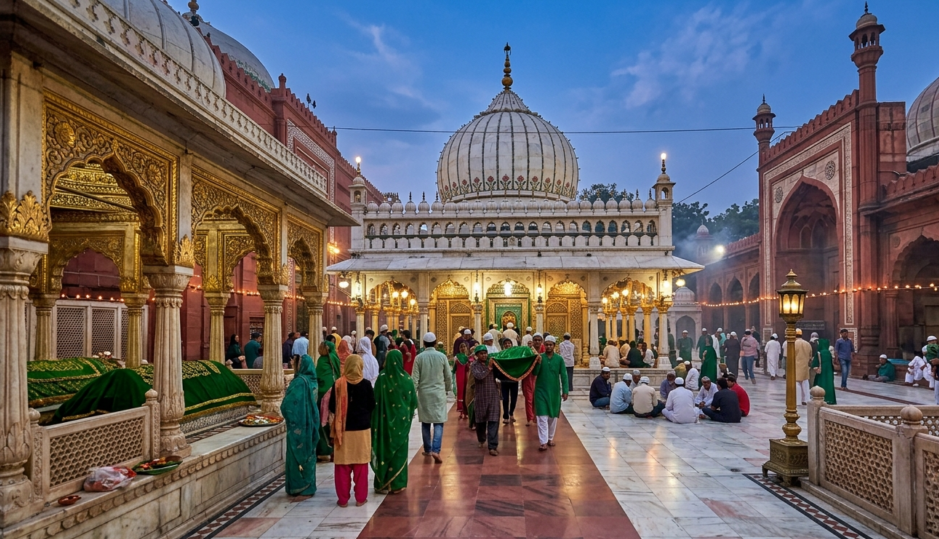
The architectural layout of the Hazrat Nizamuddin Dargah is a beautiful, seamless manifestation of classic Islamic aesthetics integrated with traditional Indian stone craftsmanship. The shrine is positioned inside a sprawling, open brick-paved central courtyard accessible through narrow historical market alleys.
- Exterior :– The main dome chamber rises from a raised square white marble plinth, capped by a magnificent, bulbous White Marble Dome. The dome is distinctively decorated with vertical black marble inlay stripes that tremendously enhance its graphic beauty, topped by an ornamental golden finial. The actual burial chamber is enclosed symmetrically by highly intricate, beautifully carved white marble lattice screens (Jaali windows), through which pilgrims peer inside to pay their respects and tie sacred red and yellow threads of vows (mannat). An ancient, deep Stepwell (Baoli) is located adjacent to the main building, engineered during the saint’s own lifetime, containing subterranean spring water that is considered deeply blessed and spiritually pure.
- Interior :– Stepping inside the inner chamber fills the senses with a wave of absolute mystical calm. The primary tomb of the Khwaja is protected by a priceless, heavily detailed solid Silver Railing (Jangla) that runs along its entire perimeter. The inner ceiling is lined with rich, deep-toned velvet canopies, while the interior marble walls are inscribed with exquisite Arabic verses from holy scripts and classical Persian Sufi poems. Directly facing the main entrance courtyard lies the prominent separate tomb of his most beloved and legendary disciple, the master poet and father of Qawwali music, Hazrat Amir Khusrau. According to ancient Sufi traditions, visitors must first pay homage at the shrine of Amir Khusrau before crossing over to the main shrine of the master. Additionally, the courtyard shelters the elegant, roofless marble tomb of Mughal Emperor Shah Jahan’s daughter, Princess Jahanara Begum, and the simple grave of the noted medieval historian Ziauddin Barani.
Travel Guide & Routes
- Ticket and Charges :– Entry into the entire Hazrat Nizamuddin Dargah compound and participation in all prayer sessions is completely Free for all visitors. No ticketing tariffs or entry fees exist. (Be cautious of aggressive street vendors selling flowers and ritual sheets/chadar outside who may quote exorbitant rates; bargaining is highly recommended).
- Visiting Time :– The dargah gates remain open to all visitors on all seven days of the week, operating from 5:00 AM to 11:00 PM daily. While it can be visited comfortably at any hour, planning your visit on a Thursday or Friday evening is highly recommended to experience the world-famous live Sufi Qawwali sessions.
- How to Reach :–
- By Metro :– Commuting via the Delhi Metro is the most organized option. The closest transit hub is the ‘Hazrat Nizamuddin Metro Station’ on the Pink Line, situated roughly 1 kilometer away. Alternatively, the ‘Jangpura Metro Station’ on the Violet Line is also located nearby. Upon exiting, local e-rickshaws or a brief 5-minute walk can drop you directly at the main market entrance of the shrine.
- By Train :– For visitors arriving from outside Delhi, the massive ‘Hazrat Nizamuddin Railway Station’ is located just 1.5 kilometers away from the dargah gates.
- By Bus & Auto :– The Nizamuddin Police Station bus stop on Mathura Road is the closest bus terminal, serviced continuously by dozens of major DTC bus routes across Delhi.
- Photography Spots :– Capturing the majestic white marble dome from across the open courtyard, the soft warm glow of ritual oil lamps at dusk, the intricate lattice frames of Amir Khusrau’s tomb, and the emotional expressions of the qawwals during live musical sessions are the best photography frames. Note that close-up photography inside the actual inner burial tomb room is strictly prohibited.
- Local Flavors :– The historical streets leading to the dargah are a supreme culinary paradise for meat lovers and fans of traditional old-world Mughlai cuisine. Legendary culinary establishments like Karim’s and the famous Ghalib Kabab Corner serve unmatched charcoal-grilled seekh kebabs, rich mutton korma, paper-thin rumali rotis, and hot Shahi Tukda sweets. Excellent vegetarian dining alternatives are easily accessible around the outer neighborhood blocks.
- Famous Markets :– The narrow bazaar flanking the shrine’s entrance is an incredibly vibrant shopping experience. Visitors can purchase high-quality traditional perfumes (Attar), handcrafted prayer caps, classical Sufi literature, musical records, embroidered velvet shawls, and beautiful Islamic brass handicrafts at highly reasonable prices.
Nearby Attractions in Detail
- Humayun’s Tomb :– Located less than 1 kilometer away, this majestic UNESCO World Heritage Site is an absolute architectural masterpiece. Built using red sandstone and white marble, it represents the first grand garden-tomb layout on the Indian subcontinent, which later served as the primary design inspiration for the building of the Taj Mahal.
- Sunder Nursery :– Positioned directly adjacent to Humayun’s Tomb, this is an incredibly beautiful, expansive 90-acre heritage park and botanical haven. It protects several beautifully restored 16th-century Mughal-era monuments, pristine natural lakes, modern fountains, and thousands of domestic plant and bird species, making it Delhi’s finest spot for peaceful family picnics.
- Mirza Ghalib’s Tomb :– Located right outside the primary northern gateway of the dargah rests the quiet tomb of Mirza Asadullah Khan ‘Ghalib’, universally hailed as the greatest Urdu and Persian poet of the 19th century. The site sits right next to the Ghalib Academy, which houses rare manuscripts, portrait galleries, and literary works tracing his life.
- Tomb of Abdul Rahim Khan-i-Khana :– Situated a short distance away on Mathura Road, this grand sandstone structure is the mausoleum of Rahim, the brilliant classical poet and one of the celebrated ‘Nine Jewels’ (Navaratnas) of Mughal Emperor Akbar’s court. The building has recently undergone a spectacular multi-year architectural restoration.
Interesting Facts
- The mystical bond between the Sufi saint Hazrat Nizamuddin and his premier disciple Amir Khusrau was so intense that when the Khwaja passed away in 1325 AD, a grief-stricken Khusrau passed away just six months later out of pure heartbreak. Their shrines remain positioned next to each other in the same courtyard.
- The magical atmosphere of the Thursday evening Qawwali sessions is so iconic that major Bollywood cinema masterpieces (such as the chart-busting track ‘Kun Faya Kun‘ from the movie Rockstar and ‘Bhar Do Joli Meri‘ from Bajrangi Bhaijaan) were shot and recorded live on location within this very courtyard.
- Hazrat Nizamuddin belonged to the liberal spiritual philosophy within Sufism that viewed music (Sama) not as a worldly distraction, but as a deeply holy instrument to attain a deep meditative state and connect with the Divine.
- The tomb of Princess Jahanara Begum within the compound features no marble roof or dome enclosure. Per her strict personal instructions and humble dynamic, her grave remains completely open to the sky, carpeted simply by natural green grass. Her self-written epitaph reads: “Let naught cover my grave save green grass, for grass suffices well as a covering for the tomb of the poor.”
Important Questions and Answer :-
Question 1:- What are the primary rules for entry inside Hazrat Nizamuddin Dargah, and are women allowed to enter?
Answer:– It is completely mandatory for both men and women to cover their heads with a scarf, handkerchief, or cap prior to entering the dargah. Women are absolutely welcome to enter the main complex courtyard, sit, and listen to the live Qawwali music. However, direct physical entry into the innermost room where the main burial tomb rests is traditionally restricted to men; women offer their prayers through the beautiful marble lattice screens from outside.
Question 2:- On which specific days and times is the famous live Qawwali performance organized?
Answer:- Brief devotional songs are sung daily after the evening Maghrib (sunset) prayers. However, the official, highly vibrant, and extensive Sufi Qawwali sessions take place every Thursday evening across two main slots: from 6:00 PM to 7:30 PM and later from 9:00 PM to 10:30 PM.
Question 3:- Is there a specific dress code that travelers must adhere to when visiting the shrine?
Answer:– As the dargah is a highly sacred spiritual institution, visitors must wear modest, respectful clothing that covers their shoulders and knees. Wearing shorts, short skirts, or sleeveless tops should be avoided. Carrying a clean cloth or stole to cover your head is necessary.
Author’s Thoughts :-
Amidst the towering modern skyscrapers, intense political corridors, and relentless concrete rush of New Delhi, the Hazrat Nizamuddin Dargah exists as a sublime spiritual island where the heavy weights of life instantly melt away. When twilight falls on a Thursday evening, and the soaring vocals of the qawwals echo against the ancient marble dome while the sweet fragrance of burning loban and fresh rose petals fills the air, you are pulled into a state of pure mystical transcendence. Here, all divisions of wealth, status, religion, and creed evaporate; corporate tycoons and penniless mendicants sit shoulder to shoulder on the cold stone floor, completely united in their love for the Divine. As a writer and a traveler, I firmly believe that if you wish to touch the beating, spiritual heart of Delhi and see how music can seamlessly bridge the human soul with eternity, spending an evening on the sacred threshold of Nizamuddin is an unforgettable experience.
“Awash in the gentle glow of flickering oil lamps and the soaring notes of ecstatic Qawwali, Nizamuddin’s sacred threshold remains a beautiful haven of unconditional love, offering absolute peace to every traveling soul.”