
Himachal Pradesh :- The Celestial Journey to Devbhoomi & Detailed Guide
Detailed History
Himachal Pradesh, widely known as ‘Devbhoomi‘ or the Land of the Gods, is one of the most historically enriched regions of the Indian subcontinent. Its history traces back to the prehistoric era when the people of the Indus Valley Civilization inhabited the foothills. Later, the region was dominated by indigenous tribes such as the Kols, Kiratas, Nagas, and Khasas. During the Mauryan Empire, Emperor Ashoka propagated Buddhism here, the remnants of which can still be witnessed in the stupas of Chetru (Kangra).
In the medieval period, the region was divided into several small hill principalities (Thakurais), prominently including Kangra, Chamba, Kullu, and Sirmour. These kingdoms fiercely resisted Mughal expansions and later Gurkha invasions to maintain their sovereignty. In the early 19th century, Maharaja Ranjit Singh established his control over Kangra. During the British Raj, drawn by the cool and serene climate, the British declared Shimla as their Summer Capital. On April 15, 1948, Himachal Pradesh was integrated as a Union Territory by merging 30 hill states, and eventually, on January 25, 1971, it emerged as the 18th full-fledged state of India.
Detailed Architecture
The architectural landscape of Himachal Pradesh is a magnificent amalgamation of its challenging geographical terrain and profound religious beliefs. Three primary architectural styles define the state.
Exterior Architecture :–
- Kath-Kuni Style :– This is the most famous traditional architectural style of Himachal. It involves constructing walls by layering interlocking wooden logs and local stones alternately, entirely without the use of mortar or cement. These structures are inherently earthquake-resistant. The roofs are steeply sloped and covered with local slate stones to allow snow to slide off effortlessly during winters.
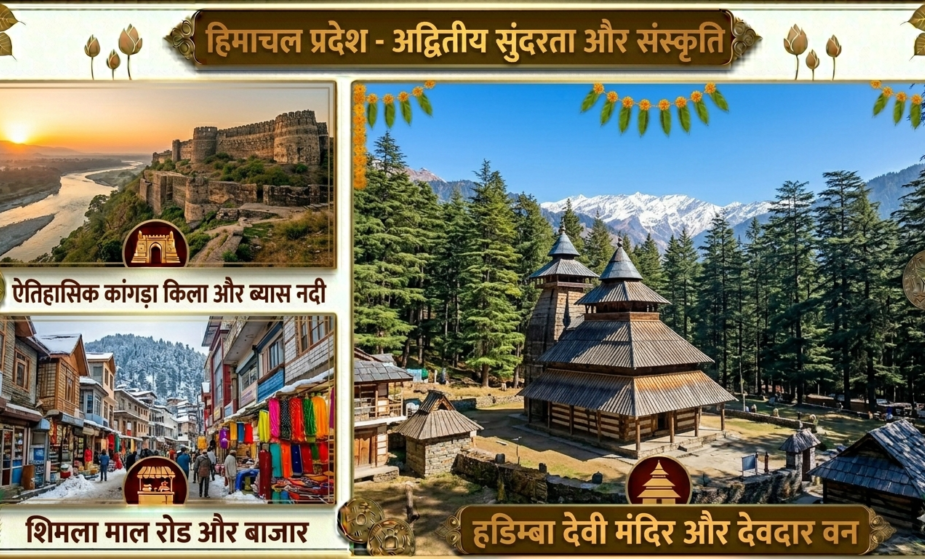
- Pagoda Style :– Inspired by Tibetan and Nepalese influences, this style features multiple pyramid-like tiered sloping roofs stacked on top of each other. The Hidimba Devi Temple in Manali stands as the finest specimen of this architecture.
- Shikhara Style :– Influenced by the plains, these are stone-carved temples featuring high-soaring spires, such as the Masrur Rock-Cut Temples.
Interior Architecture :–
- The interiors of temples and ancient palaces display intricate wood carvings on deodar (cedar) wood. The door frames are beautifully engraved with figures of deities, birds, and floral vines.
- The Sanctum Sanctorum (Garbhagriha) is usually compact and dimly lit, housing the main deity. The interior ceilings are adorned with geometric patterns and depicted scenes from ancient mythology.
Travel Guide & Routes
Tickets and Entry Fees :–
- There is no individual entry ticket or fee to enter the state of Himachal Pradesh.
- A nominal fee ranging from ₹20 to ₹100 (for Indians) and ₹200 to ₹500 (for foreign tourists) is applicable at specific monuments, museums, or national parks like the Great Himalayan National Park. Traveling to Rohtang Pass requires a mandatory National Green Tribunal (NGT) permit, the fee for which varies based on the vehicle type.
Timings (Visiting, Opening & Closing Times) :–
- State Visiting Window :– Open throughout the year. Summers (March to June) offer pleasant weather. Winters (November to February) are ideal for enjoying snowfall. Monsoons (July to September) should be avoided due to heavy landslide risks.
- Temples and Sightseeing Spots :– Generally open from 06:00 AM to 08:00 PM.
How to Reach (Routes) :–
- By Air :– Himachal houses three major domestic airports – Bhuntar (Kullu-Manali), Gaggal (Kangra-Dharamshala), and Jubbarhatti (Shimla). Regular flights operate to these destinations from Delhi.
- By Train :– The most celebrated rail route is the UNESCO World Heritage Kalka-Shimla Toy Train. Additionally, a narrow-gauge train connects Pathankot in Punjab to Kangra. For broad-gauge connectivity, Chandigarh and Ambala are the nearest major railway stations.
- By Road :– Himachal Pradesh is phenomenally connected via National Highways (NH-44, NH-5, NH-21) to Delhi, Punjab, and Haryana. Regular HRTC (State Transport) and private Volvo buses ply daily from Kashmiri Gate ISBT, Delhi.
Photography Spots, Local Cuisine, and Famous Markets
Photography Spots :–
- The Ridge and Mall Road (Shimla) :– Ideal for capturing colonial architecture against the backdrop of majestic mountain ranges.
- Solang Valley and Rohtang Pass (Manali) :– Perfect for capturing snow-capped peaks and vibrant paragliding action shots.
- Key Monastery (Spiti Valley) :– Best for capturing pristine Tibetan architecture against dramatic, barren mountain landscapes.
- Khajjiar (Chamba) :– Popularly called the ‘Mini Switzerland of India’, offering breathtaking panoramic views of lush green meadows surrounded by dense deodar forests.
Local Cuisine :–
- Dham :– This is the traditional festive thali of Himachal, served on leaf plates during weddings and celebrations. It features Madra (chickpeas cooked in a rich yogurt gravy), Siddu (a steamed yeast-leavened wheat bread savored with pure ghee), Tudkiya Bhath, and a sweet-sour dish called Khatta.
Famous Markets :–
- Mall Road (Shimla/Manali) :– Renowned for authentic wooden handicrafts, premium pashmina shawls, and winter woolens.
- Kotwali Bazaar (Dharamshala) :– Famous for Tibetan artifacts, prayer wheels, and beautifully woven carpets.
- Lakkar Bazaar (Shimla) :– Highly sought-after for exquisite wooden toys, artifacts, and personalized souvenirs.
Nearby Attractions
- Manali and Kasol :– Famous for adrenaline-pumping adventure sports, trekking trails, and hippie culture. Kasol is affectionately dubbed the ‘Mini Israel’ of India.
- Dharamshala and Mcleodganj :– The official holy residence of His Holiness the Dalai Lama, serving as a vibrant epicenter for Tibetan culture and serene Buddhist monasteries.
- Dalhousie and Chamba :– Known for its preservation of Victorian-style colonial bungalows, the scenic banks of the Ravi River, and the ancient Laxmi Narayan Temple complex.
- Kinnaur and Spiti Valley :– Acclaimed for high-altitude mountain passes, ancient monastic complexes (like Tabo Monastery), and challenging, adventurous road trips.
Author’s Thoughts
Himachal Pradesh is far more than just a mainstream tourist destination; it is a soulful, living experience that rejuvenates the inner self. The crisp mountain breeze, towering deodar trees, and the golden sun setting behind majestic peaks offer an unparalleled sense of peace away from the chaotic urban hustle. The truest beauty of Himachal resides in its simple, deeply hospitable, and honest locals who have beautifully preserved their rich heritage. Whether you are an adventure enthusiast or a seeker of absolute solitude, every winding turn in Himachal unveils a pristine new story. It is a mystical land that permanently holds a piece of your heart, beckoning you to return time and again.
Interesting Facts
- World’s Highest Post Office :– Located in the remote village of ‘Hikkim’ in the Lahaul-Spiti district, this post office sits at an astonishing altitude of 14,567 feet above sea level.
- UNESCO Heritage Toy Train :– The historic Kalka-Shimla railway track is designated as a UNESCO World Heritage site and features more than 100 mountain tunnels.
- Asia’s First Ice Skating Rink :– Shimla boasts Asia’s oldest and only natural open-air ice skating rink.
- Ancient Democracy of Malana :– The secluded village of ‘Malana’ in the Kullu Valley is widely considered one of the oldest standing democracies in the world. Its residents proudly believe they are descendants of Alexander the Great’s soldiers.
- India’s First Voter :– The historic first voter of independent India, Shyam Saran Negi, belonged to the beautiful town of Kalpa in Himachal Pradesh.
Important Questions and Answer :-
Question 1:- What is the absolute best time to visit Himachal Pradesh?
Answer:– March to June is considered ideal for enjoying incredibly pleasant summer weather, while November to February is perfect for witnessing heavy snowfall and enjoying winter sports.
Question 2:- What is the traditional food of Himachal, and where can one experience it?
Answer:– ‘Dham’ and ‘Siddu’ are the most iconic culinary preparations of the state. You can experience them at authentic Himachali theme restaurants in Shimla and Manali or during local cultural festivals.
Question 3:- Is any special permission required to travel to Rohtang Pass?
Answer:– Yes, to protect the fragile alpine ecology, it is legally mandatory for all vehicles visiting Rohtang Pass to obtain an online eco-permit issued by the National Green Tribunal (NGT).
Question 4:- Which specific destination in Himachal is known as the ‘Mini Switzerland of India’?
Answer:– ‘Khajjiar’, nestled in the scenic Chamba district, is officially designated as the ‘Mini Switzerland of India’ due to its striking topographical resemblance, vast green glades, and dense pine forests.
Question 5:- How can tourists book tickets for the Kalka-Shimla Toy Train?
Answer:– Toy train reservations can be seamlessly completed online through the official IRCTC website or directly at the reservation counters of Kalka or Shimla railway stations. Advance booking is heavily recommended during peak tourist seasons.
S“The moment you step into the snowy expanses of Himachal, your heart begins to sing, for nature has woven its most breathtaking magic across every rolling slope.”