
Detailed History
Situated in the Nizamuddin East area of New Delhi, Humayun’s Tomb is the first grand magnificent example of Mughal architecture in the Indian subcontinent. This historic monument serves as the final resting place of the second Mughal Emperor, Nasir-ud-din Muhammad Humayun. Following Humayun’s sudden demise in 1556 AD, the construction of this grand mausoleum was commissioned in 1565 AD by his grieving first and chief consort, Empress Hamida Banu Begum (also widely known as Haji Begum).
The construction of the grand structure was fully completed in 1572 AD. Its chief architect was Mirak Mirza Ghiyas, a celebrated Persian scholar and engineer specifically brought from the regions of Herat and Bukhara. Humayun’s Tomb holds a monumental place in Indian architectural history as it was the very first garden-tomb based on the classic Persian ‘Charbagh’ layout (a geometrically proportioned four-quadrant garden style) built in South Asia. Over centuries, the monument stood as a silent witness to the rise and fall of the Mughal Empire; because it houses the graves of several later Mughal princes, emperors, and consorts, it is often referred to as the ‘Necropolis of the Mughals’. A critical historical turning point occurred here during the Uprising of 1857, when the last Mughal Emperor, Bahadur Shah Zafar, took refuge here with his sons before being captured by the British officer Captain Hodson. Recognizing its exceptional cultural and architectural value, UNESCO inscribed Humayun’s Tomb as a World Heritage Site in 1993.
Detailed Architecture
The architecture of Humayun’s Tomb represents the supreme synthesis of Persian sophistication and Indian craftsmanship. It is this very design that served as the primary blueprint and major architectural inspiration for the world-renowned Taj Mahal in Agra built nearly a century later.
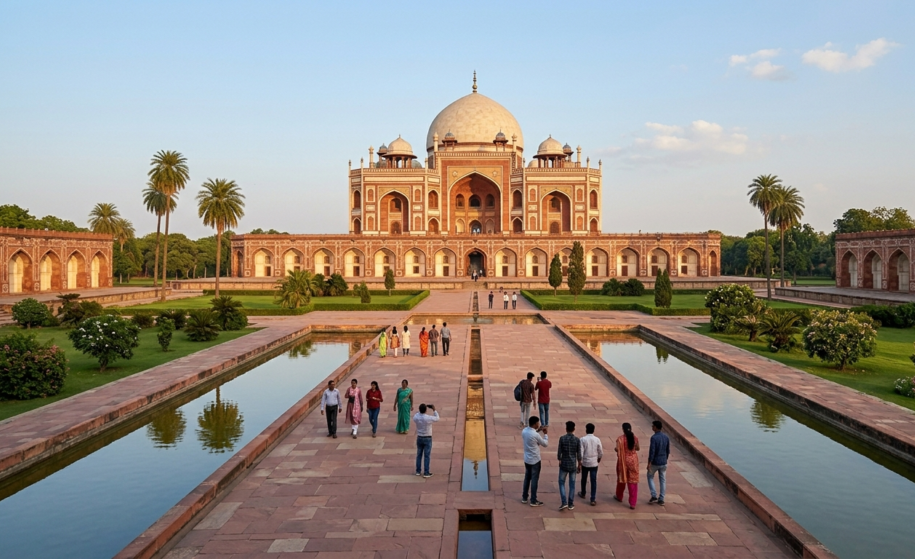
- Exterior :– The main tomb structure is elevated on a massive, high vaulted plinth, surrounded entirely by 30 acres of sprawling geometric ‘Charbagh’ lawns. The monument stands at a total height of about 47 meters (154 feet) and stretches 91 meters in width. The primary material used is native red sandstone, combined beautifully with smooth white marble strip accents to highlight its margins and artistic curves. The crowning glory of the monument is its immense double-dome, crafted entirely out of pure white marble—a distinctive hallmark of classical Persian engineering. The building features soaring arched alcoves (known as Peshthaks) on all four sides, creating perfect symmetry and a visually striking appearance from any direction.
- Interior :– Upon entering the main central chamber, a deeply serene and spiritual ambiance greets visitors, created by soft sunlight filtering through intricate marble lattice screens (jaalis). At the absolute center of the octagonal chamber lies the elegant white marble cenotaph of Emperor Humayun, while his actual burial vault rests safely in the subterranean basement below. Surrounding this central hall are smaller interconnected octagonal chambers that house the graves of other members of the royal family. The internal walls are decorated with elegant Islamic geometric designs and perfectly proportioned structural arches.
Travel Guide & Routes
- Ticket and Charges :– The entry ticket fee for Indian citizens and visitors from SAARC and BIMSTEC nations is around ₹35 to ₹40 (booking digitally or online yields a small discount). For international foreign tourists, the ticket is priced between ₹550 and ₹600. Entry is completely free for children under 15 years of age.
- Visiting Time :– Humayun’s Tomb is open to tourists on all seven days of the week, from 6:00 AM to 6:00 PM (essentially from sunrise to sunset). The late afternoon and early evening hours offer the most comfortable and beautiful lighting for exploring the grounds.
- How to Reach :–
- By Metro :– The closest metro options are the ‘JLN Stadium Metro Station’ on the Violet Line and the ‘Hazrat Nizamuddin Metro Station’ on the Pink Line. Both stations are located approximately 1.5 to 2 kilometers away from the complex, and local e-rickshaws or auto-rickshaws can easily drop you at the entrance gate in under 5 minutes.
- By Rail :– The Hazrat Nizamuddin Railway Station is the nearest major railway terminal.
- By Bus & Auto :– Numerous DTC buses connecting Central Delhi to South Delhi ply via Mathura Road, stopping directly at the dedicated Humayun’s Tomb bus stop.
- Photography Spots :– The central axis view from the main garden gateway, the reflection of the tomb in the central water channels, the grand arched framing from the western gateway, and the white marble dome glowing during golden hour are the finest photography locations.
- Local Flavors :– The adjacent neighborhood of Hazrat Nizamuddin is globally famous for its authentic, rich Mughlai street food. Visitors can enjoy local specialties like charcoal-grilled kebabs, rich biryani, and traditional Sheermal. For those looking for a contemporary cafe experience, the organic cafe inside Sunder Nursery or the premium restaurants of Khan Market are excellent choices.
- Famous Markets :– For high-end luxury goods and literature, the elite ‘Khan Market’ is located very close by. Alternatively, for traditional handicrafts, ethnic apparel, and regional art from different Indian states, tourists can take a short ride to ‘Dilli Haat’ (INA).
Nearby Attractions in Detail :-
- Sunder Nursery :– Located immediately adjacent to the tomb complex, this is a beautifully restored 90-acre heritage park and botanical garden. It features beautifully manicured lawns, pristine lakes, cascading water features, and several smaller conservation-listed Mughal-era monuments, making it a peaceful urban oasis.
- Hazrat Nizamuddin Aulia Dargah :– Situated less than 1 kilometer away, this is the holy shrine of the legendary 14th-century Sufi saint, Hazrat Khwaja Nizamuddin Aulia. The soul-stirring live Qawwali sessions held here on Thursday and Friday evenings offer an unforgettable, mystical musical experience.
- Isa Khan’s Tomb :– Located right inside the outer entrance gateway of the Humayun’s Tomb complex, this stunning octagonal monument predates the main tomb. It was constructed in 1547 AD as the burial site for Isa Khan Niazi, an influential noble in the court of Sher Shah Suri.
- Tomb of Abdul Rahim Khan-i-Khana :– Positioned a short distance away in Nizamuddin, this is the final resting place of Rahim, the iconic classical poet and one of the nine celebrated gems (Navaratnas) of Emperor Akbar’s court. The structure has recently undergone a major aesthetic restoration.
Interesting Facts
- Humayun’s Tomb is widely termed as the ‘Precursor to the Taj Mahal‘ because Shah Jahan drew extensive inspiration from its structural geometry, dual-dome technology, and symmetric layout to design the Taj Mahal for his wife.
- The extensive complex holds more than 150 graves across its multiple inner pavilions and open terraces, making it the largest single royal family cemetery across the entire Indian subcontinent.
- The monument was the first major architectural project in India to witness a large-scale collaboration between Persian masters and Indian stonemasons, establishing the standard for classic Indo-Islamic imperial style.
- During the peak of the British colonial era, the grand geometric Charbagh gardens were completely repurposed and used as commercial vegetable farms before being restored to their original form by Lord Curzon in the early 20th century.
Important Questions and Answer :-
Question 1:- Who built Humayun’s Tomb and when was it constructed?
Answer:– Humayun’s Tomb was commissioned by his chief widow, Empress Hamida Banu Begum (Haji Begum). Its construction commenced in 1565 AD and was successfully completed in 1572 AD.
Question 2:– Why is Humayun’s Tomb considered the main inspiration for the Taj Mahal?
Answer:– The Taj Mahal heavily borrowed its core architectural identity—including its signature bulbous white marble double-dome, massive recessed arched entryways (Peshthaks), and the symmetrical Charbagh layout—directly from the structural innovations introduced at Humayun’s Tomb.
Question 3:– Is Humayun’s Tomb open to visitors on Mondays?
Answer:– Yes, unlike the Red Fort of Delhi, Humayun’s Tomb remains open to the public on all days of the week, including Mondays, from sunrise to sunset.
Author’s Thoughts
Humayun’s Tomb is far more than a solemn resting place of stone; it is a gorgeous poem written in red sandstone and white marble, woven together by threads of memory and structural perfection. Away from the dense crowds of Old Delhi’s Red Fort and the stony starkness of the Qutub Minar, sitting on the lush lawns of its Charbagh gardens brings an overwhelming sense of quietude. As a writer and storyteller, I believe that to truly catch the soul of this place, one must spend an afternoon sitting on its high stairs, watching the setting sun cast its deep golden hues across the white marble dome, momentarily turning back the pages of time.
“Resting peacefully in the timeless embrace of its geometric gardens, this grand monument remains a stellar tribute to royal legacy and ancient architectural genius.”