
Independence Day :- The Grand Festival of National Pride, Sacrifice, and Unity
Detailed History
August 15, 1947, is regarded as the most glorious and golden day in Indian history. After nearly 200 years of British oppression, economic exploitation, and colonial rule, India attained complete independence on this very day. This day is not merely a date on the calendar, but an everlasting saga of the immense courage, dedication, and sacrifice of countless freedom fighters, revolutionaries, and citizens.
From Mahatma Gandhi’s movements of non-violence and Satyagraha to the revolutionary zeal of heroes like Bhagat Singh, Rajguru, Sukhdev, Netaji Subhash Chandra Bose, and Chandrashekhar Azad, the foundations of the British Empire were shaken. Consequently, on the midnight of August 14–15, 1947, India’s first Prime Minister, Pandit Jawaharlal Nehru, delivered his historic “Tryst with Destiny” speech and hoisted the Indian National Flag, the Tricolor, at the Red Fort in Delhi.
Detailed Architecture
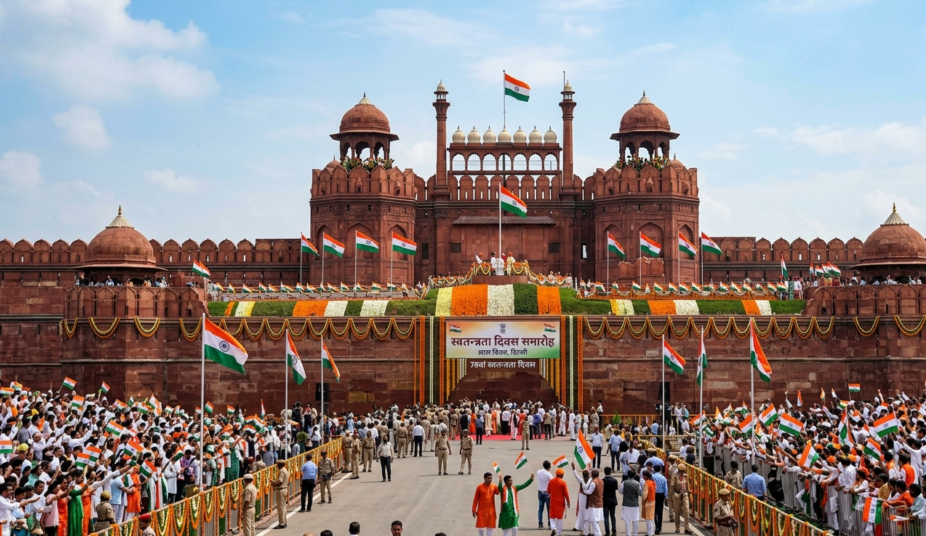
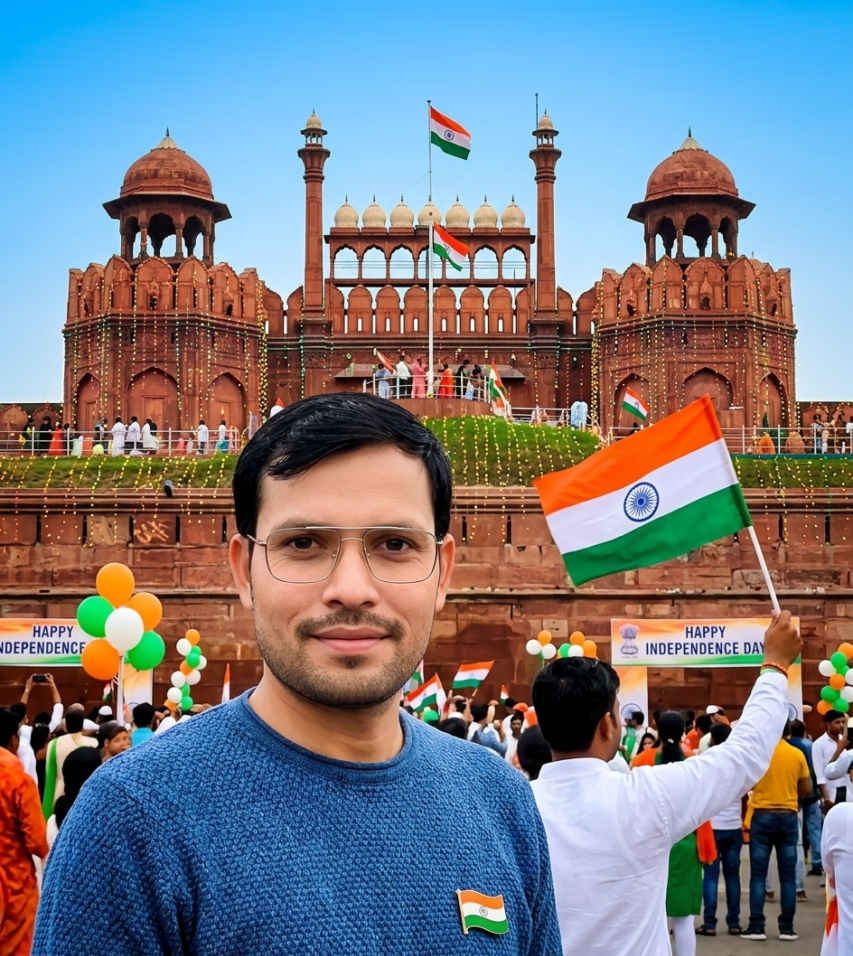
The main and most grand national celebration of Independence Day takes place at the historic Red Fort (Lal Qila) located in the national capital, New Delhi.
- Exterior Architecture :– Constructed in the 17th century using red sandstone, the Red Fort is a masterpiece of Mughal architectural heritage. Its massive ramparts and main entrance, known as the Lahori Gate, are grand and imposing. On Independence Day, these ramparts are adorned with the colors of the national flag and a ceremonial stage from where the Prime Minister addresses the nation.
- Interior Architecture :– The inner complex houses iconic structures such as Diwan-i-Aam, Diwan-i-Khas, and the Moti Masjid. On August 15, the vast grounds directly facing the ramparts are arranged for the disciplined march-past and parade of the tri-services (Army, Navy, Air Force) and police forces.
Travel Guide & Routes
- Tickets & Entry :– Attending the main ceremony on August 15 requires an official pass or invitation issued by the Ministry of Defence. On regular days, entry tickets cost ₹35–₹50 for Indian citizens and ₹550–₹600 for foreign tourists.
- Timing :– The Independence Day event begins around 6:00 AM, with the flag hoisting taking place at approximately 7:30 AM. On normal days, the fort remains open from 9:30 AM to 4:30 PM (closed on Mondays).
- How to Reach :–
- By Metro :– The nearest metro stations are Lal Qila Metro Station (Violet Line) and Chandni Chowk Metro Station (Yellow Line).
- By Rail :– The nearest major railway stations are Old Delhi Railway Station (2 km) and New Delhi Railway Station (5 km).
- By Road :– Buses and taxis are readily available from all major parts of Delhi (note that several roads near the fort are diverted on August 15 due to security protocols).
- Photography Spots :– The main Lahori Gate, the historic rampart, and the surrounding outer gardens.
- Local Food & Famous Markets :– Located directly opposite the fort is Chandni Chowk, world-famous for its culinary heritage. Highlights include Paranthe Wali Gali, Natraj’s Dahi Bhalle, and Giani’s Rabri Falooda. Nearby markets like Dariba Kalan and Bhagirath Palace are also highly famous.
Other National Festivals of India
Apart from Independence Day, other key national festivals in India reflect patriotism and national unity.
- Republic Day (26th January) :– Marks the day in 1950 when the Constitution of India came into effect, establishing India as a sovereign democratic republic. It is celebrated with a grand parade on Kartavya Path in New Delhi.
- Gandhi Jayanti (2nd October) :– Celebrates the birth anniversaries of Father of the Nation Mahatma Gandhi and former Prime Minister Lal Bahadur Shastri, promoting messages of truth, non-violence, and simplicity.
- Constitution Day (26th November) :– Commemorates the adoption of the Constitution of India by the Constituent Assembly on November 26, 1949, honoring our democratic values and constitutional rights.
Author’s Thoughts
”Independence Day is not merely a ceremonial occasion limited to remembering past events or hoisting the flag. It is a moment of deep self-reflection regarding our contributions as responsible citizens toward national development, social harmony, and integrity. True freedom remains incomplete until illiteracy, poverty, and inequality are completely eradicated from society. Independence Day serves as a vital reminder that rights and duties are two sides of the same coin, and driving the nation toward progress is a collective responsibility.”
Interesting Facts
- No National Anthem on August 15, 1947 :– At the time of independence, ‘Jana Gana Mana’ was not yet adopted as the official national anthem; it was officially declared on January 24, 1950.
- Mahatma Gandhi’s Absence :– On August 15, 1947, Mahatma Gandhi was away from Delhi, fasting in Kolkata (Noakhali) to quell communal violence.
- Other Nations Celebrating August 15 :– Apart from India, South Korea, North Korea, Bahrain, Liechtenstein, and the Republic of the Congo also celebrate their independence on August 15.
Important Questions and Answer :-
Question 1:– What is the main difference between flag ceremonies on Independence Day and Republic Day?
Answer:- On Independence Day (August 15), the national flag is pulled up from the bottom with a rope and then unfurled, which is called Flag Hoisting, performed by the Prime Minister. On Republic Day (January 26), the flag is tied at the top and unfurled, which is called Flag Unfurling, performed by the President.
Question 2:– When was the Tricolor first hoisted at the Red Fort?
Answer:- Pandit Jawaharlal Nehru first hoisted the Tricolor at the ramparts of the Red Fort on August 16, 1947, at 8:30 AM.
“Independence Day is not just a page in history, but the pride of a strong and united India built upon the foundation of uncounted sacrifices.”