
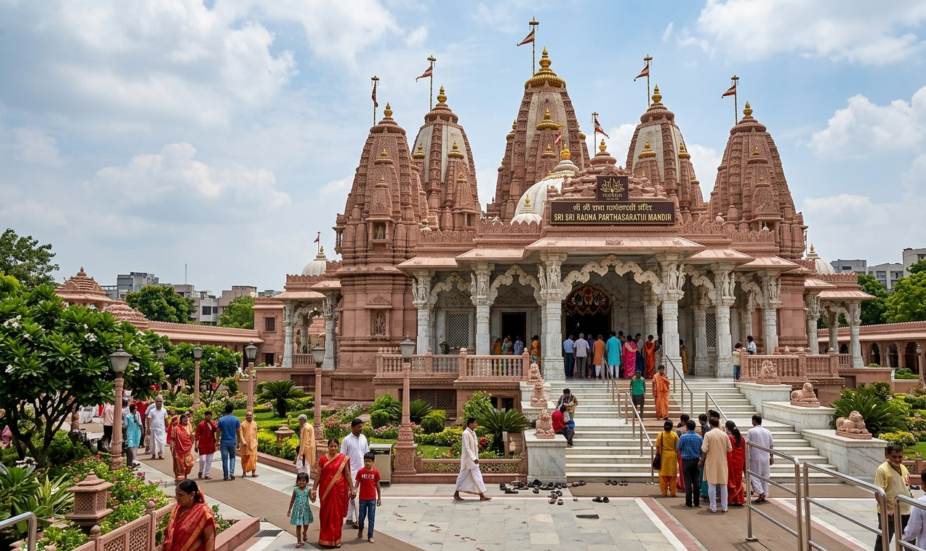
ISKCON Temple, Delhi :- The Grand Abode of Sri Sri Radha Parthasarathi and the Zenith of Cosmic Spirituality
Detailed History
Perched commandingly on the crest of the ‘Hare Krishna Hills‘ in the Kailash region of South New Delhi, the ISKCON Temple, Delhi, formally recognized as Sri Sri Radha Parthasarathi Mandir, stands tall as one of India’s most magnificent, contemporary, and celebrated Vaishnava temples. The institution is dynamically affiliated with the International Society for Krishna Consciousness (ISKCON), an international spiritual movement dedicated to propagating the teachings and profound devotion of Lord Krishna across the globe.
The foundational vision for this architectural marvel was conceptualized by the revered founder-acharya of ISKCON, A.C. Bhaktivedanta Swami Prabhupada. The structural construction of this vast complex commenced in the year 1993, based on the innovative designs of the legendary Indian architect, Achyut Kanvinde. Within a span of just five years, this world-class cultural and spiritual ecosystem was fully realized. On April 5, 1998, the temple was formally inaugurated and dedicated to the nation by the then Prime Minister of India, Shri Atal Bihari Vajpayee.
The temple is not merely a conventional house of worship; it functions as the ‘Glory of India Vedic Cultural Centre’—a sophisticated educational institution engineered to translate the eternal truths of the Srimad Bhagavad Gita and Sanatan Dharma to global audiences through next-generation multimedia platforms. Today, it serves as a primary sanctuary of absolute peace, intense devotion, and transcendental joy for millions of local citizens and international tourists.
Detailed Architecture
Exterior Architecture :-
Elevated on a high hill ridge, the exterior architecture of the Delhi ISKCON Temple presents a stunning harmony of contemporary design principles and traditional North-Indian Hindu temple shikhara engineering. The defining hallmark of its skyline is the cluster of three towering, majestic domes (Shikharas) that rise over 90 feet into the air. Crafted meticulously under the direction of Achyut Kanvinde, the exterior skin is clad in a beautiful contrast of rich red Delhi sandstone and smooth white materials, accented by clean modern geometric carvings. The towers taper elegantly toward the heavens, crowned with gleaming golden Kalash pinnacles and the sacred Sudarshana Chakras. The monumental approach stairways and the expansive outer courtyard plazas are beautifully configured with cascading water fountains and polished stone layouts, lending the shrine an imperial and serene atmosphere.
Interior Architecture :-
Internally, the structural design of the ISKCON Temple is a masterclass in spatial planning, fine art integration, and high-tech corporate infrastructure. Stepping past the primary entrance thresholds reveals a cavernous, fully air-conditioned main Temple Hall, engineered to comfortably accommodate thousands of devotees simultaneously. The sweeping overhead ceiling of this grand pavilion is adorned with spectacular, lifelike frescoes hand-painted by master Russian artists, capturing the celestial pastimes of Lord Krishna and Radha Rani.
The focal point of the hall is a row of three majestic, intricately carved marble altars housing the highly enchanting deities of Sri Sri Radha Parthasarathi, Sri Sri Gaura Nitai (Chaitanya Mahaprabhu and Nityananda Prabhu), and the divine lineage of Sri Sri Sita-Ram, Lakshman, and Hanuman Ji. Adjacent to the main temple floor sits the highly advanced interactive museum wing, featuring India’s first high-tech robotic theater, light-and-sound matrices, and sophisticated animatronics complexes dedicated to explaining the essence of the Gita. The entire interior flooring is lined with premium polished white and beige marble laid out in symmetric geometric arrays.
Travel Guide & Routes
For pilgrims, cultural tourists, and global travelers planning an excursion to the Delhi ISKCON Temple, the comprehensive logistical guide below outlines all vital information.
- Ticket and Entry Fee :– Entry into the main Temple Hall for divine darshan and congregational chanting is completely Free. No general ticketing fees are levied. However, accessing the specialized multimedia exhibition halls inside the ‘Vedic Cultural Museum’ requires a nominal token fee (approximately ₹30 to ₹50 per visitor).
- Timings (Temple Operational Hours) :–
- Daily Opening Hours :– The temple doors remain open from 04:30 AM to 01:00 PM, and reopen from 04:00 PM to 09:00 PM daily.
- The Celebrated Mangala Aarti :– Commences daily at 04:30 AM (highly revered for its intense spiritual vibrations).
- The Evening Maha Aarti :– Conducted from 07:00 PM to 07:30 PM daily. (Note: The primary altars close their gates between 01:00 PM and 04:00 PM for the holy deities’ afternoon rest and food offerings.)
- Opening and Closing Days :– The temple operates seamlessly all seven days of the week, throughout the entire year. During the mega-festival of Janmashtami, the facility stays open continuously round-the-clock (24/7) to manage the massive wave of global pilgrims.
- How to Reach :–
- By Metro :– The absolute most efficient and direct transit medium is the Delhi Metro. The closest transit hub is the ‘Nehru Place’ Metro Station, located squarely on the Violet Line. Additionally, the ‘Kalkaji Mandir’ Interchange Station (Violet & Magenta Lines) sits within identical proximity. The temple is a brief 800-meter to 1 km walk from both stations, from where local e-rickshaws and autos can drop you at the main gate within 5 minutes.
- By Bus :– The adjacent Nehru Place Bus Terminal is heavily connected via public DTC bus routes traversing from all sectors of the capital. Commuters can board any bus heading towards South Delhi or Nehru Place, dropping passengers just a short walk from the foot of the hill.
- By Auto/Taxi/Cab :– Positioned in a highly strategic quadrant of South Delhi, the temple is roughly 12 km from New Delhi Railway Station. App-based cabs, prepaid taxis, and local auto-rickshaws can drive visitors directly up the winding hill path to the main entrance gates.
Photography Spots, Local Food, and Famous Markets
Photography Spots :-
- The Triple Shikhara Courtyard Frame :– Capturing a wide-angle shot from the central courtyard fountains perfectly isolates the three towering red-and-white stone domes rising into the skyline.
- The Grand Art Gallery Stairways :– The sweeping, polished marble approach steps flanked by manicured hill gardens offer a pristine, high-aesthetic background for cultural portrait photography.
- The Vedic Museum Atrium :– The contemporary structural lines of the external cultural center block present a brilliant perspective for modern architectural captures. (Note: To honor core religious protocols and preserve security guidelines, photography, video filming, or digital streaming inside the main temple hall facing the sacred deities is strictly prohibited.)
Local Food :-
Catering to an extensive global footprint, the temple campus hosts one of India’s most celebrated destinations for pure vegetarian culinary arts.
- Govinda’s Restaurant :– An iconic in-house culinary institution managed by the temple trust. It is universally famous for serving immaculate, premium quality ‘Sattvik’ vegetarian cuisine (prepared strictly without onions or garlic). It offers a lavish, royal ‘Chhappan Bhog’ buffet alongside a diverse selection of premium Indian and continental dishes that have been pre-offered to the Lord.
- Nehru Place Commercial Food Courts :– Located just at the base of the hill, the commercial business district features a vast multi-cuisine food plaza hosting famous local sweet houses, traditional Chole-Bhature hubs, and premium global fast-food options.
- Kalkaji Street Treats :– The street kiosks near the outer perimeter serve quick local favorites like crisp samosas, Bedmi-Kachoris, and freshly squeezed fruit juices for budget-conscious pilgrims.
Famous Markets Nearby
- Nehru Place Market :– Located right at the base of the hill, this is universally celebrated as Asia’s largest commercial hub for IT systems, computer hardware, electronics retail, and mobile networks.
- Kalkaji Main Market :– A bustling, traditional neighborhood high-street bazaar immensely popular for festive ethnic apparel, traditional Indian jewelry, and specialized prayer items.
- The Lotus Temple Complex :– Located barely 1 kilometer away, this world-famous Baha’i House of Worship shaped like a blooming white lotus offers vast geometric lawns and a deeply silent meditative sanctuary.
Interesting Facts
- The World’s Largest Bhagavad Gita :– The Delhi ISKCON Temple proudly houses the ‘Astounding Bhagavad Gita’—the largest and heaviest printed sacred text on earth. Weighing a staggering 800 kilograms and spanning over 2.8 meters when open, this masterpiece was printed on specialized synthetic paper in Italy and formally unveiled by the Prime Minister of India.
- The Robotic Gita Discourses :– The interactive cultural wing features an extraordinary multimedia exhibition where advanced, high-precision human-like robots and animatronics deliver the profound philosophical dialogue of the Gita between Lord Krishna and Arjuna.
- A Prime Minister’s Commendation :– During its historic launch in 1998, Shri Atal Bihari Vajpayee highly lauded the temple’s architecture, stating that it stood as a brilliant bridge translating India’s ancient moral framework into a contemporary global language.
- The Russian Masterpieces :– The sweeping, majestic multi-layered paintings adorning the immense ceiling vaults of the primary temple hall were painstakingly detailed over several months by an elite group of volunteer artists from Russia.
Important Questions and Answer :-
Question 1:– What is the formal, official name of the Delhi ISKCON Temple?
Answer:- The official and formal institutional name of the temple is ‘Sri Sri Radha Parthasarathi Mandir’, where ‘Parthasarathi’ translates directly as the ‘Charioteer of Partha (Arjuna)’—a supreme title of Lord Krishna.
Question 2:– Which is the closest metro station to arrive at ISKCON Temple Delhi?
Answer:- The absolute closest transit station is the ‘Nehru Place’ Metro Station, located directly on the Violet Line of the Delhi Metro network.
Question 3:- Is there an entrance fee to visit the main temple hall?
Answer:- No, entry into the primary temple complex and access to the main congregational hall for darshan is completely free of cost for all global visitors.
Question 4:– What makes the in-house Govinda’s Restaurant unique?
Answer:- Govinda’s is unique because it serves entirely ‘Sattvik’ food, which means everything is prepared under high hygienic parameters without the use of onions or garlic, and is served as sanctified holy remnants (Prasadam).
Question 5:- Does the inner sanctum of the temple close during the afternoon hours?
Answer:- Yes, the primary deity altars close their gates between 01:00 PM and 04:00 PM daily for the deities’ ritual afternoon rest and offerings, while the outer administrative campus continues to remain open.
“A flawless manifestation of cutting-edge modern engineering and timeless Vedic philosophy, the Delhi ISKCON Temple stands tall on its sacred hill as an ethereal global sanctuary echoing the divine rhythm of ‘Hare Krishna’ to bring absolute peace to every searching soul.”