
Jahaz Mahal, Delhi :- A Floating Historical Marvel
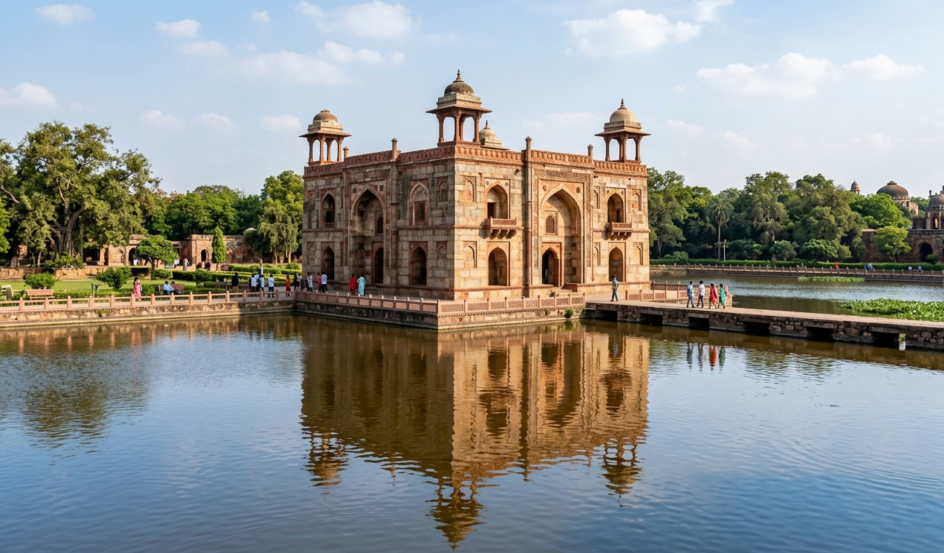
Located on the eastern bank of the historic ‘Hauz-i-Shamsi‘ reservoir in Mehrauli, South Delhi, ‘Jahaz Mahal‘ is a uniquely fascinating monument built during the Lodi Dynasty era. The name ‘Jahaz Mahal’ (Ship Palace) originates from its distinct structural design and its striking optical reflection in the surrounding water, which creates the illusion of a massive ship afloat on the lake. It remains an extraordinary specimen of Delhi’s rich medieval architecture and water palace heritage.
Detailed History
Jahaz Mahal was commissioned during the peak of the Lodi Dynasty’s reign, roughly between 1489 and 1517 AD. While there are varying consensus among historians regarding the exact individual identity of its builder, it is widely acknowledged that the palace was fundamentally structured to serve as a ‘Saray‘ (an imperial transit inn) or a summer pleasure resort. It provided a cool, scenic retreat for the Delhi Sultans, late Mughal emperors, and the royal ladies away from the scorching summer heat of Delhi.
The history of this palace is also profoundly intertwined with the iconic secular festival of Delhi known as ‘Phoolwalon ki Sair’ (Sair-e-Gulfaroshan). This three-day flower-sellers’ festival, initiated during the late Mughal period, is celebrated annually to this day. During the festivities, Hindus and Muslims jointly carry large floral sheets to the shrine of Khwaja Bakhtiyar Kaki and floral fans to the ancient Yogmaya Temple in Mehrauli. Jahaz Mahal serves as the primary stage and focal hub for all the cultural performances of this historic festival.
Detailed Architecture
The architecture of Jahaz Mahal exhibits a beautiful transition, bringing together the absolute simplicity of Lodi structural design with vibrant structural details and colorful stone decorations.
- Exterior :– The exterior walls are constructed out of sturdy local grey stone and dressed red sandstones. The building features elegant corner chatris (chambers topped with small domes) and multi-tiered arched jharokhas (windows). Historically, when the water levels of the adjacent Hauz-i-Shamsi reservoir rose to touch the lower ramparts of the building, the palace brilliantly resembled a seafaring vessel. The main entrance gateway showcases refined geometric stone carvings and ornamental bands.
- Interior :– The inner layout of the palace reveals a sprawling rectangular central courtyard, flanked by structural pillars supporting spacious pillared galleries and living chambers. The roof of the palace retains remnants of highly distinct, ornamental blue glazed tiles on its chhatris and pavilions, showcasing an early style that heavily inspired later Mughal palaces. The central courtyard also features the remains of a small internal pool and fountain system used for passive cooling.
Travel Guide & Routes
If you plan to journey through this historic water palace in Mehrauli, here is the complete travel guide arranged sequentially.
- Entry Ticket :– Entry to Jahaz Mahal is completely Free for all domestic and international visitors.
- Visiting Time :– The monument stays open from sunrise to sunset, generally from 6:00 AM to 6:00 PM.
- Closing Day :– It is open to the public on all seven days of the week.
- Photography Spots :– The elevated corner domes (Chhatris), the panoramic view of the palace stretching along the edge of the Hauz-i-Shamsi lake, the symmetry of the central inner courtyard, and the exquisite medieval blue glazed tiles on the roof serve as fantastic photography frames.
- Local Food :– The surrounding lanes of Mehrauli present an array of traditional culinary experiences similar to Old Delhi. Visitors must sample the famous local Mughlai kebabs, rich mutton stew, spicy street samosas, and traditional kachoris. Modern lifestyle cafes are also available in adjacent boutique avenues.
- Famous Market :– The historical ‘Mehrauli Main Market‘ is located within walking distance and is highly popular for traditional textiles, daily utensils, indigenous Juttis (footwear), and local home crafts.
- How to Reach :–
- By Metro :– The nearest transit stations are Qutub Minar Metro Station (Yellow Line) and Chhattarpur Metro Station. From either station, you can take an e-rickshaw or an auto-rickshaw directly to the entrance of Jahaz Mahal near the Hauz-i-Shamsi complex.
- By Road :– It is situated close to the Mehrauli Bus Terminal. You can travel via DTC buses or hire app-based cabs to the main drop points, from where a short walk through the old heritage alleys leads straight to the monument.
Nearby Attractions
While exploring Jahaz Mahal, you can easily experience these prominent nearby historical sites.
- Hauz-i-Shamsi :– The historic water reservoir directly attached to the palace, commissioned by Sultan Iltutmish of the Slave Dynasty.
- Bhool Bhulaiya (Adham Khan’s Tomb) :– A unique, mysterious octagonal Mughal tomb located about 1.5 km away.
- Mehrauli Archaeological Park :– A vast green historical reserve home to ancient marvels like Rajon ki Baoli and the Jamali Kamali Mosque.
- Qutub Minar :– The iconic UNESCO World Heritage site located just a 10-minute drive from the palace grounds.
Interesting Facts
- The striking visual illusion created by the palace reflection on the full waters of the lake led local 16th-century residents to call it ‘Jahaz Mahal’ (The Ship Palace), a name that outlived its official historical title.
- The adjacent Hauz-i-Shamsi tank has an intriguing legend; it is believed that Sultan Iltutmish built it after dreaming of Prophet Muhammad riding a winged steed, marking the exact spot where the horse’s hoof print appeared.
- The rare blue glazed tiles that adorn the palace rooftops were incredibly expensive luxury imports during the Lodi era, meant exclusively to embellish royal retreats.
- During the annual ‘Phoolwalon ki Sair’ festival held across October and November, the entire stone framework of Jahaz Mahal is illuminated with thousands of lights, making it the main stage for regional folk dances.
Important Questions and Answer :-
Question 1:– Where is Jahaz Mahal located and how did it get its name?
Answer:- Jahaz Mahal is situated in Mehrauli, South Delhi. It got its name because its structural outline and stone reflection over the adjacent lake gave it the distinct appearance of a ship floating in water.
Question 2:– Which empire or dynasty built Jahaz Mahal?
Answer:- The palace was constructed during the reign of the Lodi Dynasty of the Delhi Sultanate, spanning the late 15th and early 16th centuries.
Question 3:– Is there an entry fee to explore the Jahaz Mahal complex?
Answer:- No, entry to Jahaz Mahal and the surrounding lakeside tracks is entirely free of cost for all visitors.
Question 4:– Which historical festival is natively hosted at Jahaz Mahal?
Answer:- Jahaz Mahal is the primary cultural venue for Delhi’s famous historical secular festival, ‘Phoolwalon ki Sair’.
Author’s Thoughts
Jahaz Mahal is one of those rare, quiet fragments of ancient Delhi that has managed to maintain its serene composure amid the urban sprawl of the modern capital. Tucked away in the historic folds of Mehrauli, this palace serves as a beautiful testament to the aesthetic sensibilities and advanced water-centric designs of the Lodi architects. Standing by the quiet banks of Hauz-i-Shamsi and watching the sun set behind the weathered stone chhatris is a deeply moving experience for anyone fond of history and architecture. For travelers looking to step away from mainstream crowds and discover the deeply atmospheric roots of medieval Delhi, Jahaz Mahal is an absolutely unmatched destination.
“The timeless stones of Jahaz Mahal continue to drift peacefully over the waters of memory, holding fast to the poetic echoes of emperors and floral festivals.”