
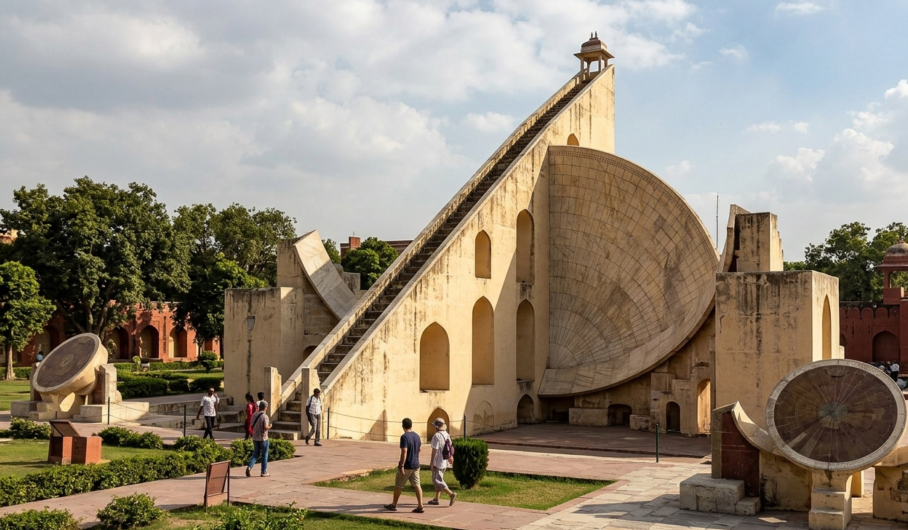
Jantar Mantar Delhi :- A Magnificent Example of Astronomical Science and Ancient Architecture
Detailed History :-
Jantar Mantar is a historical astronomical observatory located in the heart of New Delhi, the capital of India. It was built in 1724 by Maharaja Sawai Jai Singh II of Jaipur. During the reign of the Mughal Emperor Muhammad Shah, this observatory was established to update astronomical tables and to accurately calculate the movements of the sun, moon, and planets.
Maharaja Jai Singh II possessed deep knowledge of mathematics, astronomy, and architecture. Apart from Delhi, he constructed four other similar observatories in Jaipur, Ujjain, Varanasi, and Mathura. Jantar Mantar in Delhi is considered the first and one of the most significant among these five observatories. It stands as an outstanding heritage of ancient Indian astronomical expertise and architecture.
Detailed Architecture :-
The architecture of Jantar Mantar is not merely a collection of stone structures, but a vast assembly of astronomical instruments. All these structures are built using red sandstone and brick-lime mortar.
- Samrat Yantra :– This is the largest and most prominent instrument in the observatory, which is essentially a giant sundial. Standing approximately 70 feet tall, it is capable of measuring time with an accuracy down to seconds using the shadow cast by the sun.
- Jai Prakash Yantra :– It consists of two hemispherical bowl-shaped structures used to calculate the exact positions of celestial bodies and stars.
- Ram Yantra :– This instrument is used to measure the altitude and azimuth of planets between the earth and the sky. It has a cylindrical structure open at the top.
- Misra Yantra :– It is a combination of five different astronomical instruments. It was designed to determine the exact time of noon in various cities around the world (such as Zurich, Nottingham, etc.).
Travel Guide & Routes :-
- Entry Ticket :–
- Indian Citizens :– ₹25 per person (₹20 if booked online).
- Foreign Tourists :– ₹300 per person (discounts available on online booking).
- Children (up to 15 years) :– Free entry.
- Visiting Time :–
- Opening Time :– 6:00 AM.
- Closing Time :– 6:00 PM (until sunset).
- Weekly Off :– Open on all seven days of the week.
- How to Reach :–
- Metro Route :– The nearest metro stations are Patel Chowk (Yellow Line) and Janpath (Violet Line). From here, Jantar Mantar can be easily reached on foot or by e-rickshaw.
- Bus Route :– Delhi Transport Corporation (DTC) buses are available from almost all major parts of Delhi to Rajiv Chowk / Connaught Place.
- Distance from Railway Station :– It is located just 2.5 km from New Delhi Railway Station, reachable within 10 minutes by auto or e-rickshaw.
- Photography Spots :–
- The front area of the massive triangular structure of Samrat Yantra.
- The unique geometric arches and shapes of Misra Yantra.
- The lush green garden of the complex alongside the historical red sandstone structures.
- Local Taste & Nearby Markets :–
- Local Taste :– You can enjoy popular street foods such as Chole Bhature, Kathi Rolls, and café culture around Connaught Place.
- Famous Markets :– Located right next to Jantar Mantar is Janpath Market, famous for clothes, handicrafts, and decorative items. Additionally, the iconic Connaught Place (CP) and Palika Bazaar are also nearby.
Interesting Facts :-
- The sundial (Samrat Yantra) at Jantar Mantar is so precise that it can calculate local time accurately even in partial sunlight.
- The ‘Misra Yantra‘ here was designed to indicate which four other cities in the world experience noon at the exact moment it is noon in Delhi.
- Maharaja Jai Singh preferred these large stone structures over small brass and metal instruments because metal tools were prone to wear and tear and were easily affected by weather conditions.
- This site is also well known as a prominent hub for civic movements and peaceful demonstrations in Delhi.
- The name ‘Jantar Mantar’ is derived from the Sanskrit words ‘Yantra’ (instrument) and ‘Mantra’ (calculation/consultation), meaning ‘an instrument for calculation’.
Important Questions and Answer :-
Question 1:- Who built Jantar Mantar in Delhi and when?
Answer:– It was built in 1724 by Maharaja Sawai Jai Singh II of Jaipur.
Question 2:- Which is the nearest metro station to reach Jantar Mantar?
Answer:– The nearest metro stations to Jantar Mantar are ‘Patel Chowk’ (Yellow Line) and ‘Janpath’ (Violet Line).
Question 3:- Is photography and videography allowed inside Jantar Mantar?
Answer:– Yes, photography is allowed for tourists; however, prior permission from the Archaeological Survey of India (ASI) is required for commercial videography.
“Jantar Mantar in Delhi is not just a building of stones, but a living testament to the modern brilliance of ancient Indian astronomers who continue to measure the precise movement of time.”