
Detailed History
Jantar Mantar, located on Sansad Marg near Connaught Place in New Delhi, is an extraordinary architectural and mathematical marvel of ancient Indian astronomy. Rather than being a conventional historical building or fortress, it is an open-air observatory composed of immense stone-built astronomical instruments. This pioneering site was commissioned by the visionary ruler of Jaipur, Maharaja Sawai Jai Singh II, in the year 1724 AD.
Maharaja Jai Singh II was a deeply passionate mathematician and astronomer. He noticed that the astronomical tables, data sheets, and quadrants available during his era were highly inaccurate, leading to flawed predictions regarding time, seasons, and planetary transits. To rectify this issue, he secured approval during the reign of Mughal Emperor Muhammad Shah to build highly precise stone observatories. He went on to construct five such structural observatories across Northern India: in Delhi, Jaipur, Ujjain, Varanasi, and Mathura (the Mathura site has been lost over time), with the Delhi Jantar Mantar being the very first to be established. The name ‘Jantar Mantar’ is derived directly from the ancient Sanskrit terms Yantra (meaning instrument or machine) and Mantra (meaning calculation or council), translating literally to ‘The Calculating Instrument’.
Detailed Architecture
The structural engineering of Jantar Mantar is globally unique because its massive brick and lime-plastered formations are not mere walls, but scientifically optimized celestial calculation devices layered with red sandstone.
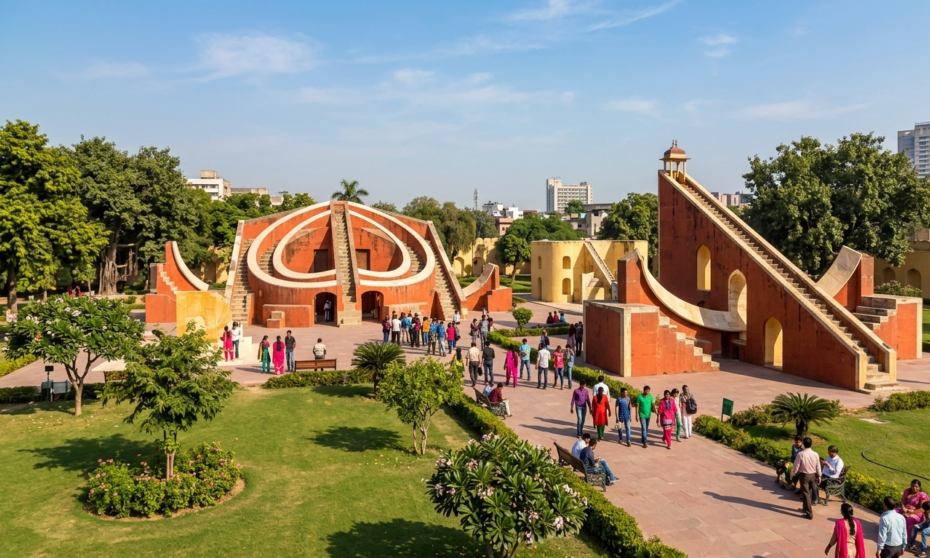
- Exterior :– The entire complex is situated within expansive, landscaped public gardens, dominated by massive red-painted geometric structures. These forms display distinct triangular, circular, and polygonal shapes that closely resemble modern abstract art sculptures. The central compound preserves four primary monumental instruments: the Samrat Yantra, the Ram Yantra, the Jayaprakash Yantra, and the Mishra Yantra. The outer plaster faces of these devices are marked with precise degree lines, angles, and markings to gauge shadow movements.
- Interior :– The structural layouts of these individual instruments display complex scientific detailing:
- Samrat Yantra (Supreme Instrument) :– Standing as the largest structure in the compound, it is a giant equinoctial sundial rising nearly 70 feet high. It features a central triangular gnomon wall oriented at an angle, which casts a precise shadow on the adjacent curved stone quadrants to read the exact local time down to minutes.
- Ram Yantra :– This consists of two massive, roofless cylindrical structures used to measure the altitude and azimuth angles of stars and planets. The interiors feature precisely calibrated stone columns and floor slits.
- Jayaprakash Yantra :– This comprises twin semi-spherical concave bowls embedded into the ground, acting as a mirror image of the sky to chart stellar movements during the night.
- Mishra Yantra (Mixed Instrument) :– A unique structure combining five individual sub-instruments. Its unique design allowed observers to determine when noon occurred across various global cities like Zurich and Greenwich relative to Delhi.
Travel Guide & Routes
- Ticket and Charges :– The entry ticket fee for Indian citizens and visitors from SAARC and BIMSTEC countries is roughly ₹35 to ₹40 (digital or online booking carries a small discount). For international foreign tourists, the ticket cost is between ₹550 and ₹600. Entry is completely free for children below 15 years of age.
- Visiting Time :– Jantar Mantar is open to the public on all seven days of the week. The official visiting hours are from 6:00 AM to 6:00 PM (typically from sunrise to sunset). Visiting during midday is highly recommended to see the distinct shadow alignments on the sundials.
- How to Reach :–
- By Metro :– The absolute easiest way to commute to the site is via the Delhi Metro. The nearest station is the ‘Janpath Metro Station’ on the Violet Line, located just a short 3-4 minute walk away. Alternatively, the massive transit hub of ‘Rajiv Chowk Metro Station’ (Connaught Place) is also within comfortable walking distance.
- By Bus & Auto :– Numerous DTC bus routes passing through Connaught Place or Central Secretariat drop passengers directly outside the Jantar Mantar gates. Local auto-rickshaws and app-based cabs can easily navigate to the site from any corner of Delhi.
- Photography Spots :– The unique heart-shaped structure of the Mishra Yantra, the vast triangular slope of the Samrat Yantra, and the symmetrical slits inside the Ram Yantra structures offer incredible backdrops for artistic photography and Instagram content.
- Local Flavors :– Given its location right next to Connaught Place (CP), visitors can try local street favorites like the famous Chole Chawal at Jain Chawal Wale, charcoal kebabs at Kake Di Hatti, or iconic flavored milkshakes at Keventers on Janpath. The hot kachoris sold near the adjacent Hanuman Temple are also legendary.
- Famous Markets :– Directly bordering the monument is the vibrant ‘Janpath Market’, highly popular for affordable fashion, tribal handicrafts, silver jewelry, and eclectic brass artifacts. The underground air-conditioned ‘Palika Bazar’ and the Khadi Gramodyog Bhavan are also close by.
Nearby Attractions in Detail
- Connaught Place (CP) :– Located just 500 meters away, this historic Georgian-style circular arcade is Delhi’s premier commercial and heritage hub, packed with global flagship stores, upscale restaurants, vibrant bars, and beautiful architecture.
- Agrasen ki Baoli :– Tucked away on Hailey Road, this is an ancient, deeply mysterious multi-storeyed stepwell. Featuring 103 stone steps flanked by dramatic red-brick arched corridors, it is an architectural marvel and a highly popular spot for cinematic film shoots (as seen in films like PK).
- Prachin Hanuman Temple :– Situated on Baba Kharak Singh Marg, this ancient temple dates back to the era of the Mahabharata. It houses a self-manifested (Swayambhu) deity of Lord Hanuman and features a continuous round-the-clock chant of “Sri Ram Jai Ram Jai Jai Ram” that holds a place in the Guinness Book of World Records.
- Gurudwara Bangla Sahib :– Located roughly 1 kilometer away, this is Delhi’s most prominent and revered Sikh shrine. Known for its massive holy water pool (Sarovar), peaceful atmosphere, and its massive community kitchen (Langar) that serves free, hot meals to tens of thousands of visitors daily regardless of caste or creed.
Interesting Facts
- The calculation accuracy of Jantar Mantar’s stone instruments is so advanced that even today, measurements taken using their shadows align perfectly with modern electronic watches with a variance of mere seconds.
- Aside from reading the time of day, the observatory was designed to forecast solar and lunar eclipses, determine planetary ascensions, track equinoxes, and predict the exact arrival of the summer monsoon.
- In modern history, the street directly outside Jantar Mantar holds a unique legacy as it served for decades as the primary designated hub for peaceful public protests, social rallies, and political gatherings in the nation’s capital.
- While the Jantar Mantar in Jaipur is larger in scale, the Delhi structure is historically significant as the very first prototype and testing ground for Maharaja Jai Singh II’s architectural innovations.
Important Questions and Answer :-
Question 1:- Who constructed the Jantar Mantar in Delhi and what was its core purpose?
Answer:– Jantar Mantar was built by Maharaja Sawai Jai Singh II of Jaipur in 1724 AD to serve as a highly precise scientific observatory for tracking planetary coordinates, stellar pathways, and local time.
Question 2:- What does the name ‘Jantar Mantar’ signify?
Answer:– The name is a local derivative of the Sanskrit terms Yantra and Mantra, which directly translates to ‘instruments for calculation’.
Question 3:– Is it mandatory to purchase online tickets prior to visiting Jantar Mantar?
Answer:– No, tickets can be purchased directly from the physical counter at the entrance. However, buying tickets digitally via the official portal offers a small discount and helps you skip the ticket lines.
Author’s Thoughts
When we think of Delhi’s architectural history, our minds naturally drift toward the grand fortresses, royal tombs, and opulent mosques of emperors. Yet, Jantar Mantar stands as a profound reminder that ancient India was not just a theater of empires and wars, but a global leader in science, physics, and advanced astronomy. Enclosed by the modern skyscrapers and bustling traffic of Connaught Place, this monument stands as an eloquent tribute to the intellectual depth of our ancestors. As a traveler, walking through these gates leaves me in absolute awe, realizing that centuries ago, Indian minds transformed simple blocks of stone into a cosmic calculator capable of decoding the deepest mysteries of the universe.
“Etched in deep crimson stone, this ancient sanctuary of science stands as a spectacular testament to the brilliant intellectual heritage of our past.”