
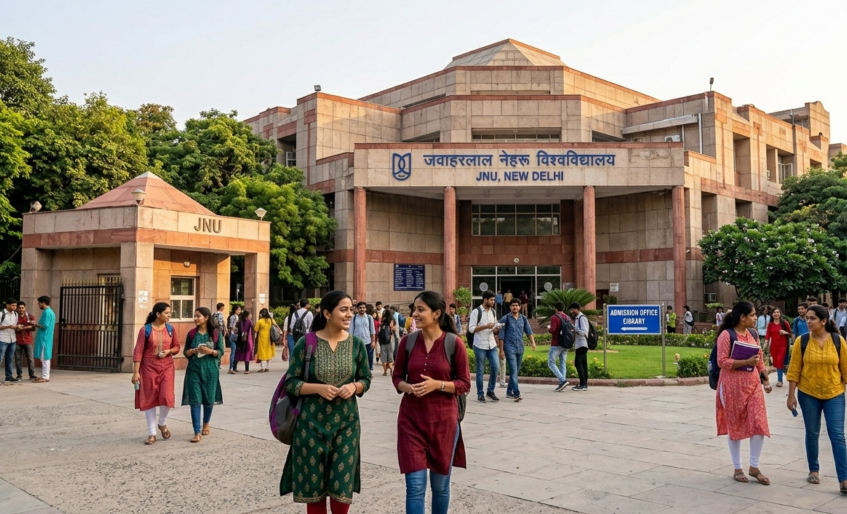
Jawaharlal Nehru University (JNU) :- A Symbol of Intellectual Freedom and Academic Excellence
Detailed History
Jawaharlal Nehru University (JNU) is a premier and globally renowned central university in India, widely celebrated for its academic excellence, cutting-edge research, and vibrant student-led democratic culture. Established in 1969 by an Act of Parliament, the university was named after India’s first Prime Minister, Pandit Jawaharlal Nehru. The core vision behind its foundation was to foster world-class higher education, research, and social justice.
The university is primarily acclaimed across the globe for its postgraduate and research programs, including M.A., M.Phil., and Ph.D. degrees. JNU has nurtured some of the finest minds, including eminent economists, politicians, bureaucrats, and scientists—most notably Nobel Laureate Abhijit Banerjee and India’s current Minister of External Affairs, S. Jaishankar. Its inclusive environment and culture of healthy debate make it stand out among global academic institutions.
Detailed Architecture :-
Spread over a massive, undulating terrain of approximately 1020 acres in the South Delhi region, JNU is located amidst the ancient scrub forests and rocky ridges of the Aravalli hills. Its architectural design beautifully harmonizes modern utility with natural landscapes.
- Exterior Architecture :– The academic and administrative blocks are characterized by their signature red-brick facades, which have become synonymous with JNU’s identity. The towering 9-story B.R. Ambedkar Central Library is the tallest and most imposing structure on campus. The roads and pedestrian pathways curve along the natural rocky topography and dense forests, giving it the feel of a serene nature reserve rather than a conventional campus.
- Interior Architecture :– The interiors feature high-ceilinged, airy lecture halls, state-of-the-art laboratories, and spacious seminar rooms. The residential hostels and public spaces (like Sabarmati, Ganga, and Jhelum dhabas) are designed with a minimalist aesthetic, favoring community interactions, with walls often decorated with thought-provoking student art and socio-political posters.
Travel Guide & Routes :-
If you wish to experience the tranquil, green, and intellectually stimulating campus of JNU, here is everything you need to know.
- Entry Ticket :– There is no admission fee to enter or explore the campus area. (It is completely free, though visitors must present a valid ID card and log their entry details at the main gates for security reasons).
- Visiting Timings :– The ideal time to tour the sprawling campus and its iconic dhabas is between 02:00 PM and 09:00 PM. Academic buildings operate during standard daytime working hours.
- How to Reach :–
- By Metro :– The nearest metro stations are ‘Munirka’ Metro Station (Magenta Line) and ‘Hauz Khas’ Metro Station (Yellow/Magenta Line). Auto-rickshaws are easily available from these stations to the campus gates.
- By Bus :– DTC buses like 615, 621, and 764 drop commuters directly at the North Gate and Baba Gangnath Marg Gate of the university.
- By Auto/Cab :– App-based cabs and local auto-rickshaws can be booked from any part of Delhi directly to the campus premises.
Nearby Attractions :-
- Deer Park & Hauz Khas Village :– A popular destination near the campus that perfectly balances historic monuments, a beautiful lake, and trendy modern cafes.
- Qutub Minar :– Located a short drive away in Mehrauli, this iconic UNESCO World Heritage site is a magnificent marvel of Indo-Islamic architecture.
- Sanjay Van :– A vast, dense urban forest reserve adjoining the JNU campus, serving as a paradise for bird watchers and nature enthusiasts.
- Vasant Kunj Malls :– For shopping, dining, and entertainment, major high-end retail spots like Ambience Mall, DLF Promenade, and DLF Emporio are located nearby.
- Mehrauli Archaeological Park :– A dream destination for history buffs, housing centuries-old tombs, ancient mosques, and stepwells just outside the campus periphery.
Photography Spots, Local Taste, and Famous Markets :-
- Photography Spots :– ‘Parthasarathy Rock’ (PSR), the highest natural point in the campus, offers a breathtaking panoramic view of the Delhi skyline, especially during sunset. The red-brick library building and the rustic forest trails are also highly photogenic.
- Local Taste :– The legendary ‘Ganga Dhaba’ is famous for its hot tea and samosas, while ‘Jhelum Dhaba’ is renowned for its rolls and kebabs. Additionally, various state-themed student tuck shops serve authentic regional delicacies like traditional Kerala snacks.
- Famous Markets :– The adjacent Munirka Market is highly popular for affordable clothing, everyday utilities, and electronics, while the Vasant Kunj area caters to premium shopping tastes.
Interesting Facts :-
- The JNU campus sits on the eco-sensitive Aravalli ridge, where wildlife like nilgai (blue bulls), peacocks, golden jackals, and a rich variety of migratory birds coexist peacefully with the student community.
- ‘Parthasarathy Rock’ (PSR) serves as a natural open-air theater and quiet sanctuary where students gather in the evenings to write, play music, or star-gaze.
- The B.R. Ambedkar Central Library operates on a 24/7 schedule, remaining filled with students reading and researching through the night.
- All residential hostels within the university are uniquely named after major Indian rivers, such as Ganga, Yamuna, Jhelum, Sabarmati, and Mahi.
Important Questions and Answer :-
Question 1:– When was JNU established and what was its core vision?
Answer:- JNU was established in 1969 with the vision of promoting advanced research, higher learning, socio-economic inclusion, and critical independent thinking among students.
Question 2:- What is the most famous student hangout spot inside JNU?
Answer:- ‘Ganga Dhaba‘ and the scenic ‘Parthasarathy Rock‘ (PSR) are arguably the most iconic and beloved hangout spots inside the university campus.
Question 3:- Are general visitors allowed inside the JNU campus?
Answer:- Yes, outside visitors can enter the campus. However, it is mandatory to clear security checks at the gate by showing a valid government-issued photo identity proof and stating the purpose of the visit.
Author’s Thoughts :-
Jawaharlal Nehru University (JNU) is often viewed through a polarized lens in mainstream media, but stepping onto the campus reveals a completely different reality—one rooted in academic rigor, simplicity, and profound intellectual dialogue. The true beauty of JNU lies in its deeply egalitarian spirit, where students from completely diverse socio-economic backgrounds sit over a humble cup of tea to deliberate on world affairs. Cloaked in nature’s quietude, this campus gently coaxes you to look at the world with greater empathy and nuance.
“JNU is not just a place to earn academic degrees; it is a transformative space where youth learns to give a voice to the voiceless.”