
Jharkhand :- झाड़-झंखाड़ों की धरती और प्रकृति का आंचल
Detailed History
Jharkhand, derived from the words ‘Jhar‘ (bushes/forests) and ‘Khand‘ (land), literally translates to ‘The Land of Forests‘. This region is celebrated for its incredibly rich historical and cultural tapestry. Its history dates back to the Stone Age, as evidenced by ancient rock paintings discovered in the caves of Hazaribagh and Garhwa. In ancient texts, this territory was referred to as ‘Pundra’ or ‘Kikata’ Desha, with prominent mentions in the Rigveda, Puranas, and the epic Mahabharata. During the Mauryan era, Emperor Ashoka maintained a strategic hold over the Atavika (forest) tribes and actively propagated Buddhism, traces of which remain scattered across the state, such as in Itkhori (Chatra).
In the medieval period, the region was governed by the Nagvanshi, Chero, and Singh rulers, who fiercely defended their sovereignty against Mughal incursions and later the British East India Company. Under British rule, Jharkhand became a hotbed for tribal revolutions against colonial exploitation and the oppressive Zamindari system. Legendary uprisings like Baba Tilka Manjhi’s revolt (1784), the Santhal Hool led by Sido-Kanhu (1855), and Bhagwan Birsa Munda’s ‘Ulgulan‘ (1899-1900) remain immortalized in Indian history. These powerful movements sowed the seeds of a distinct regional identity. After decades of persistent socio-political movements, Jharkhand was officially carved out of Bihar on November 15, 2000 (marking the birth anniversary of Bhagwan Birsa Munda) as the 28th state of India.
Detailed Architecture
The architectural landscape of Jharkhand reflects a flawless blend of ancient temples, historical tribal forts, and indigenous lifestyle art. The layout heavily emphasizes native resources and eco-friendly structures.
Exterior Architecture :–
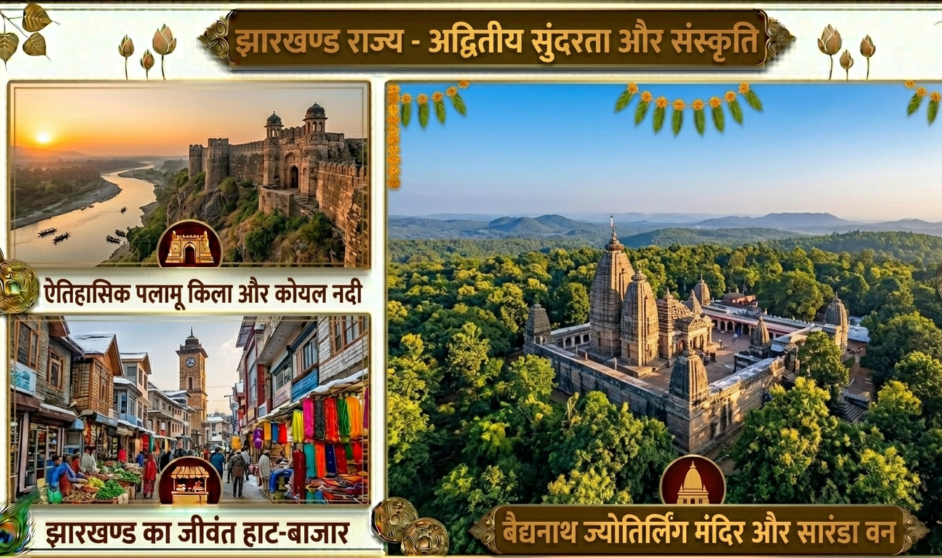
- Chala and Shikhara Style :– Ancient temples, notably the Baba Baidyanath Dham in Deoghar and the terracotta temples of Maluti in Dumka, feature the distinct ‘Bangla Chala’ (curved sloping roofs) combined with high-rising stone-carved spires. The main Baidyanath temple structure is pyramidal, and its spire is uniquely crowned with a gold kalash and a distinctive multi-pointed ‘Panchshula’ (Trident).
- Forts and Palaces :– The Palamu Fort and the Navratnagarh Palace of Doisagarh exhibit grand brick and stone work held together with a traditional mortar mix of limestone, soil, and organic binders. The structures feature massive watchtowers, secret tunnels, and airy balconies for surveillance.
Interior Architecture :–
- The interior Sanctum Sanctorum (Garbhagriha) of the temples is intentionally kept small, square, and dimly lit, placing entire spiritual focus on the naturally occurring stone deities or the sacred Shivling.
- The interiors of tribal mud-houses double up as art galleries featuring ‘Sohrai’ and ‘Khovar‘ paintings. These traditional art forms use natural earth colors to illustrate intricate geometric patterns, wildlife, and native flora on the walls.
Travel Guide & Routes
Tickets and Entry Fees :–
- There is no general entry fee or tourist tax required to enter the state of Jharkhand.
- Most natural and ecological tourist spots, such as the Bhagwan Birsa Biological Park (Ranchi Zoo), Betla National Park, and the Netarhat sunset point, charge a nominal entry ticket ranging between ₹20 and ₹50. Inside Betla National Park, vehicle rentals and mandatory guide fees for jungle safaris are charged separately.
Timings (Visiting, Opening & Closing Times) :–
- Best Time to Visit :– The winter season from October to March is the ideal window to explore Jharkhand, as the weather remains delightfully cool and comfortable. The monsoon months (July to September) unveil magnificent, roaring waterfalls, but outdoor trekking routes can become slippery.
- Sightseeing Windows :– The Baba Baidyanath Temple remains accessible from 04:00 AM to 09:00 PM daily (timings extend during the holy Shravan festival). Most eco-tourism spots, forests, and waterfalls are strictly regulated for safety and remain open from 09:00 AM to 05:00 PM.
How to Reach (Routes) :–
- By Air :– The ‘Birsa Munda Airport‘ in Ranchi is the primary domestic airport, offering seamless daily connectivity to major cities like Delhi, Mumbai, Kolkata, Patna, and Bengaluru. Additionally, commercial flight operations have successfully commenced at Deoghar Airport.
- By Train :– Major railway hubs include Ranchi, Dhanbad, Jamshedpur (Tatanagar), and Jasidih (Deoghar). These stations are very well connected to major Indian cities via high-speed premium trains like Rajdhani, Shatabdi, and Vande Bharat Express.
- By Road :– Jharkhand is integrated with neighboring states like Bihar, West Bengal, Odisha, and Chhattisgarh through well-maintained National Highways (NH-19, NH-20, and NH-33). Daily state-run (JSRTC) and private luxury AC Volvo buses connect major towns regularly.
Photography Spots, Local Cuisine, and Famous Markets
Photography Spots :–
- Hundru and Jonha Falls (Ranchi) :– The sight of water columns cascading down hundreds of feet into deep gorges surrounded by dense forests offers unmatched landscape photography frames.
- Patratu Valley :– Famous for its mesmerizing S-shaped, winding hairpin bends that look exceptionally scenic when captured from high viewpoints or via drone photography.
- Netarhat :– Affectionately called the ‘Queen of Chhotanagpur’, this hill station is acclaimed for its misty sunrise and sunset points that present dramatic panoramic views.
- Dassam Falls :– Captures the raw beauty of the water splitting into ten distinct streams slicing through jagged rock formations.
Local Cuisine :–
- Dhuska and Chilka Roti :– Dhuska is the state’s hallmark breakfast specialty. Made from a grounded batter of rice and chana dal, it is deep-fried to golden perfection and relished with spicy potato-chickpea curry and fresh coriander chutney. Marua (Ragi) Roti, Chilka Roti, Pitha, and sweet ‘Anarsa’ are other regional favorites.
Famous Markets :–
- Upper Bazar (Ranchi) :– The largest commercial wholesale and retail market in the state, celebrated for traditional sarees, textile products, and local handicrafts.
- Bistupur Market (Jamshedpur) :– A beautifully planned market highly popular for authentic Khadi garments, beautiful wooden artifacts, and modern consumer goods.
- Deoghar Local Bazaar :– A bustling market surrounding the Baba Dham temple complex, famous for religious souvenirs, brass utensils, and ‘Peda’ (a legendary milk-based sweet).
Nearby Attractions
- Deoghar (Baba Baidyanath Dham) :– Home to one of the highly revered 12 Jyotirlingas as well as a Shakti Peetha, drawing millions of saffron-clad pilgrims (Kanwariyas) who carry holy water on foot during Shravan.
- Betla National Park & Palamu Forts :– A pristine wildlife reserve in Latehar sheltering tigers, elephants, and deer, situated right next to the historic ruins of the Chero Dynasty forts.
- Parasnath Hills (Shikharji) :– Located in the Giridih district, it is the pinnacle of Jain pilgrimage, where 20 out of the 24 Jain Tirthankaras attained salvation (Nirvana) through deep meditation.
- Jamshedpur (The Steel City) :– India’s first planned industrial city, known for its sprawling Jubilee Park, Dimna Lake, and the nearby Dalma Wildlife Sanctuary.
Interesting Facts
- The Coal Capital of India :– The city of ‘Dhanbad’ in Jharkhand is globally recognized as the Coal Capital of India, housing some of the largest mineral reserves and coal mines in the country.
- Nature Worship & Sarhul :– Tribal communities here place nature above all else. Their largest annual festival, ‘Sarhul’, centers entirely on celebrating and worshiping ‘Sal’ trees and the arrival of the spring season.
- The Cradle of Chhau Dance :– The Seraikela region of Jharkhand is the birthplace of the world-famous ‘Chhau’ mask dance, which is proudly inscribed on UNESCO’s Representative List of the Intangible Cultural Heritage of Humanity.
- Home of MS Dhoni :– The capital city of Ranchi is globally recognized as the hometown of India’s legendary and most successful cricket captain, Mahendra Singh Dhoni.
- The City of Waterfalls :– Ranchi is formally nicknamed the ‘City of Waterfalls’ due to the unusual concentration of beautiful natural waterfalls in its immediate periphery.
Important Questions and Answer :-
Question 1:- Which is the highest waterfall in Jharkhand and where is it located?
Answer:– The highest waterfall in Jharkhand is ‘Lodh Falls’ (also known as Burha Ghagh). It is located on the Burha River in the Latehar district and cascades down from an impressive height of approximately 469 feet.
Question 2:- What is the spiritual significance of the ‘Panchshula’ atop the Baidyanath Temple?
Answer:– Unlike most Shiva temples that feature a regular Trident (Trishul), the Deoghar temple features a ‘Panchshula’ (a combination of five tridents). It is mythologically believed to act as a protective shield, and local lore states that lightning has never struck the dome because of it.
Question 3:- How is Jharkhand’s famous traditional snack ‘Dhuska’ prepared?
Answer:– Dhuska is prepared by soaking and grinding Arva rice and chana dal (sometimes mixed with a little urad dal) into a thick batter overnight. Cumin seeds, asafoetida, and green chilies are added before deep-frying portions until golden brown.
Question 4:- Why is Parasnath Hills referred to as ‘Shikharji’ and what is its religious value?
Answer:– Named after Lord Parshvanath, the 23rd Tirthankara, it is also called ‘Sammed Shikharji’. It holds supreme value for Jains because 20 of their 24 enlightened Tirthankaras performed intense penance and attained ultimate spiritual liberation (Moksha) here.
Question 5:- Which tree is most commonly found in the forests of Jharkhand, and what are its uses?
Answer:– The ‘Sal’ tree (locally known as Sakhua) is the most dominant species. Its exceptionally durable wood is utilized for heavy constructions and railway sleepers, while its leaves are woven together to make traditional eco-friendly plates (Pattal).
Author’s Thoughts
Jharkhand is far too often viewed purely through the lens of heavy industrial mining, smoke-emitting chimneys, and massive steel plants; however, stepping onto its soil reveals that it feels like nature’s very own emerald embrace. The endless canopy of Sal forests, the winding mountain roads of Patratu, and the therapeutic sound of hidden waterfalls offer a meditative escape from the digital rush. The true essence of Jharkhand lies in its deeply hospitable and modest tribal culture, which beautifully demonstrates how humanity can co-exist harmoniously with nature, safeguarding its roots. If you crave an authentic trail away from overcrowded commercial tourist hubs, Jharkhand’s pristine landscapes will leave an indelible mark on your soul.“In every valley of Jharkhand, the unique symphony of nature echoes, and within its soil, the fragrance of ancient heritage remains beautifully alive.”