
Karnataka :- The Confluence of Grand Heritage, Technology & Natural Beauty
Detailed History
The history of Karnataka is exceedingly ancient and glorious, with profound mentions in Indian epics like the Ramayana and the Mahabharata. ‘Kishkindha‘, the mythical monkey kingdom chronicled in the Ramayana, is believed to be located near modern-day Hampi (Vijayanagara). Historically, during the 3rd century BCE, this region was an integral part of the Mauryan Empire. In fact, Emperor Chandragupta Maurya spent his final days performing ascetic penance alongside the Jain saint Bhadrabahu on the hills of Shravanabelagola.
In the medieval era, Karnataka became the cradle for some of the most powerful empires in Indian history, including the Chalukyas of Badami, the Rashtrakutas, the Chalukyas of Kalyani, the Hoysalas, and the Kadamba dynasty. These rulers provided unprecedented patronage to art, literature, and architecture. Following this, the establishment of the Vijayanagar Empire in the 14th century ushered in a golden age of South Indian art and culture, the majestic remnants of which still stand proudly in Hampi. In the later medieval period, the Adil Shahi Sultans of Vijayapura (Bijapur), the Wodeyar dynasty of Mysore, and Tipu Sultan governed various parts of the state. Under British rule, it was recognized as the ‘Princely State of Mysore’. Post-independence, on November 1, 1956, the state was reorganized on a linguistic basis, and in 1973, it was officially renamed ‘Karnataka‘ (derived from Karunadu, meaning the land of black soil or elevated land).
Detailed Architecture
The architecture of Karnataka is globally acclaimed for its unique structural innovations, breathtakingly intricate carvings, and monumental scales. It served as the experimental ground for major Indian architectural styles.
Exterior Architecture :–
- Vesara & Hoysala Style :– The Chalukya and Hoysala kings beautifully blended features of the Nagara (Northern) and Dravidian (Southern) styles into a distinct hybrid known as the ‘Vesara style‘. The Hoysala temples at Belur, Halebidu, and Somnathpura are built on a unique star-shaped elevated platform (Jagati). Constructed out of fine-grained Soapstone (steatite), the exterior walls feature dense, layered carvings depicting elephants, charging horses, mythological episodes, and celestial nymphs (Madanikas).
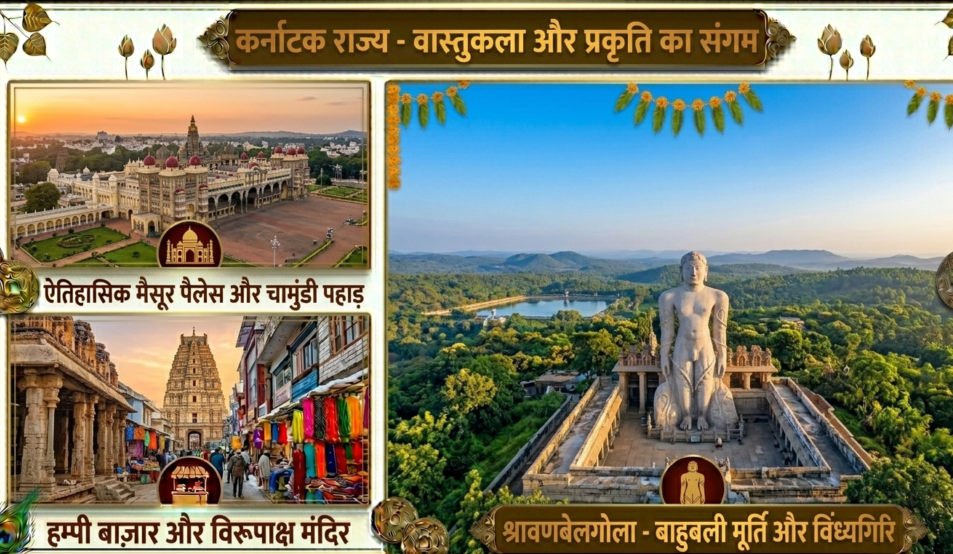
- Dravidian & Vijayanagara Style :– The Virupaksha and Vittala temples in Hampi represent the zenith of late Dravidian architecture. The iconic Stone Chariot and the monolithic Musical Pillars (which resonate with musical notes when tapped) at the Vittala temple complex remain stunning engineering marvels.
- Indo-Islamic Style :– The Gol Gumbaz in Vijayapura exhibits a massive, imposing exterior dome, ranking as one of the largest self-supporting domes in the entire world.
Interior Architecture :–
- The interiors of Hoysala temples feature incredible lathe-turned stone pillars that were mechanically rotated and polished until they achieved a mirror-like obsidian sheen. The ceilings are deeply carved with multi-layered multi-petaled octagonal lotuses.
- The interiors of the Mysore Palace (Amba Vilas Palace) represent colonial-era royal luxury at its finest. The Durbar Hall and Amba Vilas Hall feature multi-colored stained-glass ceilings imported from Europe, Belgian crystal chandeliers, ivory-inlaid rosewood doors, and gold-leaf frescoes.
- The interior of the Gol Gumbaz features the world-famous ‘Whispering Gallery’, where even the softest whisper echoes multi-directionally up to seven times.
Travel Guide & Routes
Tickets and Entry Fees :–
- Entry tickets for UNESCO World Heritage Sites (Hampi and Pattadakal) and major monuments (Mysore Palace, Gol Gumbaz) cost ₹25 to ₹50 for Indian citizens and ₹300 to ₹600 for foreign nationals.
- Wildlife safaris inside Bandipur National Park or Nagarhole National Park range from ₹300 to ₹1,500 depending on the vehicle configuration and choice of safari.
Timings (Visiting, Opening & Closing Times) :–
- Best Time to Visit :– The winter months from October to March are highly recommended due to the exceptionally pleasant weather. Hill stations like Coorg and Chikmagalur display unmatched emerald beauty during the monsoons (July to September).
- Sightseeing Windows :– Monuments in Hampi and Badami remain accessible daily from 06:00 AM to 06:00 PM. Mysore Palace is open from 10:00 AM to 05:30 PM, and it is spectacularly illuminated by nearly 100,000 lightbulbs every Sunday and during festive occasions from 07:00 PM to 07:45 PM.
How to Reach (Routes) :–
- By Air :– The ‘Kempegowda International Airport‘ in Bengaluru is a world-class aviation hub connecting the state globally. Domestic airports also actively operate at Mangaluru, Hubballi, Belagavi, and Mysore.
- By Train :– Bengaluru (SBC/YPR), Mysore, and Hubballi are the primary railway junctions. They are seamlessly connected to all parts of India via high-speed daily premium trains. Karnataka also runs a luxurious heritage tourist train called ‘The Golden Chariot’.
- By Road :– Karnataka features an excellent network of National Highways (NH-48, NH-4, NH-66) linking it directly with Maharashtra, Goa, Kerala, Tamil Nadu, and Andhra Pradesh. KSRTC runs premium multi-axle luxury sleeper buses like ‘Ambari Utsav’ and ‘Club Class’ across major routes.
Photography Spots, Local Cuisine, and Famous Markets
Photography Spots :–
- The Stone Chariot & Hemakuta Hills (Hampi) :– Unbeatable frames during sunset when the golden light bathes the sprawling boulder-strewn ruins.
- Mysore Palace (Night Illumination) :– A breathtaking sight for night photography when the entire palace outline glows brilliantly.
- Coffee Plantations & Abbey Falls (Coorg) :– Perfect for capturing misty valleys, vast green canopies, and hidden forest waterfalls.
- Jog Falls (Shivamogga) :– Captures one of India’s highest untamed plunges dropping majestically during peak monsoons.
- Murdeshwar Temple :– Offers striking frames of the world’s second-tallest Lord Shiva statue seated directly on the edge of the Arabian Sea.
Local Cuisine :–
- Mysore Masala Dosa & Bisi Bele Bhath :– Bengaluru’s iconic ‘Mysore Masala Dosa’ (featuring a signature spicy red chutney layered inside) and ‘Bisi Bele Bhath’ (a hot, comforting blend of rice, lentils, vegetables, and ghee) are globally famous. Other highlights include coastal delicacies like ‘Mangalorean Fish Curry’, ‘Neer Dosa’, ‘Kundapur Chicken’, and legendary sweets like pure ghee ‘Mysore Pak’ and ‘Dharwad Peda’.
Famous Markets :–
- Commercial Street & Chickpet (बेंगलुरु) :– Highly sought-after for authentic silk sarees, traditional textiles, and contemporary fashion accessories.
- Devaraja Market (Mysore) :– A vibrant, historic bazaar famous for premium Mysore Silk sarees, authentic sandalwood oils, aromatic incense sticks (Agarbatti), and heaps of colorful traditional powders.
- Channapatna Toy Market :– Famous for its brightly lacquered traditional wooden toys, which hold an official Geographical Indication (GI Tag).
Nearby Attractions
- Bengaluru (The Silicon Valley) :– The IT capital of India, loved for its expansive green lungs (Lalbagh Botanical Garden, Cubbon Park), the Tudor-style Bangalore Palace, and a booming modern cafe and microbrewery culture.
- Coorg (The Scotland of India) :– A misty hill station famed for sprawling coffee estates, spice plantations, cascading waterfalls, and the Tibetan Golden Temple at Bylakuppe.
- Chikmagalur :– The birthplace of coffee in India. Key sights include the scenic Baba Budangiri hills and Mullayanagiri, which stands as the highest peak in Karnataka.
- Badami, Aihole & Pattadakal :– Famous for rock-cut cave temples and intricately carved stone complexes that served as the cradle of Chalukyan temple architecture.
- Gokarna :– Known for its clean, laid-back, and pristine beaches shaped like spiritual symbols (such as Om Beach), offering a tranquil alternative to crowded beach resorts.
Important Questions and Answer :-
Question 1:- Why is Hampi designated as a UNESCO World Heritage Site and what makes it special?
Answer:– Hampi was the historic capital of the grand Vijayanagara Empire. It houses extensive, monumental ruins of Dravidian temples, markets, and administrative quarters. Its monolithic Stone Chariot and the operational Virupaksha Temple are architectural pinnacles of Indian heritage.
Question 2:– What is the royal history behind the invention of the famous sweet ‘Mysore Pak’?
Answer:– Mysore Pak was accidentally invented in the royal kitchens of Mysore Palace during the reign of Maharaja Krishnaraja Wodeyar. The royal chef, Kakasura Madappa, combined gram flour, ghee, and sugar into a rich syrup that solidified. It was named ‘Mysore Pak’ after the palace’s culinary section (Pakashala).
Question 3:- What makes Jog Falls unique among water cascades in India?
Answer:– Jog Falls, located on the Sharavathi River in Shivamogga, is one of India’s highest untamed, untiered plunges. It drops down nearly 830 feet in four distinct, thunderous cascades creatively named Raja, Rani, Rocket, and Roarer.
Question 4:- What is the historical and spiritual significance of Shravanabelagola?
Answer:– It is one of the most sacred pilgrimage centers for Jainism. It features a spectacular 57-foot monolithic statue of Lord Bahubali (Gommateshwara) carved out of a single granite block atop Vindhyagiri Hill. Every 12 years, millions gather here for the grand ritual bath known as Mahamastakabhishek.
Question 5:- Why is Bengaluru globally called the ‘Silicon Valley of India’?
Answer:– Bengaluru earned this title because it serves as the absolute epicentre of India’s Information Technology (IT) sector, hosting thousands of software enterprises, tech startups, and global R&D research hubs.
Author’s Thoughts
Karnataka is a rare geographical marvel that effortlessly anchors the depth of India’s past with the velocity of its technological future. On one side, the glass facades, bustling startup lanes, and seamless metro networks of Bengaluru reflect a progressive India. On the other side, the weathered, silent boulders of Hampi and the breathtaking carvings of Belur transport you to an era where stone was sculpted like soft poetry. The dramatic mists of the Western Ghats, the crisp aroma of coffee beans wafting through Coorg, and the therapeutic crash of waves on Gokarna’s cliffs ground your soul. Traveling through Karnataka teaches you that true growth lies in sprinting toward the future while holding your heritage and ecology sacredly close. It remains a definitive, unmissable experience for any true traveler.
“Within the ancient stones of Karnataka, the heartbeat of history echoes clearly, while the winds of its coffee valleys carry nature’s ultimate tranquility.”