
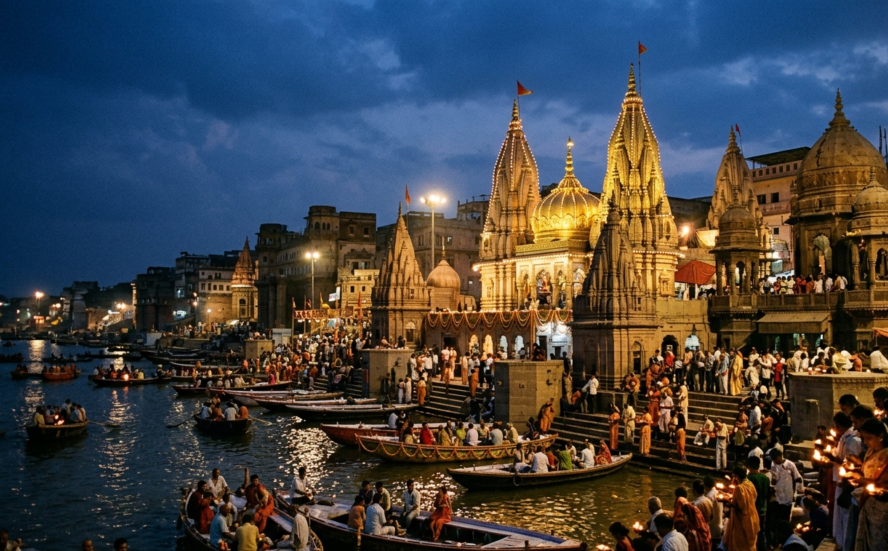
Kashi Vishwanath Temple, Varanasi :- The Symbol of Spirituality, History, and Salvation
Detailed History :-
Situated on the western bank of the sacred river Ganga in the ancient and holy city of Varanasi (Kashi), the Kashi Vishwanath Temple is one of the most revered among the twelve Jyotirlingas. In Hinduism, this temple holds paramount importance; it is believed that a single glimpse (Darshan) of the Jyotirlinga and a holy dip in the Ganges liberates the human soul from the cycle of rebirth, granting Moksha (salvation). The city of Kashi is mythologically believed to be resting on the trident of Lord Shiva. History bears witness that this temple faced multiple brutal onslaughts by foreign invaders. From Qutb-ud-din Aibak in 1194 to the Mughal Emperor Aurangzeb in the 17th century, the structure witnessed series of demolitions. The present majestic temple structure was rebuilt in 1780 by the noble Maratha ruler, Maharani Ahilyabai Holkar of Indore. Later in 1835, Maharaja Ranjit Singh of Punjab generously donated around 1000 kg of pure gold to plate the temple’s iconic spires. Recently, the transformation via the ‘Kashi Vishwanath Corridor‘ project has turned this into a massive, highly accessible complex connecting the temple directly to the Ganga Ghats.
Detailed Architecture :-
The Kashi Vishwanath Temple is a peerless specimen of traditional Indian temple architecture. Inside the primary temple complex sits a small sanctum sanctorum housing the sacred Jyotirlinga, safe-kept within a solid silver alter.
- The Golden Spires :– The temple features three distinct spires. Two of these magnificent spires are wrapped completely in pure gold leaf, earning it the world-famous title, ‘The Golden Temple of Varanasi’.
- The Kashi Vishwanath Corridor :– Spanning over an enormous 5 lakh square feet, the newly engineered corridor replaced congestion with wide, easily navigable spaces. The structures are carved out of premium Chunar sandstone, bordered by deep reliefs, grand entryways, and numerous smaller historic shrines.
- Sabha Mandap and Nandi :– Directly facing the inner sanctum is a wide congregation hall (Sabha Mandap). The outer courtyard features a highly revered, massive stone idol of ‘Nandi‘ (the sacred bull and vehicle of Lord Shiva), keeping an eternal vigil toward the deity.
Travel Guide & Routes :-
- Entry Ticket :– Standard entry and Darshan at the Kashi Vishwanath Temple are entirely Free. For streamlined queueing (Sugam Darshan) or joining legendary Aartis (like Mangala Aarti, Bhog Aarti, or Saptrishi Aarti), paid bookings can be made on the temple’s official online portal.
- Visiting Time :– The temple doors open for devotees every day from 4:00 AM to 11:00 PM. The holy day commences with the pristine Mangala Aarti from 3:00 AM to 4:00 AM, after which general entry is unlocked.
- How to Reach :–
- By Air :– The closest domestic and international terminal is Lal Bahadur Shastri International Airport (VNS) in Babatpur, located roughly 25 km from the temple site. Cabs and prepaid rentals operate continuously from the airport.
- By Rail :– Varanasi Junction (BSB) and Pt. Deen Dayal Upadhyaya Junction (DDU) are central railheads connecting Varanasi to all major states across India. Auto-rickshaws and e-rickshaws are available in abundance from these stations to Godowlia.
- By Road :– Varanasi is systematically linked via an extensive national highway network to major hubs like Lucknow, Prayagraj, Patna, and Delhi. Reliable state-run UPSRTC buses run round-the-clock.
- Local Flavors & Famous Markets :– No trip to Kashi is complete without relishing the traditional morning breakfast of Kachori-Sabzi, crispy Jalebis, rich thick Banarasi Lassi, and the iconic Banarasi Paan. For authentic shopping, explore the chaotic alleys of ‘Godowlia Market‘ and ‘Chowk‘, globally famous for exquisite handwoven Banarasi Silk Sarees, religious brass artifacts, and wooden handicrafts.
- Photography Spots :– Due to extreme security protocols, cameras, smartphones, and any digital accessories are strictly prohibited inside the temple barricades. Nonetheless, you can snap breathtaking panoramic clicks outside at the riverfronts, near Lalita Ghat entrance, or catch the magical view of the evening Ganga Aarti from a boat at Dashashwamedh Ghat.
Nearby Attractions :-
- Dashashwamedh Ghat :– The most vibrant and historic ghat of Varanasi, world-renowned for the daily evening synchronized ‘Maha Ganga Aarti’.
- Manikarnika Ghat :– Adjoining the new corridor, this is Kashi’s core cremation ground, reflecting the profound, eternal reality of life and detachment.
- Kaal Bhairav Temple :– Revered as the ‘Kotwal (Guardian) of Kashi‘. Tradition dictates that a pilgrimage to Varanasi is incomplete without paying respects here.
- Sankat Mochan Hanuman Temple :– Established by the legendary saint Goswami Tulsidas, this temple is heavily visited by devotees seeking spiritual strength.
Interesting Facts :-
- The Gyanvapi Well :– Situated within the temple premises is an ancient well named ‘Gyanvapi‘ (the Well of Knowledge). Historical legends state that when the temple was attacked by Aurangzeb, the main priest jumped into this well along with the original Jyotirlinga to shield it from destruction.
- Ahilyabai’s Vision :– Local folklore tells that Lord Shiva himself appeared in the dreams of Queen Ahilyabai Holkar, prompting her to restore the lost glory of this sacred site.
- Raja Todarmal’s Influence :– In 1585, the brilliant finance minister of Emperor Akbar, Raja Todarmal, had initially rebuilt this great temple with assistance from top scholar Narayan Bhatt, long before it was dismantled again during later reigns.
Important Questions and Answer :-
Question 1:- What is the most ideal season to plan a trip to Kashi Vishwanath?
Answer:– The winter phase from October to March offers highly comfortable weather for exploring. Additionally, experiencing the temple during Mahashivratri or the holy month of Shravan (Sawan) provides an unmatched cultural immersion.
Question 2:– Are there reliable locker spaces near the temple checkpoints?
Answer:– Yes, safe cloakrooms and locker facilities run by the temple trust as well as authorized local vendors are easily accessible at the Godowlia crossing and near the main entrance gates.
Question 3:- How has the Kashi Vishwanath Corridor changed the pilgrimage?
Answer:– The corridor acts as a structural bridge, allowing devotees to take a holy dip in the Ganges at Lalita Ghat and comfortably walk straight up to the temple courtyard for Abhishek without squeezing through hazardous, congested alleys.
Author’s Thoughts :-
Stepping past the threshold of the Kashi Vishwanath Temple feels like walking into an eternal spiritual dimension. The vast layout of the new corridor, combined with the gentle breeze rising from the Ganges and the roaring chants of ‘Har Har Mahadev’, instantly clears the mind of worldly stress. Kashi is not just a destination; it is an emotion. This seamless blend of ancient essence and modern infrastructure brings every seeker closer to their inner roots.
“Kashi is that timeless realm where even death is celebrated as a release, and Shiva remains the absolute reality.”