
Detailed History
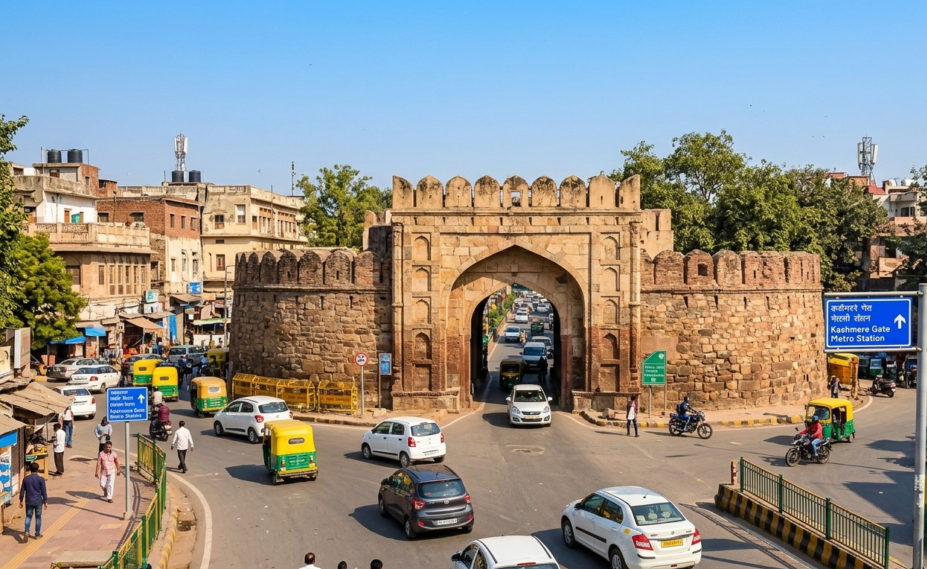
The Kashmiri Gate of Delhi is not merely a locality or a bustling metro station; it is a living monument to one of the most glorious and turbulent chapters in Indian history. It was built in 1638 AD by the Mughal Emperor Shah Jahan as part of the massive fortification to protect his newly established capital city, ‘Shahjahanabad‘ (now known as Old Delhi). A formidable defensive wall made of red sandstone and rubble masonry surrounded the city, featuring 14 massive entry gates. The northern gate of this fortified city was named ‘Kashmiri Gate‘ because the road passing through it led directly towards the state of Kashmir.
The most critical and decisive history of the Kashmiri Gate walls is tied to the First War of Indian Independence in 1857. During the rebellion, Indian freedom fighters (revolutionaries) seized control of Delhi and fortified themselves behind these robust walls of Kashmiri Gate. To recapture Delhi, the British army laid siege to the entire area for nearly four grueling months.
On September 14, 1857, British military engineers used heavy gunpowder to blast open the strong wooden gates and walls of Kashmiri Gate. During this fierce and bloody battle, countless cannonballs were fired at the walls, causing massive structural damage. It was only after breaching the Kashmiri Gate walls that the British troops managed to re-enter and retake Delhi. Even today, the deep craters and scars left by the cannonballs on the walls tell the solemn story of that historic and violent struggle.
Detailed Architecture
Exterior Architecture :-
The Kashmiri Gate and its surrounding defensive walls are a stellar example of Mughal military architecture. The walls were constructed using a sturdy mix of local red sandstone and heavy rubble masonry. Kashmiri Gate itself is a grand, double-arched gateway, featuring two separate passages for entry and exit. The top of the wall is adorned with battlements (crenellations), which were strategically used by soldiers to fire arrows or muskets while remaining sheltered. The walls were extraordinarily thick and wide, allowing multiple soldiers to patrol the ramparts simultaneously. On the exterior facade, the deep impact scars from British artillery shells are still vividly visible—intentionally preserved by the Archaeological Survey of India (ASI) as physical evidence of history.
Interior Architecture :-
The inner side of the fortification walls houses small arched chambers and guard rooms designed to station garrisoned soldiers and store ammunition. Stepping inside the gateway, the towering ceiling and the sheer thickness of the walls evoke the immense structural strength of Mughal engineering. Stone staircases inside the complex lead up to the ramparts, which once provided soldiers a strategic vantage point over the battlefield. Right next to the inner structure, a beautifully manicured lawn and park have been developed, offering visitors a clear view of the wall’s massive scale. The weathered inner stones and the structural scratches from the historic war can be closely observed and felt here.
Travel Guide & Routes
To plan your visit to the historic walls of Kashmiri Gate and witness this monumental heritage site, use the detailed guide below.
- Ticket and Entry Fee :– There is no entry fee or ticket required to visit Kashmiri Gate and its walls. Entry is completely Free for all national and international tourists.
- Visiting Time :– It is an open historical monument accessible from 06:00 AM to 06:00 PM (Sunrise to Sunset).
- Opening and Closing Days :– The monument remains open on all 7 days of the week.
- How to Reach :–
- By Metro :– The most convenient way to reach the site is via the Delhi Metro. The ‘Kashmiri Gate’ Metro Station is a massive interchange terminal connecting the Red, Yellow, and Violet lines. Exiting from Gate No. 1 or Gate No. 7, the historic walls are just a brief 2-minute walk away.
- By Bus :– The Inter-State Bus Terminus (ISBT Kashmiri Gate), one of Delhi’s largest bus hubs, is located right next to the site. Buses from all parts of Delhi and neighboring states terminate here.
- By Auto/E-Rickshaw :– You can easily hire an e-rickshaw or an auto-rickshaw from Old Delhi Railway Station or Chandni Chowk, reaching the walls in less than 5 to 10 minutes.
Photography Spots, Local Food, and Famous Markets
Photography Spots
- Cannon Ball Craters :– Capturing a close-up shot of the deep craters blasted into the exterior red sandstone wall by 1857 artillery shells is a must for history buffs.
- The Double Arched Gateway :– Framing a vintage perspective looking straight through the twin arches of the Kashmiri Gate provides a beautifully symmetric historical shot.
- The Ramparts & Gardens :– Photographing the sheer height and grandeur of the defensive walls from the lush green lawns below creates a magnificent contrast.
Local Food :-
The vicinity of Kashmiri Gate offers a delicious taste of traditional Old Delhi street food.
- Kashmiri Gate Chole Bhature :– The piping hot, spicy Chole Bhature sold near the metro station and ISBT premises are immensely popular among commuters and travelers.
- Amritsari Kulcha :– Several small local food outlets nearby serve crisp, butter-laden authentic Amritsari Kulchas packed with flavor.
- Bedmi Puri & Kachori :– For a traditional morning breakfast, enjoy the crisp Bedmi Puris served with spicy potato gravy and a hot cup of Kulhad Chai at local stalls.
Famous Markets Nearby :-
- Lothian Road Market :– Situated directly opposite the monument, this market is North India’s premier commercial hub for automobile spare parts and components.
- Chandni Chowk & Khari Baoli :– Located just 1.5 km away, this is Asia’s largest historic wholesale market for garments, wedding trousseau, and exotic spices.
- Lajpat Rai Market :– A massive, old electronic goods market situated a short distance away from the gate.
Interesting Facts :-
- Turning Point of 1857 Revolt :– The blasting of the Kashmiri Gate wall with gunpowder by British engineers is regarded as the most decisive and critical event in the Siege of Delhi during the 1857 uprising.
- The Gateway to Kashmir :– During the Mughal era, this northern gate of Shahjahanabad marked the starting point of the royal highway that led straight to Kashmir, hence earning its name.
- Physical Scars of War :– Kashmiri Gate is one of the very few monuments in India that still displays raw, unaltered physical damage from cannon fire dating back to the First War of Independence.
- Connection to Mutiny Memorial :– To commemorate the British officers and soldiers who lost their lives attacking these very walls, the Mutiny Memorial (Ajitgarh) was later built on the nearby Delhi Ridge.
Important Questions and Answer :-
Question 1:– Who built the walls of Kashmiri Gate and when?
Answer:- The walls and the gateway were built by the Mughal Emperor Shah Jahan in 1638 AD to safeguard his new imperial capital city, Shahjahanabad.
Question 2:– What caused the deep craters and marks on the walls of Kashmiri Gate?
Answer:- Those deep marks were caused by heavy cannonballs fired by the British artillery against the Indian revolutionaries during the historic Siege of Delhi in 1847.
Question 3:– Is there an entry ticket to explore the Kashmiri Gate walls?
Answer:- No, the monument is an open historical site and entry is absolutely free for all visitors.
Question 4:- Which is the closest metro station to visit the historic walls?
Answer:- The closest station is the ‘Kashmiri Gate‘ Metro Station, which serves as a major intersection for the Red, Yellow, and Violet lines.
Question 5:– Why was this specific gate named ‘Kashmiri Gate’?
Answer:- During the Mughal period, the road passing out of this northern gate of the fortified city ran directly towards Kashmir, which is why it was named Kashmiri Gate.
“The historic walls of Kashmiri Gate are not just a structure of stone and mortar, but an eternal canvas painted with the gunpowder of 1857 and the immortal bravery of Indian revolutionaries.”