
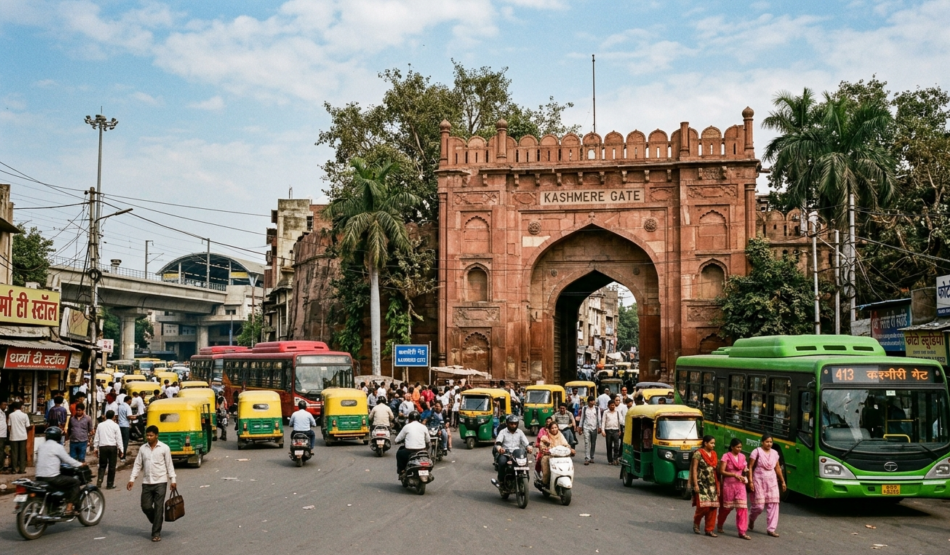
Kashmiri Gate, Delhi :- The Battle-Scarred Monument of the Mughal and Colonial Epochs
Detailed History
Kashmiri Gate, positioned along the western banks of the Yamuna River in Northern Delhi, functions today as an incredibly high-density commercial district and metropolitan transit hub. However, its historical legacy runs far deeper; this grand portal is the silent, battle-scarred sentinel that witnessed the dramatic collapse of the Mughal Empire and the bloodiest turning point of the First War of Indian Independence in 1857.
The imperial foundation of this monumental gateway dates back to the year 1638, commissioned under the royal patronage of the Mughal Emperor Shah Jahan during the systematic layout of his new imperial capital, ‘Shahjahanabad‘ (modern-day Old Delhi). To secure the city against foreign incursions, a massive, semi-circular defensive wall constructed of local stone ashlar was raised, punctured by 14 monumental entry points. This specific portal was officially named ‘Kashmiri Gate’ because it sat at the apex of the primary imperial highway heading directly north towards the province of Kashmir, serving as the exclusive exit route utilized by the Mughal emperors and royal caravans embarking on northern excursions.
The most critical and devastating chapter in the lifecycle of Kashmiri Gate unfolded in September 1857. During the peak of the Indian Uprising, Indian sepoys and revolutionary freedom fighters had successfully seized control of Delhi, establishing Kashmiri Gate as their primary northern bastion of resistance. To breach the city’s inner perimeter, British military engineers executed a high-risk, desperate charge under heavy musket fire, planting massive gunpowder kegs directly against the heavy wooden doors of the gate. The resulting explosion ripped open the gateway, allowing British troops to storm Shahjahanabad. This brutal encounter effectively marked the permanent de facto termination of Mughal sovereignty in India, transitioning direct administrative governance to the British Crown.
Detailed Architecture :-
The architectural profile of Kashmiri Gate presents a rare and unique amalgamation of classical mid-17th-century Mughal structural engineering and subsequent 19th-century colonial military reinforcements.
- The Rare Double-Bay Configuration :– Unlike its surviving sister portals like Delhi Gate or Ajmeri Gate, which feature a single central thoroughfare, Kashmiri Gate is remarkably engineered as a Double-Bay Gateway. It possesses two parallel, sweeping arched entry paths side-by-side, which significantly enhanced traffic management for imperial cavalries and public caravans.
- Heavy Quartzite and Sandstone Masonry :– The structure was raised using durable local grey quartzite stones and finished with thick veneers of red and yellow sandstone. The upper ramparts were originally topped with classic pointed battlements and specialized loop-holes engineered to allow royal musketeers to fire safely upon approaching adversaries.
- The Historic Cannonball Scars :– For the modern observer, the most compelling aspect of Kashmiri Gate’s architecture is its deep, unhealed surface trauma. The exterior facade is heavily indented with massive craters, fractures, and deep depressions. Far from ordinary structural wear, these are the authentic cannonball impact scars sustained during the intense British artillery bombardment of 1857. The Archaeological Survey of India (ASI) has intentionally preserved these craters to serve as permanent physical testaments to the conflict.
- Photography Spots :– For documentary filmmakers, military historians, and street photographers, Kashmiri Gate offers an exceptional conceptual frame. Positioning a lens to capture the rhythmic visual alignment of the double-arched bays framing the constant movement of modern cycle-rickshaws and urban commuters creates a powerful juxtaposition of classical history and modern life. The raw texture of the fractured sandstone walls against the surrounding green lawns provides magnificent high-contrast lighting variables for fine-art monochrome photography.
Travel Guide & Routes :-
- Ticket :– Because Kashmiri Gate stands integrated into the public urban landscape of Northern Delhi, there is absolutely no entry fee or ticket fee mandated to view or study the monument. Open-air architectural photography is completely free.
- Visiting Time :– The monument site remains accessible to the public at all hours. However, the most optimal window for an undisturbed tour and high-clarity photography is between 07:00 AM and 10:00 AM, before peak commercial traffic congests the surrounding roads.
- How to Reach :–
- By Metro :– The absolute most efficient transit gateway is the Kashmiri Gate Metro Station, which functions as Delhi Metro’s largest and most expansive multi-level interchange hub linking the Red Line, Yellow Line, and Violet Line. Exiting via Gate 1 or Gate 2 places visitors a mere 200-meter walk away from the historical monument.
- By Bus :– The adjacent Kashmiri Gate Interstate Bus Terminus (ISBT) is the oldest mega-bus terminal in Delhi, managing round-the-clock express fleets originating from Punjab, Haryana, Himachal Pradesh, Rajasthan, Jammu & Kashmir, and Uttarakhand. Local city buses from all quadrants terminate here.
- By Rail :– The Old Delhi Railway Station (DLI) is situated roughly 1 kilometer from the gate compound, easily covered via a brief pedestrian walk or local e-rickshaw transit.
- By Road :– The monument sits in direct proximity to the main Ring Road and the Grand Trunk Karnal Road artery. (Crucial Note: Due to the high commercial density and persistent traffic congestion of this historic automobile market zone, driving a private four-wheeled vehicle directly to the monument is highly discouraged; utilizing the metro system is highly recommended to save transit time).
- Nearby Attractions :– St. James’ Church (Delhi’s oldest operational colonial church, located within walking distance), the historic Remains of the British Magazine, Dara Shikoh’s Ancient Library Complex, the historic Lothian Road Cemetery, and the bustling Chandni Chowk district.
- Local Flavors & Famous Markets :– The peripheral culinary lanes of Kashmiri Gate host highly historic eateries deeply celebrated for traditional North Indian street food, specifically spiced chole-bhature, crispy Bedmi Poori with aloo sabzi, and thick, sweet Punjabi lassi. For specialized commercial retail, the immediate area operates as India’s largest wholesale hub for automotive parts and components. Additionally, the famous book market of Nai Sarak and the consumer electronic clusters of Lajpat Rai Market are located a short distance away.
Interesting Facts :-
- Kashmiri Gate stands as the exclusive surviving imperial gateway of Shahjahanabad that preserves the raw, unedited structural scars of heavy artillery fire from the historic uprising of 1857.
- The nearby St. James’ Church, commissioned by the legendary Anglo-Indian military commander Colonel James Skinner, was extensively targeted by revolutionary sepoy artillery during the 1857 siege due to its status as a premier architectural symbol of British administrative presence in the capital.
- During the late 19th century, the immediate neighborhood surrounding Kashmiri Gate operated as Delhi’s premier ‘European Quarter,’ hosting the capital’s first luxury retail outlets, high-end colonial banks, and elite British residential mansions.
Important Questions and Answer :-
Question 1:– Why did Emperor Shah Jahan specifically choose the name ‘Kashmiri Gate’ for this structure?
Answer:- The gateway was named strictly after its primary geographic orientation. It anchored the start of the northern grand trunk route that connected the royal palace of Shahjahanabad directly to the valley of Kashmir, the preferred summer retreat of the Mughal court.
Question 2:– Are visitors allowed to climb to the top of the Kashmiri Gate ramparts?
Answer:- To ensure structural conservation and public safety, the internal staircases leading to the upper gun battlements are currently restricted by the ASI, but the entire double-arched base and the extensive surrounding fortified walls are fully accessible for up-close inspection.
Question 3:– What makes the architecture of Kashmiri Gate unique compared to Lahori Gate or Ajmeri Gate?
Answer:- While most surviving gates of Old Delhi feature a singular entryway, Kashmiri Gate was uniquely engineered with a grand double-arched facade, making it a rare and distinct example of multi-lane entry systems in medieval military planning.
Author’s Thoughts :-
Gazing up at the massive double arches of Kashmiri Gate while running your fingers across the deep craters left by 1857 colonial cannon fire is a humbling experience. It is a striking visual paradox: on one side, you have the hyper-accelerated modern energy of Delhi’s busiest metro interchange, and on the other, this solemn, quiet stone giant that marks the graveyard of the Mughal Empire and the birth of India’s freedom struggle. Kashmiri Gate demands that we stop and look past the surrounding traffic to read the raw, unfiltered history written on its walls. For any traveler who truly wishes to understand how the lavish capital of Shahjahan changed hands and shaped modern India, a thoughtful morning walk around this battle-scarred icon is absolutely non-negotiable.
“Imprinted with the grand imperial visions of Shah Jahan and scarred by the revolutionary fires of 1857, Kashmiri Gate remains an unyielding stone chronicle of the dramatic rise and fall of empires in Delhi.”