
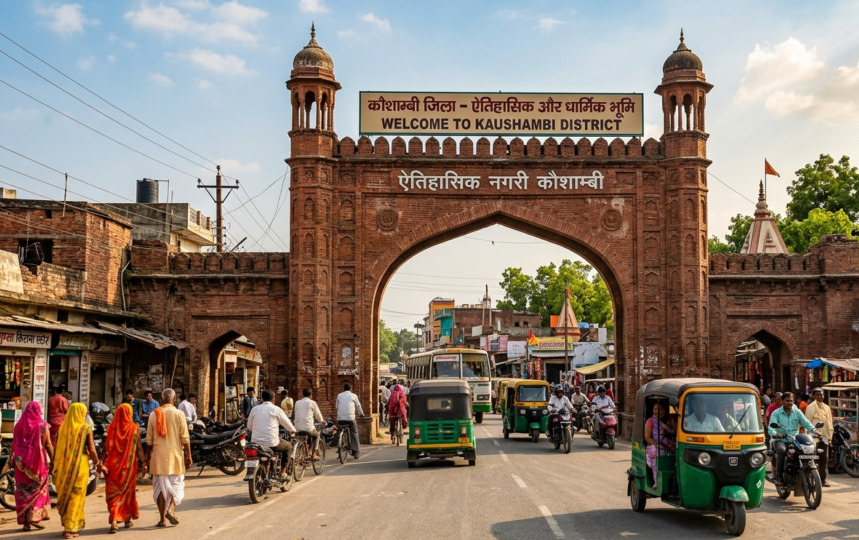
Kaushambi District :- An Ancient Confluence of Buddhist and Jain Culture
Detailed History
Situated on the banks of the Yamuna in south-western Uttar Pradesh, Kaushambi is historically and religiously profound. Formed on April 4, 1997, after separating from Allahabad, it was the capital of the ‘Vatsa‘ Mahajanapada in ancient times under King Udayana. It is a sacred pilgrimage for both Buddhists and Jains. Lord Buddha visited here several times to preach, and it is the birthplace of the 6th Jain Tirthankara, Lord Padmaprabhu. The Ashoka Pillar located here is a testament to its Mauryan legacy.
Detailed Architecture
Exterior Description :–
The exterior of Kaushambi is a blend of ancient ruins and religious serenity. The use of Mauryan-era bricks is prominent. The fortification walls of ancient Kaushambi stretch over 6 km, appearing as high earthen and brick slopes. The riverfront of Yamuna adds to its spiritual and historical grandeur.
Interior Description :–
The interiors of sites like Ghositarama Monastery exhibit advanced ancient planning, with residential cells and prayer halls for monks. The Lord Padmaprabhu Jain Temple features modern marble interiors. Local houses and old havelis maintain traditional courtyards, reflecting the vernacular art of the region.
Nearby Attractions
- Kaushambi Fort Ruins :– Remnants of King Udayana’s palace and city fortifications.
- Ghositarama Monastery :– A primary center during Lord Buddha’s time.
- Ashoka Pillar :– A symbol of Mauryan architectural excellence.
- Prabhasgiri (Pabhosa) :– A holy hill for Jains offering scenic views of the Yamuna.
- Sheetla Mata Temple (Kara) :– A historic Shaktipeeth and spiritual site.
- Lord Padmaprabhu Jain Temple :– Dedicated to the 6th Tirthankara, known for its tranquility.
Travel Guide & Routes
- How to Reach :–
- By Rail :– Nearest major station is Prayagraj (50-60 km). Local station Bharwari is closer.
- By Road :– Well-connected to Prayagraj and Kanpur via road.
- By Air :– Nearest airports are Prayagraj (Bamrauli) and Varanasi.
- Tickets & Timings :– ASI sites require a nominal entry fee. Timings: 8:00 AM to 5:00 PM. Temples are free.
- Photography Spots :– Views from Prabhasgiri hill, Ashoka Pillar, and the monastery ruins.
- Local Taste :– Famous for local village-style ‘Pickles’ and traditional ‘Chaat’.
- Famous Markets :– ‘Manjhanpur Bazaar‘ and ‘Bharwari Bazaar‘ for local pottery and handicrafts.
Interesting Facts
- Lord Buddha spent his 6th and 9th years after enlightenment in Kaushambi.
- Excavations have revealed ‘Painted Grey Ware‘ (PGW) culture dating back thousands of years.
- Famous traveler Xuanzang described Kaushambi’s grandeur in his travelogues.
Important Questions and Answer :-
Question 1:– Kaushambi was the capital of which ancient kingdom?
Answer:- It was the capital of the ‘Vatsa’ Mahajanapada.
Question 2:– When was Kaushambi district formed?
Answer:- It was established on April 4, 1997.
Question 3:– Which Jain Tirthankara is associated with Kaushambi?
Answer:- The 6th Tirthankara, Lord Padmaprabhu.
Question 4:– On which river bank is Kaushambi situated?
Answer:- It is located on the northern banks of the Yamuna River.
Question 5: What is the significance of Prabhasgiri?
Answer:- It is a sacred Jain site where Lord Padmaprabhu is believed to have meditated.
Author’s Thoughts
Kaushambi is more than a district; it is a living museum of Indian history. The peace in its air and the glory in its ruins offer a unique experience of spiritual and intellectual growth. In my view, for any history enthusiast, Kaushambi is a must-visit destination.
“Kaushambi, nestled between the ruins of history and the ripples of Yamuna, tells an eternal tale of peace and wisdom.”