
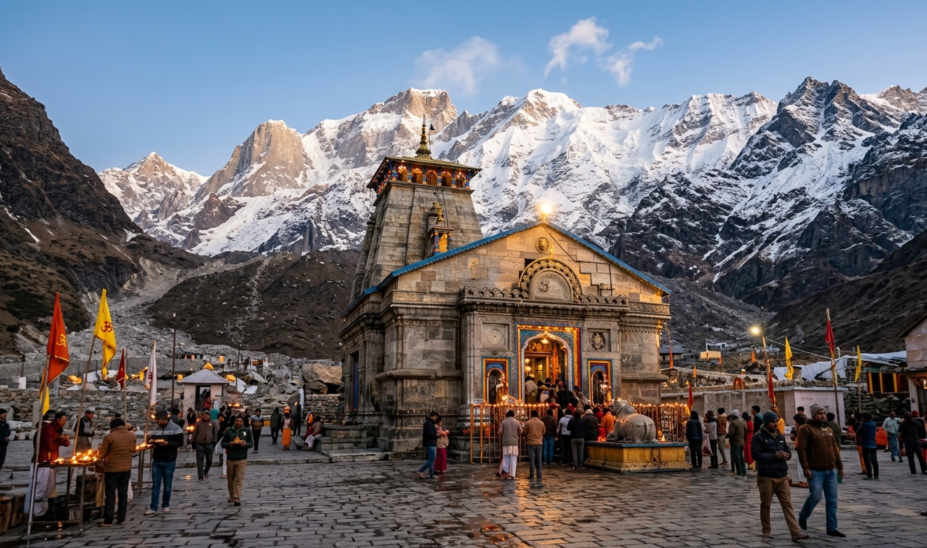
Kedarnath Temple :- The Gateway to Salvation in the Himalayas
Detailed History
Situated at 3,583 meters above sea level, Kedarnath Temple is the most prominent of the 12 Jyotirlingas and a vital part of the ‘Chota Char Dham‘ pilgrimage. According to mythology, the temple was built by the Pandavas to seek penance from Lord Shiva after the Mahabharata war. It was later revived by Adi Shankaracharya in the 8th century. Located on the banks of the Mandakini River, the temple remains open for devotees for only 6 months a year (May to November).
Detailed Architecture
- Exterior :– Built in the ‘Katyuri style‘, the temple uses massive, grey stone slabs. A grand statue of ‘Nandi‘, the bull, stands guard at the entrance. The roof is designed with large stone slates to withstand the heavy Himalayan snowfall.
- Interior :– The sanctum sanctorum houses a natural rock formation in a triangular shape, worshipped as Lord Shiva’s hump. The inner walls are decorated with carvings of various Hindu deities and mythological scenes.
Travel Guide & Routes
- Entry Ticket :– Entry is Free, but ‘Char Dham Registration‘ is mandatory.
- Timings :– Open from 4:00 AM to 9:00 PM (Closed for rest between 3:00 PM and 5:00 PM).
- How to Reach :–
- By Air :– Jolly Grant Airport (Dehradun) is the nearest airport. Helicopter services are available from Guptkashi, Phata, and Sersi.
- By Rail :– The nearest railway stations are Rishikesh and Yog Nagari Rishikesh.
- By Road & Trek :– From Rishikesh, travel to Sonprayag/Gaurikund by bus/taxi. From Gaurikund, there is a 16-18 km steep trek to the temple, which can be covered on foot, by ponies, or palanquins.
- Photography Spots :– The ‘Bheem Shila‘ behind the temple and the panoramic views of the snow-clad peaks. (Photography is prohibited inside the sanctum).
- Local Taste & Markets :– Basic Garhwali food is available. Shop for local wooden artifacts at Gaurikund Market.
Nearby Attractions
- Bhairav Nath Temple :– Located a short walk away, Bhairav Baba is considered the protector of the valley.
- Vasuki Tal :– A high-altitude lake 8 km away, popular with trekkers.
- Shankaracharya Samadhi :– The memorial of Adi Shankaracharya located right behind the main temple.
- Triyuginarayan Temple :– The legendary site of Lord Shiva and Parvati’s wedding, a short drive from Sonprayag.
Interesting Facts
- During the 2013 floods, a massive rock (Bheem Shila) miraculously diverted the water, protecting the temple from destruction.
- During winters, the deity is moved to Ukhimath for worship as Kedarnath becomes inaccessible due to snow.
- The temple is built using ancient interlocking techniques without mortar.
Important Questions and Answer :-
Question 1:- When is the best time to visit Kedarnath?
Answer:- May to June and September to October provide the most stable weather.
Question 2:- Are there medical facilities available?
Answer:- Yes, basic medical camps are set up along the trekking route and near the temple.
Author’s Thoughts :-
A journey to Kedarnath is a life-changing experience. The challenging trek tests your physical endurance, but the first sight of the temple against the backdrop of the Himalayas fills the heart with immense gratitude and peace. It is where nature’s raw power meets divine serenity.
“Kedarnath is that sacred land where devotion for Mahadev touches the heights of the Himalayas, granting ultimate peace to the soul.“