
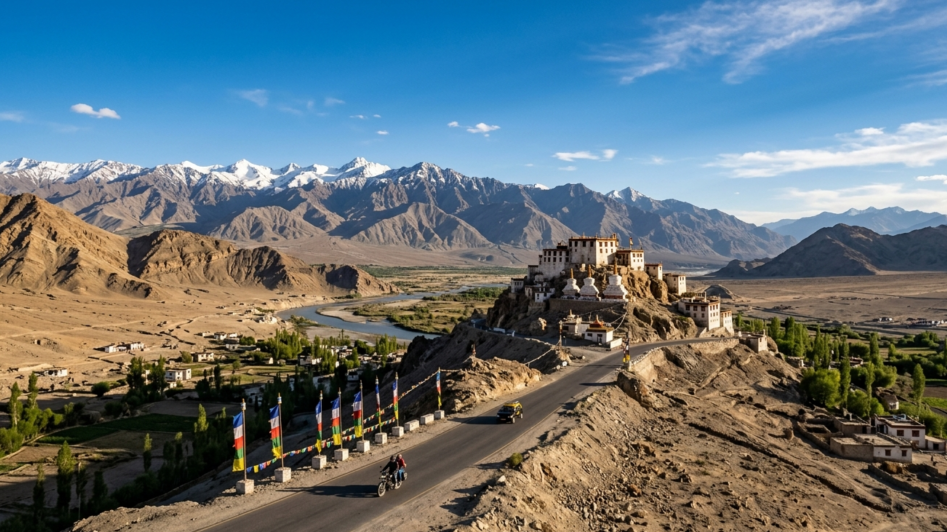
Ladakh :- The Land of High Passes and the Magic of the Cold Desert
Ladakh is a Union Territory of India known for its ethereal beauty, towering mountains, deep valleys, and serene Buddhist monasteries. Often referred to as ‘Little Tibet‘, its culture and landscape are truly mesmerizing.
Detailed History
Ladakh has an ancient history and was a vital part of the Silk Route. For centuries, it was an independent kingdom ruled by the Namgyal dynasty. In 1834, it was annexed by the Dogra ruler Gulab Singh. Post-independence, it remained part of Jammu and Kashmir until October 31, 2019, when it was established as a separate Union Territory.
Detailed Architecture
The architecture of Ladakh is shaped by its harsh climate and Buddhist heritage.
- Monasteries (Gompas) :– Built on hilltops, monasteries like Thiksey and Hemis use stone, wood, and mud, featuring vibrant Thangka paintings and carvings.
- Leh Palace :– A 17th-century palace showcasing Tibetan architecture. It has nine storeys and resembles the Potala Palace in Lhasa.
- Mud Houses :– Traditional homes have thick mud walls to provide natural insulation against the biting cold.
Top Attractions and Points of Interest
- Pangong Lake :– The world’s highest saltwater lake, famous for changing its color from turquoise blue to light green and brown.
- Nubra Valley :– Home to the cold desert of Hunder, where you can ride the rare double-humped Bactrian camels.
- Magnetic Hill :– A place where gravity seems to defy itself, as vehicles appear to roll uphill on their own.
- Shanti Stupa :– A white-domed stupa symbolizing peace, offering a panoramic view of the entire Leh town.
- Khardung La Pass :– One of the world’s highest motorable roads, offering a thrilling experience for bikers.
Travel Guide & Routes
- How to Reach :–
- By Air :– Kushok Bakula Rimpoche Airport in Leh is well-connected to Delhi and major cities.
- By Road :– Accessible via the Manali-Leh Highway or the Srinagar-Leh Highway, which are legendary routes for adventure seekers.
- Tickets & Timings :– Entry to most monasteries is between ₹20 to ₹50. Inner Line Permits (ILP) are mandatory for certain areas. Timings: 8:00 AM to 6:00 PM.
- Local Taste :– Must try ‘Thukpa‘ (noodle soup), ‘Momos‘, and the traditional ‘Butter Tea’ (Gur-Gur Chai).
- Famous Market :– Leh Main Market for Pashmina shawls, silver jewelry, and Tibetan handicrafts.
- Photography Spots :– The crystal blue waters of Pangong, Thiksey Monastery stairs, and the sand dunes of Nubra.
Interesting Facts
- Ladakh houses the world’s highest battlefield, the ‘Siachen Glacier‘.
- Hemis National Park is home to the elusive ‘Snow Leopards‘.
- Due to minimal rainfall, Ladakh is technically a ‘Cold Desert‘.
Important Questions and Answer :-
Question 1:- What is the best time to visit Ladakh?
Answer:- June to September is the ideal time when the roads are clear and the weather is pleasant.
Question 2:- Is there an oxygen problem in Ladakh?
Answer:- Yes, due to high altitude, oxygen levels are lower. Travelers are advised to rest for 24-48 hours upon arrival for acclimatization.
Question 3:- What is the capital of Ladakh?
Answer:- Ladakh has two capitals – Leh and Kargil.
Question 4:- What is the secret of Magnetic Hill?
Answer:- It is an optical illusion where the layout of the surrounding land makes a slight downhill slope appear to be an uphill slope.
Question 5:- How much of Pangong Lake is in India?
Answer:- About one-third of the lake lies in India, while the remaining two-thirds are in China (Tibet).
Author’s Thoughts :-
Ladakh is not just a destination; it is a journey of self-discovery. The silence of the valleys and the vastness of the mountains take you to a world far away from your daily worries.
“Where the sky meets the earth and peace dwells in the wind, that is Ladakh.”