
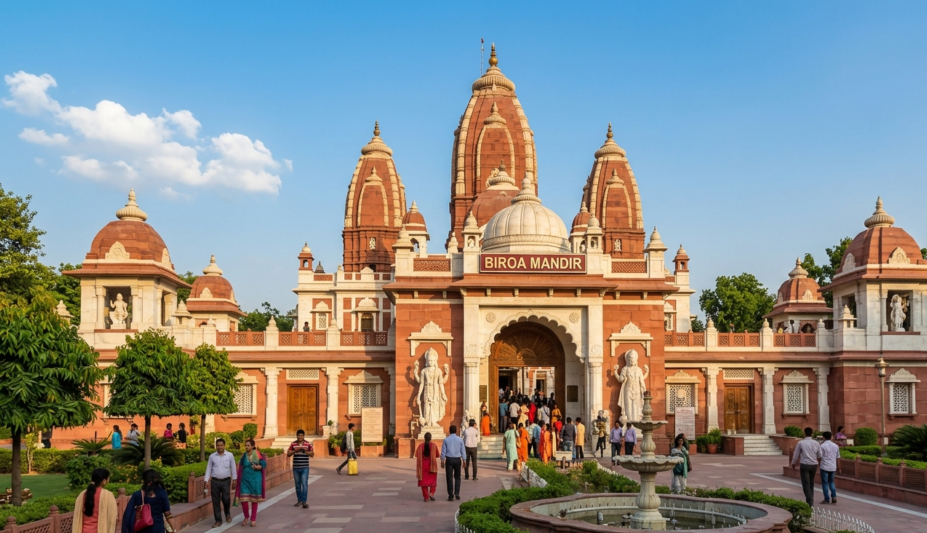
Laxminarayan Temple (Birla Mandir) Delhi :- The Pinnacle of Modern Architecture, Social Equality, and Divine Devotion
Nestled peacefully just west of the hyper-commercial transit ring of Connaught Place on Mandir Marg, the ‘Laxminarayan Temple’—ubiquitously celebrated by locals and global backpackers as the ‘Birla Mandir’—stands as one of New Delhi’s most illustrious, grand, and historically significant spiritual sanctuaries. Dedicated to Lord Vishnu (the Preserver) and his divine consort Goddess Lakshmi (the Deity of Prosperity), this sprawling red-sandstone and marble fortress is not merely an architectural wonder; it represents a monumental shift in modern India’s socio-political history. Commissioned during the British Raj, its towering spires, intricate stone carvings, and serene landscape offer a captivating window into the nation’s cultural renaissance. In this comprehensive blog, we will journey through its glorious history, unique structural elements, and complete visitor map.
Detailed History
The historical chronicle of Delhi’s Birla Mandir is deeply intertwined with the rise of industrial philanthropy in India and the profound social philosophies of Mahatma Gandhi.
- Genesis and Founders :– The conceptualization and funding of this massive sanctuary were driven by the legendary industrialist-philanthropist Baldeo Das Birla and his visionary son, Jugal Kishore Birla. The structural layout began its initial ground-breaking in 1933 and was completed meticulously over six years, culminating in its grand opening in 1939.
- The Historic Inauguration by Mahatma Gandhi :– The defining chapter of this temple’s history lies in its consecration. In 1939, when the Birla family invited Mahatma Gandhi to officially inaugurate the temple, the Father of the Nation placed a revolutionary, non-negotiable condition: ‘I will only inaugurate this temple if its gates are thrown open to every human being without any discrimination of caste, creed, or social class, specifically allowing the untouchables and Dalits equal rights to worship.’ The Birlas readily institutionalized this rule, and Gandhi Ji personally opened the complex to the world, making it the first major modern temple in India to legally ban caste discrimination at birth.
Detailed Architecture :-
The structural blueprint of the Birla Mandir is a magnificent celebration of the classic North Indian Nagara Style of temple architecture, subtly integrated with modern space layouts. It was engineered under the careful supervision of the renowned swadeshi architect Srischandra Chatterjee, who sought to revive traditional Indian craftsmanship using indigenous materials.
- Exterior Architecture :–
- The Spires (Shikharas) :– The central monumental spire towers precisely to a height of about 160 feet, cutting an imposing silhouette against the sky. Flanking it are two smaller regional spires, creating a highly balanced, symmetric multi-tiered structural mountain.
- Material Harmony :– The entire outer shell is heavily clad in premium red sandstones sourced from Kota, beautifully interspersed with pristine white marble tiles from Makrana, Rajasthan. This color palette absorbs the changing rays of the sun, reflecting an ethereal crimson-and-gold glow at dusk.
- Mythological Reliefs :– The external walls and columns are deeply incised with detailed stone-relief carvings executed by master artisans from Jaipur. These sculptures depict timeless scenes from the Vedas, the Upanishads, the Ramayana, and the Mahabharata.
- Interior Architecture :–
- The Holy Sanctum Sanctorum (Garbhagriha) :– The main altar is a vision of spiritual opulence, housing the flawlessly sculpted white marble idols of Lord Laxminarayan. The smooth, lifelike finish of the deities reflects the zenith of Rajasthani stone craft.
- The Pantheon of Sub-Shrines :– Radiating from the central hall are specialized individual shrines dedicated to Lord Shiva, Goddess Durga, Lord Ganesha, Hanuman Ji, and a peaceful dedicated chamber for Lord Buddha, showcasing India’s cultural inclusivity.
- The Mythological Back Garden :– Sprawling at the rear of the monument is a massive, three-tiered artificial rock-and-water garden. It features cascading waterfalls, walking paths, a dedicated children’s artificial cave structure, and large concrete models of epic scenes, including a massive multi-headed Sheshnag and the battle-chariot of Arjuna.
Travel Guide & Routes :-
For heritage travelers, families, and solo explorers organizing a trip to this iconic central Delhi landmark, the complete practical sequence is organized below.
- Ticket :– Entry into the entire Birla Mandir complex, including the rear mythological gardens, is completely Free of charge. No dynamic pricing passes or electronic booking tickets are required.
- Visiting Time :– The temple operates daily in two distinct shifts to allow for midday rituals:
- 04:30 AM to 01:30 PM
- 02:30 PM to 09:00 PM
- The absolute premier window to visit is during the evening twilight hours, around 06:30 PM, to witness the spectacular grand Aarti ritual when the resonance of heavy brass bells, drums, and Vedic chants completely transforms the atmosphere.
- Code of Conduct & Restrictions :– Due to strict internal security codes and religious etiquette, visitors must strictly adhere to the following rules:
- All footwear must be deposited at the safe, managed ‘Joda Ghar’ (shoe repository) outside the main steps free of charge.
- Mobile phones, professional cameras, and all electronic recording gadgets are strictly prohibited inside the main temple building. Visitors must lock their electronic devices in the secure, free-of-charge cloakroom lockers provided right at the entrance gate before stepping onto the security screening rows.
- How to Reach :–
- By Metro :– The closest transit node is the ‘R.K. Ashram Marg’ Metro Station on the Blue Line, located roughly 1.5 kilometers away. Upon exiting, you can hop onto a shared or private e-rickshaw for a swift 5-minute ride to Mandir Marg. Alternatively, ‘Shivaji Stadium’ (Airport Express Line) and ‘Patel Chowk’ (Yellow Line) are also very close by.
- By Bus :– The site is thoroughly linked via city transit. Any DTC bus heading via Mandir Marg or Connaught Place stops directly at the ‘Birla Mandir’ bus stop situated right in front of the gate.
- By Road/Cab :– You can drive down or hail app-based cabs directly to ‘Laxminarayan Temple / Birla Mandir, Mandir Marg’. The temple administrative body operates a safe, dedicated curbside car and two-wheeler parking lot adjacent to the main walls.
Photography Spots, Local Flavors, and Famous Markets
- Photography Spots :–
- The Grand Front Approach :– Positioning yourself near the base of the entry stairs allows you to capture the sweeping perspective of the stairs rising up toward the three massive crimson spires.
- The Garden Fountains :– The landscaped rear gardens offer fantastic frames capturing the stone waterfalls and the giant concrete mythological structures with the back facade of the temple towering behind them.
- (Crucial Restriction Note:– Absolutely no photography, filming, or digital streaming is permitted inside the indoor prayer halls or near the sacred idols to maintain spiritual sanctity. Restrict all camera activities strictly to the external grounds and gardens).
- Local Flavors :– The nearby historic Gole Market junction is a legendary culinary hotspot for old Delhi street food. Visitors can indulge in exceptionally crispy samosas, bedmi puris, and classic milk-sweets at heritage stalls. For a more modern setting, the endless global cafes of Connaught Place are just a short drive away.
- Famous Market :– The avenue is highly proximate to the Gole Market commercial hub. Furthermore, moving down Baba Kharak Singh Marg opens up access to the State Emporiums and the prime corridors of Connaught Place (CP), famous globally for high-street retail, Indian textiles, and handicrafts.
Nearby Attractions
Maximize your central Delhi travel itinerary by effortlessly combining your temple visit with these iconic surrounding milestones.
- Gurudwara Bangla Sahib :– The majestic, gold-domed premier Sikh shrine hosting a massive sacred pool, located just 1.5 kilometers down the road.
- Connaught Place (CP) :– The colonial Georgian-style ringed architectural commercial district of the capital.
- Jantar Mantar :– The 18th-century massive open-air masonry astronomical observatory constructed by Maharaja Jai Singh II.
- Cathedral Church of the Redemption :– A stunning, quiet, and historically rich heritage church tucked away beautifully within the lutyens administrative zone near Mandir Marg.
Interesting Facts
- This structure was the definitive architectural prototype for the iconic ‘Birla Temples’ built across major Indian metropolises (including Jaipur, Hyderabad, and Kolkata) by the Birla family, standardizing modern Nagara masonry temple styles in India.
- The temple features a massive dedicated wing called the ‘Gita Bhawan’. Designed to celebrate the philosophical discourse of Lord Krishna, its smooth marble walls are exquisitely carved with all the key slokas and verses of the Srimad Bhagavad Gita.
- The annual festival of Janmashtami (the birth of Lord Krishna) turns the temple into a mega-spectacle. Attracting hundreds of thousands of pilgrims in a single day, the temple’s elaborate floral decorations and light works are broadcast live nationwide on national television networks like Doordarshan.
Important Questions and Answer :-
Question 1:– Is there an entry charge or any special darshan ticket fee at Birla Mandir?
Answer:- No, entry is completely free for everyone. There are absolutely no VIP lines, commercial tickets, or hidden charges to view the deities or explore the vast landscaped gardens.
Question 2:– Why is the Laxminarayan Temple popularly called Birla Mandir?
Answer:- While the theological name of the temple remains the Laxminarayan Temple, it was entirely financed, constructed, and maintained by the legendary Birla industrial family. Over the decades, public usage shifted to honor the builders, making ‘Birla Mandir’ its globally recognized identifier.
Question 3:- Can foreign nationals easily visit the temple, and what is the recommended attire?
Answer:- Yes, foreign tourists are warmly welcomed daily. While there is no rigid dress code, visitors are highly encouraged to dress respectfully and modestly (keeping shoulders and knees covered) to honor the religious traditions of the shrine.
Author’s Perspective :-
From my perspective, the Delhi Birla Mandir is far more than an assembly of carved red sandstones and marble altars; it is a living monument to India’s social transformation. The fact that its very inception was conditioned on complete caste inclusivity by Mahatma Gandhi imbues this space with a deep ethical beauty. Amidst the fast, hyper-paced commercial pulse of central Delhi, stepping onto the cool marble floors of Mandir Marg offers an instant therapeutic release. Walking into the vast rock gardens at the back, hearing the gentle splash of the fountains, and looking up at the 160-foot hand-carved spires completely recalibrates the mind. Whether you are searching for deep historic roots, architectural inspiration, or a moment of spiritual quietude, the Birla Mandir remains an absolute crown jewel of the capital’s heritage trail.
Si“Rising with crimson architectural grace near the heart of modern Delhi, this grand sanctuary stands as an immortal monument where Mahatma Gandhi’s vision of social harmony meets the eternal beauty of Vedic devotion.”