
Madhya Pradesh :- The Heart of India, Grand Heritage & Wilderness Abode
Detailed History
Madhya Pradesh is affectionately designated as ‘The Heart of India‘ owing to its central geographical position on the subcontinent’s map. The state’s history traces back to the very dawn of human evolutionary civilization. The ancient hominid fossils discovered in the Narmada Valley and the iconic rock shelters of Bhimbetka in the Raisen district conclusively prove that prehistoric hunter-gatherers inhabited this terrain during the Stone Age. In the ancient classical era, the western region was a pivotal part of the Avanti Mahajanapada, with its capital at Ujjayini (modern-day Ujjain), where legendary rulers like King Vikramaditya and the philosopher-king Bhartrihari governed. During the Mauryan period, Emperor Ashoka served as the governor of Vidisha and later commissioned the construction of the world-famous Great Stupa at Sanchi to institutionalize Buddhism.
During the medieval period, Madhya Pradesh evolved into an experimental canvas for grand imperial dynasties. Between the 10th and 12th centuries, the Chandela Dynasty dominated the Bundelkhand region, leaving behind the architectural wonder of the Khajuraho temples. Following them, the Paramara rulers of Malwa (notably Raja Bhoj, who engineered Bhopal and Bhojpur), the Tomar Rajputs of Gwalior, and the Afghan Sultans of Mandu left indelible architectural footprints. In the late pre-modern era, the territory transitioned under the Maratha Confederacy, governed efficiently by the Holkars of Indore (under the benevolent matriarch Lokmata Ahilyabai Holkar) and the Scindias of Gwalior. Following India’s independence, various princely states were integrated on November 1, 1956, to formulate the modern state of Madhya Pradesh. In the year 2000, its eastern tribal belt was carved out to create the separate state of Chhattisgarh.
Detailed Architecture
The architectural structural landscape of Madhya Pradesh is a magnificent ocean of stylistic diversity, ranging from primitive rock-cut caves to complex, multi-tiered temples and indomitable medieval mountain forts.
Exterior Architecture :–
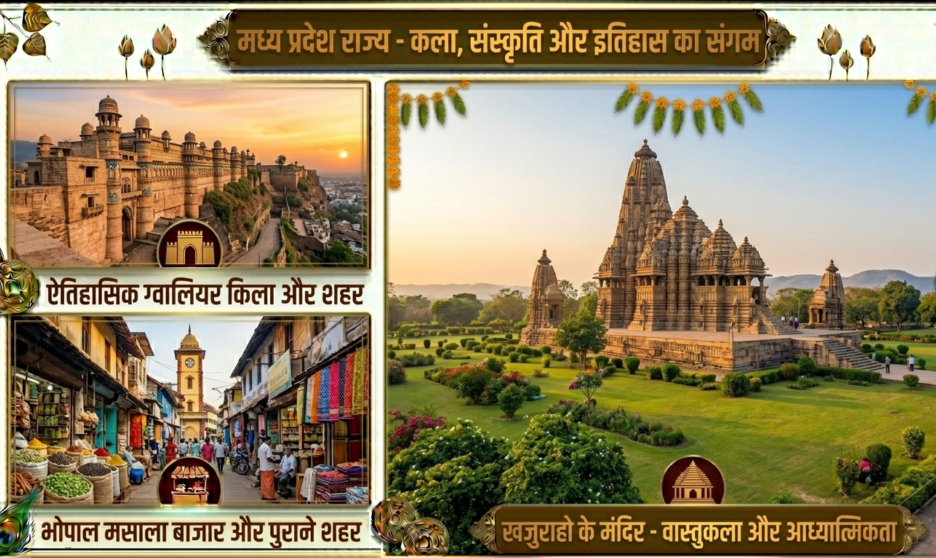
- Nagara & Khajuraho Style :– The Khajuraho Group of Monuments (such as the Kandariya Mahadeva Temple) represents the absolute zenith of the Nagara architectural style. The exterior walls are carved out of fine-grained sandstone utilizing a sophisticated dry-interlocking mortise-and-tenon technique without any binding material. The outer façades are adorned with multi-layered, fluid sculptures capturing eroticism (Mithuna panels), battle sequences, celestial musicians, and secular daily medieval life with incredible anatomical precision.
- Forts & Palaces :– The Gwalior Fort, famously lauded by Babur as ‘The Pearl amongst the Fortresses of India’, exhibits a grand sandstone exterior wall beautifully embellished with brilliant cerulean blue, green, and yellow glazed enameled ceramic tiles forming geometric borders on the Man Singh Palace facade. In Orchha, the Bundela architecture displays towering residential chhatris (cenotaphs) punctuated by sharp, pointed spires and heavy bracketed balconies.
Interior Architecture :–
- Sanchi Stupa :– The main hemispherical dome at Sanchi is a solid, unadorned masonry mass enclosing the sacred relics of Lord Buddha. While the inner pathways reflect deep monastic simplicity, the monumental four gateways (Toranas) flanking the exterior are covered in dense, intricately carved low-relief sculptures chronicling the Jataka tales.
- The Palaces of Mandu (Jahaz Mahal & Hindola Mahal) :– The interior of Hindola Mahal (Swinging Palace) features innovative, massive sloping lateral walls designed to give the visual illusion of a swaying structural swing. The wide interior pointed arches and high T-shaped pillars reflect the austere yet structural perfection of early Tughlaq-Afghan military architecture.
Travel Guide & Routes
Tickets and Entry Fees :–
- There is no mandatory entry pass or regional inner-line tax required to enter the state boundary of Madhya Pradesh.
- Entry tickets for major UNESCO World Heritage Sites (Khajuraho, Sanchi Stupa, Bhimbetka Caves) cost ₹35 to ₹40 for Indian nationals and ₹500 to ₹600 for foreign passport holders.
- Jungle safaris into the core zones of premium tiger reserves (Kanha, Bandhavgarh, Pench) range between ₹4,000 and ₹8,000 per open-top Gypsy (inclusive of mandatory forest entry permits, eco-vehicle fees, and certified naturalists). Online safari slots must be booked well in advance.
Timings (Visiting, Opening & Closing Times) :–
- Best Time to Visit :– The winter block from October to March offers exceptionally comfortable, crisp weather ideal for historical heritage loops and safaris. During the monsoon (July to September), nature reserves remain officially closed due to mating season and track washouts, but hill stations like Pachmarhi and Mandu turn into lush paradises.
- Historical Monuments :– Open daily from sunrise to sunset. Khajuraho hosts a spectacular evening Sound & Light show narrating Chandela history.
How to Reach (Routes) :–
- By Air :– Bhopal (BHO) and Indore (IDR) serve as the primary international/domestic aviation gateways. Excellent localized domestic airport infrastructure also actively connects Gwalior, Jabalpur, and Khajuraho to major Indian metros.
- By Train :– Situated at the geographic core of India, the state features an exceptional railway network. Itarsi, Bhopal, Indore, Jabalpur, Gwalior, and Katni are crucial trans-continental railway junctions. Daily high-speed premium trains like Vande Bharat, Rajdhani, and Shatabdi run directly through the state.
- By Road :– Madhya Pradesh is efficiently linked to Rajasthan, Uttar Pradesh, Chhattisgarh, Maharashtra, and Gujarat via heavy National Highways (NH-44, NH-46, NH-52). The state and private luxury transport agencies operate premium Volvo and multi-axle AC sleeper coaches routinely from Indore and Bhopal.
Photography Spots, Local Cuisine, and Famous Markets
Photography Spots :–
- The Khajuraho Temple Complexes :– Spectacular during the morning and evening ‘Golden Hours’ when the warm sunlight accents the depth of the sandstone stone relief carvings.
- Bhedaghat (Jabalpur) :– Unbeatable frames of the massive, sheer white marble cliffs (Marble Rocks) flanking the deep blue Narmada River and the roaring mist at Dhuandhar Falls.
- Sas-Bahu Temple (Gwalior Fort) :– Ideal for architectural macro-photography, capturing the structural geometry of the deeply recessed ceilings.
- The Chhatris of Orchha (Kanchana Ghat) :– Striking reflection long-exposure landscape shots captured across the Betwa River during twilight.
- Bandhavgarh & Kanha Core Zones :– The premier destination for global wildlife photographers aiming to capture the majestic Royal Bengal Tiger in high-contrast sal forests.
Local Cuisine :–
- Poha-Jelebi & Bhutte ka Kees :– Indore’s legendary breakfast combo of light, steamed flat-rice (Poha) served topped with crispy sev and sweet, juicy Jalebis is globally celebrated. ‘Bhutte ka Kees’—a savory Malwa specialty made of grated fresh corn simmered with milk, mustard seeds, and local aromatic spices—is highly recommended. Other regional delicacies include Bhopal’s aromatic ‘Sulaimani Tea’, pure ghee-dipped ‘Dal-Bafle’, and rich desserts like ‘Mawa Baati’ and cardamom-infused ‘Shrikhand’.
Famous Markets :–
- Sarafa Bazar (Indore) :– Operating as a conventional glittering jewelry market by day, it miraculously transforms post-10:00 PM into Asia’s premier midnight street food culinary street, swarming with thousands of food lovers until dawn.
- Chowk Bazar (Bhopal) :– Famous worldwide for authentic handwoven Chanderi and Maheshwari silk sarees, alongside exquisite Zardozi beaded royal purses (Batwas).
- Maharaj Bada (Gwalior) :– A monumental market hub ideal for shopping for traditional hand-crafted stone artifacts and ethnic textiles.
Nearby Attractions
- Ujjain (The Holy City of Mahakal) :– Seated along the sacred Kshipra River, it houses the revered Lord Mahakaleshwar Temple, one of the 12 unique Jyotirlingas, famous for its intense dawn Bhasm Aarti. The newly unveiled ‘Mahakal Lok’ corridor is a modern marvel of spiritual art.
- Pachmarhi :– The solo hill station of the state, titled the ‘Queen of Satpura’. It is highly loved for its Bee Falls, therapeutic natural pools, rugged sandstone Jashankar caves, and high sunset ridges.
- Mandu (The City of Joy) :– A ruined medieval fortress city perched on a plateau, famous for its romantic palaces like Rani Roopmati Pavilion and Jahaz Mahal, which look exceptionally magical during the monsoon mist.
- Kanha & Bandhavgarh National Parks :– World-renowned wildlife reserves offering unparalleled tiger sighting frequencies amidst dense grasslands and pristine sal forests.
- Amerkantak :– The holy geographical source where the sacred Narmada and Son rivers originate, serving as a tranquil pilgrimage center surrounded by lush forests.
Important Questions and Answer :-
Question 1:- Who commissioned the Khajuraho temples, and what makes their structural design internationally famous?
Answer:– The Khajuraho temples were commissioned by the sovereign kings of the Chandela Dynasty between 950 and 1050 CE. They are internationally acclaimed for their architectural Nagara-style spires and the highly expressive, fluid sandstone relief carvings that depict everyday life, music, warfare, and spiritual sensuality (Mithuna art).
Question 2:- What makes Indore’s ‘Sarafa Bazar’ a unique culinary cultural phenomenon?
Answer:– Sarafa Bazar exhibits a brilliant dual life. By day, it operates as a high-value marketplace for gold and silver merchandise. After closing hours at night, the storefronts host a legendary late-night street food marketplace, specializing in unique regional desserts and savory snacks like Garadu and Rabdi.
Question 3:- What unique geological formations can tourists witness at Bhedaghat in Jabalpur?
Answer:– At Bhedaghat, the Narmada River carves through a massive, deep gorge of pure magnesium limestone cliffs rising nearly 100 feet from the water level. This produces the stunning ‘Marble Rocks’ formation, culminating in the powerful Dhuandhar Falls, where water hits the rocks so forcefully it creates a permanent mist.
Question 4:- What is the spiritual specialty of the ‘Bhasm Aarti’ performed at Ujjain’s Mahakaleshwar Temple?
Answer:– Unlike other Jyotirlingas, the Mahakaleshwar idol is uniquely south-facing (Dakshinamurti), holding immense tantric value. The daily Bhasm Aarti is a sacred dawn ritual where the deity is elaborately adorned using fresh sacred ash (traditionally from a funeral pyre, now symbolically substituted with cow-dung cake ash) amidst thunderous chants.
Question 5:- Why is Madhya Pradesh officially crowned as the ‘Tiger State’ of India?
Answer:– Madhya Pradesh houses a dense concentration of India’s most successful and strictly managed tiger reserves. According to national wildlife census matrices, the state holds the highest population count of wild Royal Bengal Tigers in India, safely earning its official title as the ‘Tiger State’.
Author’s Thoughts :-
Madhya Pradesh is not merely a central coordinate on the geographical matrix of India; it is the absolute repository of the country’s cultural and historical soul. Traveling through this vast state is like flipping through the grand chapters of Indian history simultaneously—the primitive rock art of Bhimbetka brings you face-to-face with humanity’s earliest artistic expressions, while the unshakeable stillness of Sanchi instills a deep, meditative calm. The sandstone monuments of Khajuraho prove that ancient Indian master-craftsmen didn’t just carve stone; they made it breathe. To stand at the edge of the Satpura ranges or track a tiger through the golden grasslands of Kanha is to witness nature in its rawest, most beautiful form. The true crown of Madhya Pradesh, however, lies in its slow, grounded rhythm and the boundless warmth of its people. It remains an essential pilgrimage for any traveler who wishes to experience the true essence of India—because, as the iconic tagline goes, ‘MP Ajab Hai, Sabse Gazab Hai!’
“Deep within the heart of Madhya Pradesh, the grandeur of ancient history and the untamed whisper of the wilderness unite, capturing the soul of every true traveler forever.”