
Manipur :- The Jewel of India, Unique Culture & Cradle of Floating Lakes
Detailed History
Situated on the easternmost frontier of India, Manipur is universally hailed as the ‘Land of Jewels‘ owing to its breathtaking natural vistas and deeply rooted cultural legacy. The legendary freedom fighter Netaji Subhash Chandra Bose affectionately called it the ‘Switzerland of India‘. According to regional mythological lore, when Lord Shiva and Goddess Parvati performed the celestial Raasleela in this valley, the King of Serpents, Nagaraj, illuminated the entire terrain by casting rays from his divine cosmic jewels, giving the land its eternal name, ‘Manipur‘. The territory also finds profound historical mention in the ancient epic Mahabharata; Princess Chitrangada of Manipur was wedded to the Pandava warrior Arjuna, and their brave son Babruvahana subsequently ruled over this majestic kingdom.
Historically, Manipur was governed under an unbroken line of the sovereign Meitei Dynasty, institutionalized in 33 CE by the visionary King Nongda Lairen Pakhangba. The state possesses a rare, meticulous written court chronicle known as the ‘Cheitharol Kumbaba’, which accurately documents the royal lineages and significant political milestones over two millennia. In the 19th century, the kingdom faced devastating Burmese invasions, a dark period chronicled in history as the ‘Chahi Taret Khuntakpa‘ (Seven Years of Devastation). This culminated in British intervention and the eventual integration of the territory into the British Empire following the fierce Anglo-Manipur War of 1891. During World War II, Manipur transformed into a critical global battlefield where the Indian National Army (INA), allied with Japanese forces, fought valiantly against British rule. On April 14, 1944, the INA triumphantly hoisted the Indian tricolor flag for the first time on Indian soil at Moirang in Manipur. Post-independence, the kingdom merged with the Union of India on September 21, 1949, and attained full statehood on January 21, 1972.
Detailed Architecture :-
The architectural landscape of Manipur is uniquely shaped by its highly active seismic geography (Seismic Zone V) and the profound cosmic symbols of traditional Meitei culture, creating highly specialized structures designed to live in harmony with nature.
Exterior Architecture :–
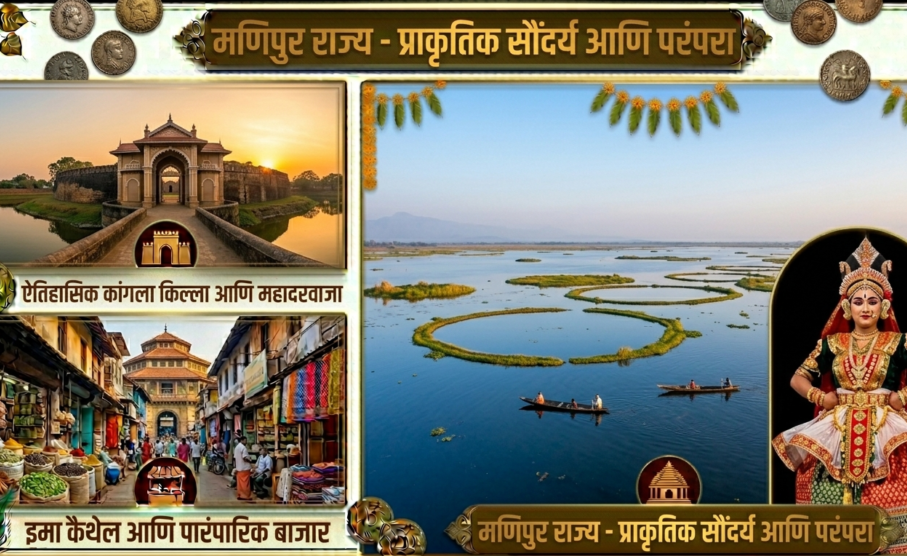
- Kangla Fort :– Perched along the banks of the scenic Imphal River, this historical brick-and-laterite fortress stands as the ancestral seat of Manipuri royalty. The massive exterior gateways are flanked by monumental white structural installations of the ‘Kangla-Sha’—the sacred mythological guardian creatures featuring the powerful body of a lion and the crowned head of a stylized dragon.
- Traditional Yumjao Structural Style :– The classic residential architecture of Manipur, called ‘Yumjao’, utilizes eco-friendly local materials like matured bamboo, reed thatch, and processed mud walls. The exterior structures are defined by high, triangular, and deeply sloped roofs that allow heavy monsoon downpours to drain rapidly without compromising the light, highly flexible earthquake-resistant bamboo framing.
- Shree Govindajee Temple :– Located adjacent to the royal palace complex in Imphal, the exterior of this historic temple features two towering gold-leafed domes (Golden Domes), displaying an elegant architectural blending of Bengali Vaishnavite and classical Meitei design structures.
Interior Architecture :–
- Within the historic ruins of Kangla Fort, the ancient temple of Lord Sanamahi (the indigenous deity of the Meitei faith) features a highly austere, octagonal inner sanctuary designed with deep geometric precision to facilitate traditional rituals.
- The large royal assembly and preaching halls (Mandapas) house grand timber pillars carved with traditional Meitei geometric motifs and seasonal foliage. These spacious inner sanctuaries purposefully leave a massive, unobstructed circular central floor layout to accommodate the sweeping movements of the classical Manipuri Raasleela dance.
Travel Guide & Routes
Mandatory Permits (ILP) :–
- Inner Line Permit (ILP) :– It is absolutely mandatory for all domestic Indian tourists visiting Manipur to obtain an Inner Line Permit. This can be instantly acquired via the official online portal of the Government of Manipur or physically at the Imphal Airport arrival counter. International travelers are exempt from Protected Area Permits (PAP) but must register at local foreign registration checkposts upon arrival.
Tickets and Entry Fees :–
- Entry into the historic Kangla Fort complex requires a nominal maintenance ticket ranging from ₹10 to ₹20 per individual.
- To explore the floating ecosystems of Loktak Lake and the Keibul Lamjao National Park via traditional wooden longboats, standard boat safari charges range from ₹300 to ₹500 per vessel.
Timings (Visiting, Opening & Closing Times) :–
- Best Time to Visit :– The winter block from October to April offers premium, comfortable, and clear weather conditions ideal for exploring the valley. The region experiences intense, continuous monsoon rain from June to September.
- Sightseeing Windows :– Kangla Fort and royal museums welcome visitors daily from 09:00 AM to 05:00 PM. The ideal window to experience the floating national park on Loktak Lake is between 06:00 AM and 10:00 AM, when the endemic wildlife is most active near the water banks.
How to Reach (Routes) :–
- By Air :– The ‘Bir Tikendrajit International Airport’ (IMF) in Imphal serves as the primary aviation hub of the state, directly linking Manipur to New Delhi, Kolkata, Guwahati, Bengaluru, and Silchar via daily direct and connecting flights.
- By Train :– Currently, railway lines operate up to Jiribam on the Manipur border. The monumental ‘Imphal-Jiribam Rail Project’—which features the construction of the world’s tallest pier railway bridge—is entering its final operational stages. Until its full completion, the nearest major commercial railhead is located at Dimapur (Nagaland) and Guwahati (Assam), roughly 200 km from Imphal.
- By Road :– Manipur enjoys excellent highway connectivity via National Highway 2 (NH-2), linking it directly to Kohima and Dimapur, and NH-37 linking it to Silchar. The Manipur State Transport (MST) and several private luxury agencies run overnight sleeper buses and shared tactical taxis across these routes.
Photography Spots, Local Cuisine, and Famous Markets
Photography Spots :–
- Loktak Lake Landscapes :– Yields world-class aerial and elevated landscape shots capturing the vast expanse of blue water punctuated by perfectly circular rings of floating bio-mass (Phumdis).
- Ima Keithel (Mothers Market) :– A goldmine for documentary and street photography, capturing the vibrant expressions, traditional handwoven ethnic attire, and spirited commerce of thousands of Manipuri women.
- Shirui Lily Peak (Ukhrul) :– Ideal for capturing panoramic mountain ranges blanketed in low-hanging clouds and the rare, pale pink Shirui Lily flowers during May and June.
- The Monolithic Kangla-Sha :– Provides dramatic silhouette framing against the setting sun at the historic main gate of the Kangla Fort.
Local Cuisine :–
- Eromba & Chamthong :– Traditional Manipuri cuisine is highly nutritious, relying entirely on fresh organic herbs and zero commercial cooking oils. The undisputed culinary anchor of the state is ‘Eromba’—a spicy mash of boiled seasonal vegetables, local potatoes, and fermented fish (Ngari), intensely flavored with the ultra-hot local U-Morok (King Chilli). Other must-try items include ‘Chamthong’ (a clean, stewed vegetable broth), ‘Singju’ (a fiery herb salad), and for dessert, the decadent ‘Chak-Hao Kheer’ made from Manipur’s premium indigenous black rice, which carries an official Geographical Indication (GI Tag).
Famous Markets :–
- Ima Keithel (Mothers Market) :– Boasting a 500-year-old operational history, this iconic commercial hub is managed exclusively by over 5,000 married women traders. It stands proudly as the world’s only all-women-operated marketplace. It is the ultimate destination for purchasing premium handwoven traditional wrap-around skirts (Phanek), exquisite shawls (Innaphi), and fine bamboo wickerwork.
- Moirang Bazaar :– Highly sought-after for local handloom merchandise and authentic dried Malabar river fish.
Nearby Attractions
- Loktak Lake & Keibul Lamjao :– This is the largest freshwater lake in Northeast India. It encloses the world-famous Keibul Lamjao National Park, which is globally celebrated as the World’s Only Floating National Park. This fragile ecosystem is the last remaining natural sanctuary for the critically endangered, elegant Sangai Deer (the dancing deer of Manipur).
- Moirang (INA Memorial Complex) :– A historic town on the banks of Loktak Lake housing the official museum of the Indian National Army. It showcases a grand bronze monument of Netaji Subhash Chandra Bose, rare wartime battlefield weaponry, and authentic historic photographs from the freedom struggle.
- Ukhrul :– A picturesque hill station situated nearly 80 km from Imphal, highly popular for its refreshing alpine climate, rare Shirui Lily flora, and the deep, mysterious limestone Khangkhui Caves.
- Moreh (Indo-Myanmar Border) :– Located 110 km from the capital, this bustling international border town allows travelers to walk across the international boundary line into the Myanmarese town of Tamu to photograph magnificent golden Buddhist Pagodas.
- Imphal War Cemetery :– A beautifully manicured, deeply peaceful Commonwealth war memorial dedicated to the supreme sacrifice of British, Indian, and Allied soldiers who fought the historic Battle of Imphal during World War II.
Important questions and answer :-
Question 1:- Why is the ‘Ima Keithel’ market in Imphal considered a globally unique social phenomenon?
Answer:– Ima Keithel (literally translating to ‘Mother’s Market’) is a unique socio-economic marvel where all commercial spaces are strictly owned and operated by married women. This centuries-old institution stands as a powerful symbol of women-led financial independence, driving the entire textile and agrarian trade economy of the state.
Question 2:- What is the scientific reason behind Keibul Lamjao being classified as a ‘Floating’ National Park?
Answer:– The park floats entirely on the waters of Loktak Lake because its ground mass is composed of ‘Phumdis’—thick, floating mats of heterogeneous masses of vegetation, organic soil, and decaying matter. These massive biological carpets vary in thickness and float organically on the water’s surface, supporting an entire forest ecosystem.
Question 3:- What unique characteristic earned the Sangai Deer its title as the ‘Dancing Deer’?
Answer:– The Sangai (Rucervus eldii eldii) is the official state animal of Manipur. It is called the dancing deer because it lives on the spongy, floating Phumdis of Loktak Lake. As the deer walks across the shifting, bouncy vegetation mats, it takes light, delicate, and calculated steps to maintain balance, which visually mimics a graceful dance form.
Question 4:- What makes Manipur’s ‘Chak-Hao’ Black Rice highly valuable?
Answer:– Chak-Hao is a premium indigenous variety of glutinous black rice native to Manipur, holding an official GI Tag. It turns a deep, royal purple color when cooked, possesses an intense nutty aroma, and is packed with high levels of therapeutic anthocyanin antioxidants, making it a highly sought-after superfood worldwide.
Question 5:- What are the distinct artistic features of the classical Manipuri Raasleela dance?
Answer:– Manipuri Raasleela is a major Indian classical dance form centered entirely on Vaishnavite themes of divine love between Radha and Krishna. It stands out due to its gentle, fluid, and circular movements, completely avoiding sharp or jerky steps. The female dancers wear a unique, highly decorative barrel-shaped stiff skirt called a ‘Kumil’, which gives them the illusion of gliding gracefully across the stage.
Author’s Thoughts :-
Manipur is far more than a geographic state on the map of Northeast India; it is an ethereal, living canvas where raw nature and human resilience paint a magnificent picture. Standing at the edge of Loktak Lake in the quiet hours of dawn, watching the mist rise off the floating Phumdis while a lone Sangai deer grazes in the distance, makes you feel like you are witnessing the first morning of creation. The sheer grit and vibrant spirit of the state are beautifully mirrored in the lanes of Ima Keithel, where the soft rustle of handwoven silk meets the determined voices of thousands of mothers who anchor this society. From being the historical cradle where the modern sport of Polo was born to preserving classical dance forms that feel like moving poetry, Manipur holds its heritage sacredly close to its heart. Traveling through this valley of jewels is a deeply grounding experience that fundamentally alters your understanding of beauty, leaving a quiet piece of its misty hills permanently in your soul.
“Within the floating rings of Loktak Lake, nature has sculpted its rarest miracle, while the timeless grace of Manipur’s mothers holds the proud soul of the valley alive.”