
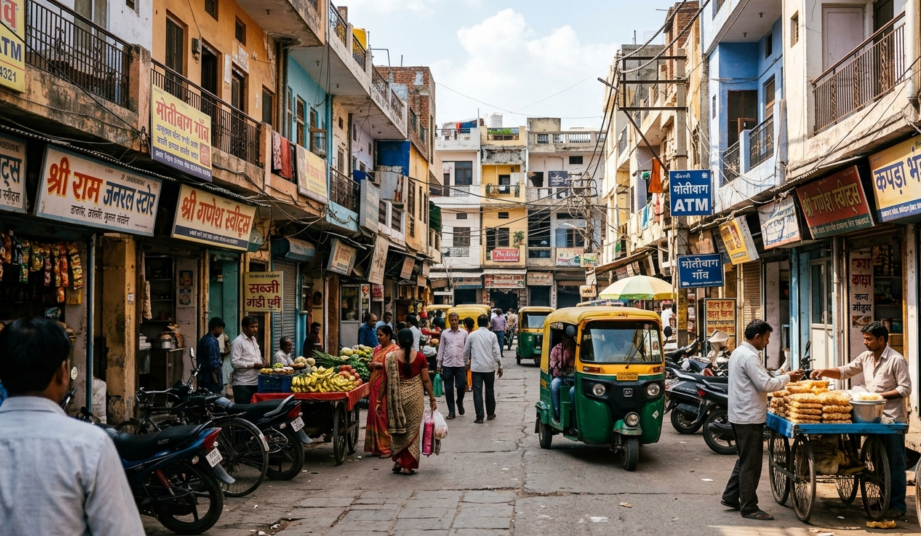
Moti Bagh Gaon :- A Historical Window Enclosed by Modern Delhi
Best known today for its bustling intersections, modern metro stations, and posh government colonies, the locality of ‘Moti Bagh’ conceals an old rural and historical fabric. What we know today as ‘Moti Bagh Gaon’ (Moti Bagh Village) continues to maintain its distinct and unique identity amidst the shimmering concrete advancements of South Delhi. Let us dive deep into the layers of this significant urban village through this blog.
Detailed History
The history of Moti Bagh Village traces its roots back to the Mughal era and subsequent periods. According to local lore and historical references, this entire region was once covered with sprawling, lush orchards and gardens (Bagh) during the Mughal reign. It is widely believed that the village was named ‘Moti Bagh’ either after a prominent local historical figure named ‘Moti’ or due to the pristine beauty of the gardens that sparkled like pearls (Moti).
The village was originally an agrarian settlement where local farmers cultivated the surrounding fertile lands. When the rapid expansion and urbanization of post-independence Delhi began, the government acquired the agricultural fields to develop modern residential complexes and administrative offices. Despite this transition, the core residential nucleus of the village survived, retaining its narrow alleys and close-knit traditional social structures. It stands as a silent witness to Delhi’s journey from a collection of rustic hamlets to a sprawling global metropolis.
Detailed Architecture
The architectural landscape of Moti Bagh Village presents a stark and fascinating contrast where traditional rural layouts directly meet modern urban construction.
- Exterior Architecture :– Around the fringes of the village, you will find multi-story concrete structures and modern apartment blocks. Winding, narrow lanes define the core area, crowded with decade-old shops and small marketplaces along the entrances. Remnants of older community wells and traditional public spaces (Choupals) subtly hint at the village’s architectural past.
- Interior Architecture :– The interiors of the older ancestral homes still feature traditional ventilation layouts and small central spaces. Over time, many of these houses have been retrofitted, turning ground floors into commercial shops while retaining residential flats above. In sharp contrast, the adjacent ‘New Moti Bagh’ township boasts meticulously planned modern architecture, wide tree-lined avenues, and state-of-the-art green complexes.
Travel Guide & Routes
If you wish to explore Moti Bagh Village and its unique urban-rural setup, all the essential travel details are sequentially compiled below.
- Ticket :– Exploring Moti Bagh Village and its surrounding public markets is completely Free of charge.
- Visiting Time :– The area can be visited anytime between 06:00 AM to 08:00 PM. The evening hours are highly recommended to experience the local market vibrancy.
- Opening & Closing Time :– Being a bustling residential and commercial zone, the area is accessible 24/7. However, the local shops and major commercial establishments operate primarily from 10:00 AM to 09:00 PM.
- How to Reach :–
- By Metro :– The nearest metro station is ‘Sir Vishweshwaraiah Moti Bagh’, located on the Pink Line. The village is at a short walking distance or a quick e-rickshaw ride from the station. Dhaula Kuan (Airport Express Line) is also located nearby.
- By Bus :– Moti Bagh is a major transit hub in South Delhi. Almost all prominent DTC buses running through the Ring Road stop at the ‘Moti Bagh’ bus stand, making the village extremely accessible.
- By Road/Cab :– You can easily drive or hail a cab via the Ring Road directly to ‘Moti Bagh Village‘. Due to narrow internal lanes, it is recommended to park your vehicle at the nearby metro station parking lot.
Photography Spots, Local Flavors, and Famous Markets
- Photography Spots :–
- The striking juxtaposition of old rural brick houses and newly constructed urban structures.
- The panoramic view of modern transit systems blending with nature near the Moti Bagh flyover.
- The bustling, colorful, and tightly knit street frames inside the village lanes.
- Local Flavors :– The eateries and corners of Moti Bagh Village serve excellent North Indian street food. Piping hot chole bhature, samosas, bread pakoras, and tangy aloo chaat are incredibly popular here. Due to a large population of working professionals and students nearby, the area also features numerous affordable meal joints (thalis) and momo stalls.
- Famous Market :– The village contains its own local market known for pocket-friendly garments, electronics, and daily consumer goods. For premium lifestyle shopping or global brands, the upscale ‘Yashwant Place’ in Chanakyapuri or the famous street-shopping hub ‘Sarojini Nagar Market’ are situated just a short distance away.
Nearby Attractions
Moti Bagh Village is strategically surrounded by some of Delhi’s finest tourist landmarks.
- National Rail Museum :– Located in Chanakyapuri, this iconic museum is just a 5-minute drive away and is perfect for all age groups.
- Nehru Planetarium & Teen Murti Bhavan :– An excellent educational and historical stop for science and history enthusiasts.
- Sarojini Nagar Market :– One of India’s most famous flea and street shopping markets is located in close proximity.
- Shanti Path & Diplomatic Enclave :– Known for its highly secured, meticulously landscaped lawns and beautiful avenues perfect for a peaceful drive or stroll.
Interesting Facts :-
- Moti Bagh Village is currently flanked by one of the most high-security and premium government residential complexes (New Moti Bagh), which houses top-tier bureaucrats, diplomats, and statesmen.
- The Ring Road running adjacent to the village is considered the ultimate transit lifeline of Delhi, seamlessly connecting this old settlement to all four corners of the city.
- Despite decades of hyper-urbanization, the village community actively preserves its rural heritage, celebrating traditional festivals with classic community zeal.
Important Questions and Answer :-
Question 1:– Is there an ancient fort or palace to visit inside Moti Bagh Village?
Answer:- No, there are no grand forts or palaces inside the village. Its historical significance lies in its Mughal-era origin and its transformation journey during Delhi’s urban development phase.
Question 2:– Is parking easily available inside the village lanes?
Answer:- No, the inner lanes are too narrow for four-wheelers. Visitors should ideally park their vehicles at the designated parking facilities of the Sir Vishweshwaraiah Moti Bagh Metro Station.
Question 3:- Can one easily walk to Sarojini Nagar Market from Moti Bagh?
Answer:- Yes, the distance is roughly 1.5 to 2 kilometers. It can be covered either via a short walk or a 5-minute auto/e-rickshaw ride.
Author’s Perspective :-
Observing Moti Bagh Village up close provides a profound lesson in the co-existence of historic heritage and aggressive modern development. On one side, the plush high-rises of New Moti Bagh represent India’s institutional advancement, while on the other, the native village reminds us that the foundation of this megalopolis rests upon these very hamlets. In my view, Delhi’s urban villages shouldn’t be dismissed as mere congested zones; they deserve to be recognized and preserved as living monuments of Delhi’s structural evolution.
S “Beneath the rush of rapid metro lines and heavy flyover transit, Delhi’s rustic past safely breathes within the lanes of Moti Bagh.”