
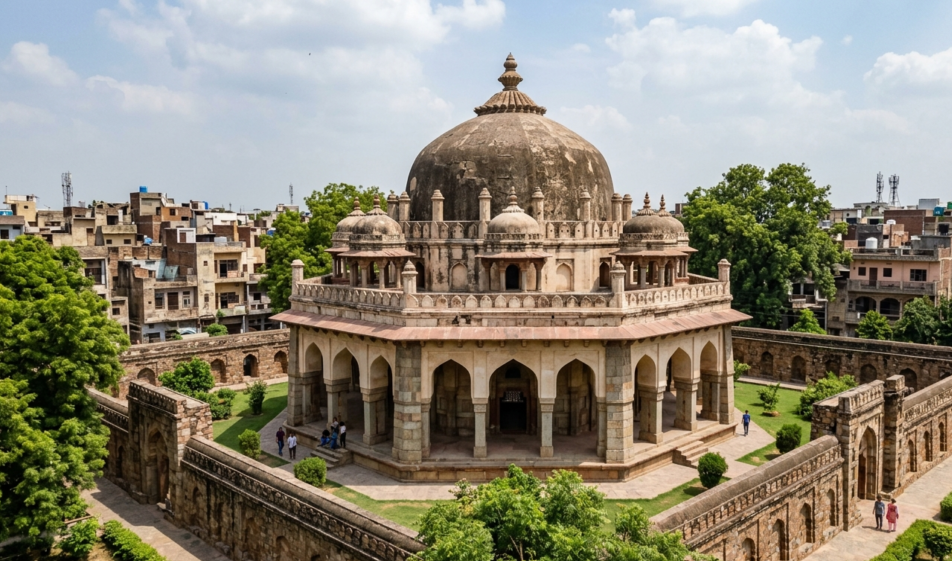
The Saga of Historic Mubarak Shah’s Tomb :- History, Architecture, and Complete Travel Guide
Detailed History :-
The Tomb of Mubarak Shah is an extremely significant and historic heritage site from the era of the Sayyid Dynasty located in Delhi. This grand mausoleum is situated in the bustling and densely populated locality of ‘Kotla Mubarakpur’ in Delhi, which used to be a serene village during the medieval period. The construction of this magnificent tomb was initiated by Sultan Muizuddin Mubarak Shah, the second ruler of the Sayyid Dynasty, during the final years of his lifetime, and was fully completed around 1434 AD following his demise. Mubarak Shah ruled Delhi from 1421 to 1434 AD, and his reign came to an end when he was assassinated as part of a conspiracy hatched by one of his own ministers.
The reign of the Sayyid Dynasty is considered a period of political instability in Indian history, due to which major forts or opulent palaces could not be constructed during this era. However, the rulers of this dynasty introduced a unique and innovative architectural style in the construction of tombs. This tomb of Mubarak Shah is an ideal example of how, even amidst political turmoil, artisans maintained a high standard of art and architecture. This mausoleum continues to preserve the memory of the Sultan of that era in a quiet corner of Delhi today.
Detailed Architecture :-
From an architectural standpoint, the Tomb of Mubarak Shah is considered one of the earliest and finest octagonal tombs in Delhi. Its unique structural layout and the primary features of its architecture include the following.
- Construction Material :– Locally available ‘Grey Quartzite’ stones and lime mortar were primarily utilized in the construction of this historic tomb. Red sandstone and white plaster were also used in certain sections for ornamentation and on the arches.
- Exterior Architecture :– The tomb is built entirely in an octagonal (eight-sided) design. It features a spacious veranda running all around it, with three arched openings (Arches) on each of its eight sides. The roof of the tomb is crowned with a very grand and massive central dome (Central Dome), which rests upon a raised octagonal drum. Beautiful small kiosks (Chhatris) are built on the roof surrounding the dome, giving the structure a regal and balanced appearance.
- Interior Architecture :– The central chamber inside the tomb is quite wide and well-ventilated. In the center rest the graves of Sultan Mubarak Shah and other members of his family. The interior walls and arches of the chamber were once adorned with beautiful carvings and verses from the Quran, the remnants of which can still be traced on the plaster work today. The inner design of the dome reflects the advanced geometric understanding of the craftsmen of that period.
Travel Guide & Routes :-
If you are planning to visit this rare architectural marvel of the Sayyid period and explore the pages of history, a complete travel guide is provided below.
- Entry Fee :– Visitors do not have to pay any fee to view, explore, and photograph the Tomb of Mubarak Shah. It is completely Free for everyone.
- Visiting Time :– This monument is nestled between the narrow lanes and residential colonies of Kotla Mubarakpur. The best time to visit is from 06:00 AM to 06:00 PM, as the architectural details can be appreciated more clearly in the daylight.
- How to Reach :– Being located close to the major market hubs of South-Central Delhi, reaching here is quite convenient:
- By Metro :– The nearest metro station to reach here is ‘South Extension’, which is situated on the Pink Line of the Delhi Metro. Alternatively, the ‘Jawaharlal Nehru Stadium’ (JLN Stadium) station on the Violet Line is also close by. From the metro station, you can take a local e-rickshaw or an auto-rickshaw to reach the tomb inside Kotla Mubarakpur within 5-10 minutes.
- By Bus & Auto :– Owing to its proximity to the Ring Road, buses heading towards South Extension and AIIMS are readily available from all parts of Delhi. From there, you can easily walk or take an auto to enter the Kotla Mubarakpur village area.
- Photography Spots :– The small compound surrounding the tomb and its towering octagonal arches provide an excellent background for photography. During the afternoon, when the sunlight directly strikes its stone surface, the photographs of its dome and kiosks turn out remarkably stunning.
- Local Food :– Countless culinary options are available in Kotla Mubarakpur and the adjacent South Extension Market. You can relish traditional North Indian delicacies and spicy street chaat at local eateries, or enjoy international cuisines at modern cafes.
- Famous Markets :– The area where the tomb resides is itself known as the ‘Kotla Mubarakpur Market’, which is a massive commercial hub for hardware, clothing, and household goods. Additionally, Delhi’s highly upscale and popular shopping destination, ‘South Extension Market’, is within walking distance, where you can shop for branded apparel and jewelry.
Nearby Attractions :-
During your trip to Mubarak Shah’s Tomb, you can also include these other prominent historical and sightseeing landmarks located nearby in your itinerary.
- Lodhi Garden :– Situated just 2.5 kilometers away, this is a vast and picturesque park housing several grand tombs of the Sayyid and Lodhi dynasties, such as the tombs of Sikandar Lodhi and Mohammed Shah.
- Safdarjung Tomb :– The last grand specimen of Mughal architecture is also located very close to this region, renowned for its beautiful gardens and fountains.
- Hauz Khas Village :– This unique blend of history and modern nightlife is located a short distance away, featuring an ancient madrasa and lake dating back to the era of Alauddin Khalji.
- Dilli Haat, INA :– A wonderful cultural hub located very close by, perfect for exploring handlooms from different Indian states and savoring diverse regional cuisines.
Interesting Facts :-
- The Tomb of Mubarak Shah is among the select monuments in Delhi after which an entire modern locality, ‘Kotla Mubarakpur’, was named. ‘Kotla’ translates to a fortress or a small citadel.
- The octagonal architectural style of this tomb was considered so successful and aesthetically pleasing that later rulers of the Lodhi Dynasty, and subsequently the Mughals, adopted this design for their monumental tombs (such as Humayun’s Tomb).
- According to historians, the tomb was originally enclosed by a large defensive wall and a grand gateway, which were lost over time due to urbanization and residential encroachments.
- This mausoleum stands as one of the most significant and substantial surviving structures built under the direct patronage of the Sayyid Sultans.
Important Questions and Answer :-
Question 1:– Who was Mubarak Shah and where is his tomb located?
Answer:- Mubarak Shah was the second sultan of the Sayyid Dynasty who ruled over Delhi in the 15th century. His tomb is located in the ‘Kotla Mubarakpur’ locality near South Extension in New Delhi.
Question 2:- What is the primary architectural feature of Mubarak Shah’s Tomb?
Answer:- The defining feature of this tomb is its octagonal structure. It features a massive central dome surrounded by elegant kiosks, along with a veranda with arched openings that represent the hallmark of Sayyid architecture.
Question 3:- Is there any entry fee to visit the Tomb of Mubarak Shah?
Answer:- No, entry into the Tomb of Mubarak Shah is entirely free of charge, and there are no fees for photography either.
Question 4:- Which is the nearest metro station to reach this tomb?
Answer:- The closest metro station to the tomb is the ‘South Extension Metro Station’ (Pink Line). ‘Jawaharlal Nehru Stadium Metro Station’ (Violet Line) is another nearby option.
Author’s Thoughts :-
Amidst the glitz and glamour of Delhi’s highly celebrated monuments like Humayun’s Tomb or Qutub Minar, the Tomb of Mubarak Shah feels like a serene and forgotten chapter of history. Coming across this grand mausoleum suddenly amidst the narrow lanes and busy bazaars of Kotla Mubarakpur evokes a sensation akin to time travel. It is simultaneously bittersweet and fascinating to observe how modern urban settlements have completely enveloped this historical heritage, yet its massive dome stands resolute, preserving its ancient grandeur. If you wish to discover the history of Delhi that is less talked about in mainstream textbooks, you must visit here to experience its tranquility and historic craftsmanship. This monument reminds us that history doesn’t just survive in vast open lawns, but occasionally breathes through the cramped alleys of a metropolis.
“Amidst the narrow lanes of a changing Delhi and the clamor of modern markets, this silent tomb of Mubarak Shah still echoes the legacy and grandeur of the Sayyid Sultanate.”