
ऐतिहासिक नजफ खान का मकबरा :- History, Architecture, and Complete Travel Guide
Detailed History
The Tomb of Najaf Khan reflects an era in Delhi’s history when the mighty Mughal Empire was on the brink of its ultimate decline. This historical mausoleum is situated in the Lodhi Colony area of South-Central Delhi, directly opposite the Safdarjung Airport. The tomb belongs to Mirza Najaf Khan, who was a highly powerful, courageous, and influential noble as well as the commander-in-chief of the Mughal army during the 18th century. Originally hailing from the Safavid Dynasty of Iran, Mirza Najaf Khan later migrated to India. He served as the chief commander (Mir Bakshi) of the Mughal forces during the reign of the later Mughal Emperor, Shah Alam II.
Mirza Najaf Khan was renowned for his astute military strategies and successful campaigns against the Rohillas, Jats, and Sikhs. He temporarily infused economic and military stability into the crumbling Mughal Empire. Following his death in 1782 AD, he was buried in his favorite scenic garden, which is known today as Najaf Khan’s Tomb. Right next to him, the grave of his daughter, Fatima, is also located within the same complex. This tomb stands as a quiet witness to that specific period of Delhi when the central authority had weakened considerably, yet architectural simplicity and dignity remained intact.
Detailed Architecture :-
The architecture of Najaf Khan’s Tomb presents a beautiful and serene example of the Charbagh style and structural simplicity belonging to the late Mughal period. The primary architectural features of this monument are outlined below.
- Construction Material :– Local ‘Red Sandstone‘ and brickwork covered with white lime plaster were primarily utilized in constructing this tomb. The absence of the opulent building materials seen in early Mughal monuments is evident here, reflecting the financial constraints of that political era.
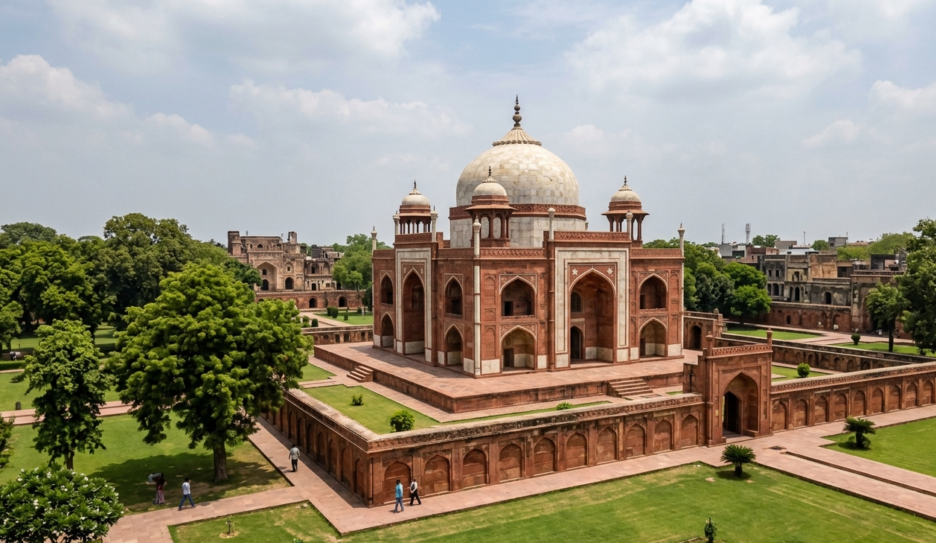
- Exterior Architecture :– Unlike other famous Mughal tombs, this structure does not feature a massive central dome. Instead, it is designed as a large, elevated, two-story square platform made of red sandstone. Beautiful arched openings (Archways) run along the sides of this raised platform, with stone steps leading to the main terrace. The defining feature of this structure is its flat-roofed profile without a central dome, making it unique among Mughal monuments.
- Interior Architecture :– In the center of the platform lies the main burial chamber, which houses the beautifully carved marble cenotaphs of Mirza Najaf Khan and his daughter. The plaster carvings and geometric finishes on the interior walls are understated yet aesthetically appealing. The structure is enveloped by a vast and peaceful garden developed on the lines of the traditional Mughal ‘Charbagh’ (four-quadrant garden) design.
Travel Guide & Routes :-
If you are planning to explore this forgotten chapter of history and experience its tranquil surroundings, here is a comprehensive travel guide.
- Entry Fee :– Admission to Najaf Khan’s Tomb and its enclosed gardens is completely Free for all national and international tourists.
- Visiting Time :– The monument is preserved under the Archaeological Survey of India (ASI) and remains open from 06:00 AM to 06:00 PM daily. The early morning or late afternoon hours are considered the ideal times to visit.
- How to Reach :– Located close to the center of Delhi, reaching this heritage site is highly convenient:
- By Metro :– The nearest metro station is ‘Jor Bagh’, situated on the Yellow Line of the Delhi Metro. Additionally, ‘Lodhi Colony’ metro station on the Pink Line is also very close. From the station, you can walk or hire a local e-rickshaw or auto-rickshaw to reach the tomb within 5 minutes.
- By Bus & Auto :– Owing to its proximity to Lodhi Road and Safdarjung, direct buses connect this area to all major parts of Delhi. You can also easily book a cab or take an auto-rickshaw directly from New Delhi Railway Station.
- Photography Spots :– The elevated red sandstone terrace, the vaulted corridors, and the scenic view of the structure through the dense surrounding foliage offer excellent backdrops for photography. The minimal crowd allows you to capture crisp frames in complete tranquility.
- Local Food :– The adjacent areas of Lodhi Colony and Khan Market are home to globally acclaimed culinary joints. You can dine at upscale restaurants in Lodhi Colony or head to the nearby Amar Colony market to enjoy its famous tandoori momos and vibrant street food selection.
- Famous Markets :– Delhi’s premier luxury shopping hub, ‘Khan Market’, is located nearby, renowned for its designer boutiques, high-end bookstores, and elite cafes. For ethnic clothing and traditional Indian handicrafts, ‘Dilli Haat, INA’ is also just a short distance away.
Nearby Attractions :-
During your visit to Najaf Khan’s Tomb, you can easily explore these major tourist landmarks located in the vicinity:
- Safdarjung Tomb :– Situated just 1.5 kilometers away, this is the last monumental garden-tomb of the Mughal architectural style, famous for its grand central dome and fountains.
- Lodhi Garden :– A beautiful expansive public park housing the magnificent historical tombs of the Sayyid and Lodhi rulers, making it a paradise for heritage lovers and morning walkers.
- Humayun’s Tomb :– This majestic UNESCO World Heritage Site, which represents the pinnacle of early Mughal architecture, is located within a 10-15 minute drive.
- Lodhi Art District :– India’s first open-air public art district, where the walls of Lodhi Colony have been transformed into vibrant canvases with spectacular graffiti by global artists, making it highly popular among millennials.
Interesting Facts :-
- Mirza Najaf Khan was the last formidable commander of the Mughal forces who held enough power to effectively defer the final collapse of the empire. Following his demise, the Mughal military structure disintegrated rapidly.
- The flat-roofed architectural layout without a grand dome structurally documents the acute financial stringency plaguing the imperial treasury towards the end of the 18th century.
- The tomb complex is situated exceptionally close to the runway of the Safdarjung Airport, ensuring that the surrounding zone has remained heavily forested, green, and free from high-rise encroachments.
- Historians and local explorers frequently categorize it as a ‘Hidden Monument’ of Delhi due to the immense serenity it offers compared to heavily commercialized tourist spots.
Important Questions and Answer :-
Question 1:- Who was Mirza Najaf Khan?
Answer:- Mirza Najaf Khan was an influential noble of Persian descent and the commander-in-chief (Mir Bakshi) of the Mughal army during the reign of Emperor Shah Alam II in the late 18th century.
Question 2:- Where is Najaf Khan’s Tomb located and what is the nearest metro station?
Answer:- The tomb is located near Safdarjung Airport in the Lodhi Colony area of New Delhi. The nearest metro stations are ‘Jor Bagh’ (Yellow Line) and ‘Lodhi Colony’ (Pink Line).
Question 3:- Is there an admission ticket to visit Najaf Khan’s Tomb?
Answer:- No, entry to Najaf Khan’s Tomb and its surrounding gardens is entirely free of charge.
Question 4:– Why is the architecture of this tomb different from conventional Mughal tombs?
Answer:- It differs because it lacks a traditional central dome. The entire monument is structured simply as an elevated, two-story square terrace built of red sandstone with a flat roof.
Author’s Thoughts :-
Amidst the booming narratives of the Qutub Minar and the Red Fort that dominate Delhi’s heritage tourism, Najaf Khan’s Tomb sits like a quiet footnote in history, waiting for a patient observer. Stepping from the busy lanes of Lodhi Colony into this enclosed compound instantly isolates you into a world of quietude. This monument beautifully reminds us that history doesn’t just belong to the absolute victors or emperors of golden eras; it equally belongs to the resilient commanders who fought to preserve a fading empire until their last breath. In my view, if you seek a peaceful, green hideout away from the urban rush to connect with a unique architectural style, spending an hour at Najaf Khan’s Tomb will be a deeply fulfilling and therapeutic experience.
“Embracing the simplicity of a fading empire within its stones, the tomb of Najaf Khan continues to narrate a serene chapter of the past under the modern canopy of Delhi.”