
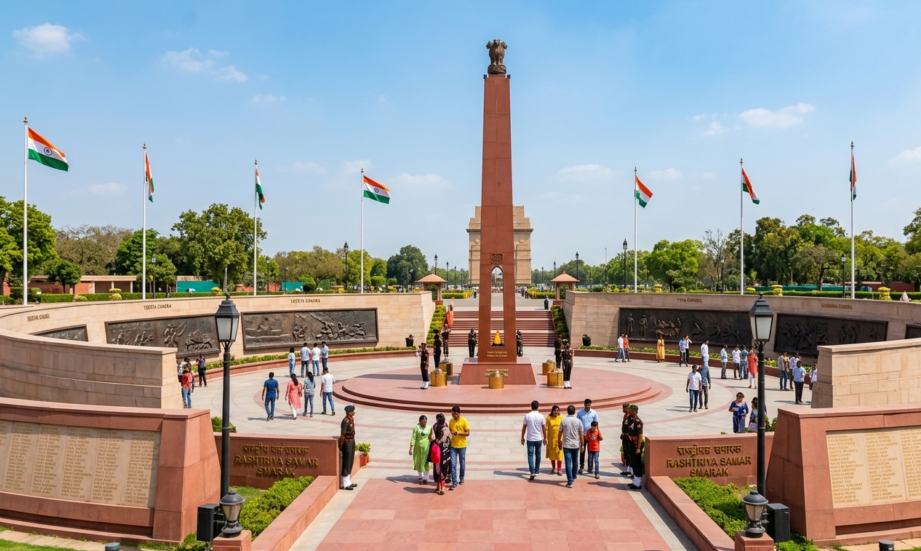
National War Memorial Delhi :- Complete History and Architecture
Situated right behind India Gate within the grand Central Vista complex in New Delhi, the ‘National War Memorial’ (Rashtriya Samar Smarak) is a deeply revered national shrine of independent India. This state-of-the-art monument is dedicated to the historic armed forces personnel who made the supreme sacrifice in the line of duty defending the nation’s sovereignty and integrity during various post-independence conflicts (from 1947 onward), counter-insurgency operations, and UN Peacekeeping deployments. It stands as a profound space of solemn reflection, national gratitude, and collective pride for every citizen.
Detailed History
Following India’s independence, there was a persistent and long-standing request from the armed forces and citizens for a dedicated central memorial where the martyrs of the post-1947 era could be systematically honored (since the historic India Gate was built under the British Raj primarily to honor soldiers of the First World War). After decades of review and design evaluations, the Government of India formally approved the project in 2015.
The construction was executed with meticulous speed, and on February 25, 2019, Prime Minister Narendra Modi dedicated the monument to the nation by lighting the eternal flame. The complex is beautifully spread across roughly 40 acres of landscaped terrain.
The spiritual and emotional significance of this site reached its zenith on January 21, 2022, during a historic military ceremony. The legendary ‘Amar Jawan Jyoti‘ flame, which had been burning under the archway of India Gate for exactly fifty years, was ceremonially merged with the main eternal flame at the National War Memorial, centralizing all national acts of remembrance under one sacred flame.
Detailed Architecture
The architecture of the National War Memorial is remarkably modern, deeply symbolic, and inspired by traditional Indian philosophy and military formations. Its layout represents the structure of a classic military ‘Chakravyuh’ and is configured into four large concentric circles, each signifying a progressive stage of a warrior’s journey and ultimate sacrifice.
Concentric Circles and Spatial Details
- 1. Amar Chakra (Circle of Immortality) :– This forms the core inner sanctuary of the monument. It features a soaring 15-meter-tall central obelisk made of premium stone, at the foot of which the ‘Amar Jawan Jyoti’ (Eternal Flame) burns continuously. This undying flame represents the immortal spirit of the fallen soldiers.
- 2. Veerta Chakra (Circle of Bravery) :– The second concentric ring is designed as a sheltered, sunken gallery. The walls of this loop feature six exquisitely crafted bronze bas-relief murals that depict famous battles fought by the Indian Army, Navy, and Air Force (including the 1947-48 War, 1965 and 1971 conflicts, the 1999 Kargil War, and modern counter-terrorism operations).
- 3. Tyag Chakra (Circle of Sacrifice) :– Positioned further outward, this third ring is completely dedicated to the memory of individual martyrs. It consists of concentric circular structural walls lined with independent granite bricks. Each brick contains the individual name of over 26,000 fallen soldiers carved in gleaming gold lettering along with their rank and specific military regiment.
- 4. Rakshak Chakra (Circle of Protection) :– This forms the outermost protective boundary of the memorial, lined with rows of over 600 dense, evergreen trees. These sentinel-like trees symbolize the continuous, unwavering protection provided by the country’s armed forces to the citizens of the nation.
- Param Yodha Sthal :– Adjoining the circular loops is an expansive parkland featuring the bronze busts of all 21 recipients of the Param Vir Chakra (India’s highest wartime gallantry decoration), accompanied by detailed narratives of their heroic acts.
Travel Guide & Routes
If you are planning to pay your respects at the National War Memorial, here is a comprehensive logistical and visitor guide.
- Ticket (Entry Fee) :– Entry to the entire National War Memorial complex and the adjoining Param Yodha Sthal is absolutely Free for all domestic and international tourists.
- Visiting Time :– The monument remains open all 7 days of the week. The general operating hours are from 9:00 AM to 8:30 PM (closing at 7:30 PM during the peak winter months of November to January). Visitors are highly encouraged to stay for the solemn ‘Next-of-Kin’ wreath-laying ceremony and the formal military Change of Guard performed every evening around sunset.
- Photography Spots :– Symmetrical angles featuring the central obelisk with the eternal flame, panoramic sweeps along the brick patterns of Tyag Chakra, and the orderly arrangement of bronze busts at Param Yodha Sthal offer profoundly powerful backdrops for photography (while keeping within the decorum of a military memorial).
- Local Food :– The exterior perimeter near the India Gate roundabout features organized vending zones. Visitors can access classic local street eats like spiced Chaat, Golgappas, flavored Chuskis, and premium ice creams. The nearby Pandara Road market houses iconic restaurants specializing in gourmet North Indian culinary spreads.
- Nearby Markets :– The upscale boutiques of Khan Market are just a short drive away, while the dynamic retail arcades of Connaught Place and the cultural handicraft kiosks of Janpath Market are highly accessible.
How to Reach :-
- By Metro :– The most efficient access point is the ‘Central Secretariat’ Metro Station, which connects both the Yellow and Violet Lines. Additionally, the ‘Khan Market’ station on the Violet Line is very close. The complex is a brief walk or e-rickshaw ride from either exit.
- By Bus :– Extensive public bus routes stop right along the India Gate C-Hexagon outer ring. Buses heading toward Patiala House, National Museum, or Central Terminal provide direct connectivity.
- By Air :– The Indira Gandhi International Airport (IGI) is located approximately 14 kilometers away from the memorial grounds.
- By Rail :– New Delhi Railway Station is roughly 4.5 kilometers away, while the Hazrat Nizamuddin Railway Station is located about 5.5 kilometers to the south.
Nearby Attractions
- India Gate :– Standing majestically right across the front clearing, this historic colonial-era archway forms a continuous monumental axis with the new memorial.
- Netaji Subhas Chandra Bose Canopy :– Located directly on the structural axis between the two monuments, it features a grand monolithic 28-foot granite statue of Netaji.
- Kartavya Path :– The newly revitalized ceremonial boulevard that stretches seamlessly from the memorial grounds all the way to the gates of Rashtrapati Bhavan.
- National Museum :– Positioned at the corner of Janpath, this premier cultural institution holds an extensive collection of ancient Indian artifacts and heritage treasures.
- National Gallery of Modern Art (NGMA) :– Housed in the historic Jaipur House at the outer edge of the hexagon, it contains a world-class archive of modern Indian art.
- Purana Qila (Old Fort) :– Located just 2 kilometers away, this ancient citadel offers picturesque lakeside boating and a popular evening sound-and-light show on Delhi’s history.
Interesting Facts
- Interactive Digital Tribute :– The complex incorporates interactive touch-screen digital kiosks. Visitors can input the name of any martyr to discover their unit details, operational theater, and leave a digital tribute or light a virtual lamp.
- Seamless Landscape Integration :– The memorial was purposefully constructed in a subterranean, sunken format. This ensures that its structural components do not disrupt the historical line-of-sight or the sweeping views of the Central Vista axis.
- The Next-of-Kin Honor :– In a unique daily military custom, a representative family member of one of the etched martyrs is formally invited by the armed forces every morning to place a ceremonial wreath at the base of the main pillar.
Important Questions and Answer :-
Question 1:– Where exactly is the National War Memorial located in Delhi?
Answer:– It is located within the central C-Hexagon complex of New Delhi, positioned directly east of India Gate at the end of the ceremonial axis.
Question 2:- When was the National War Memorial inaugurated?
Answer:– The memorial was formally inaugurated and opened to the public by Prime Minister Narendra Modi on February 25, 2019.
Question 3:– Why was the Amar Jawan Jyoti shifted to this location?
Answer:– The flame was merged on January 21, 2022, to bring all national remembrance services under a singular, unified eternal flame that honors all post-independence martyrs alongside historical ones.
Question 4:– How are the names of the soldiers organized on the memorial walls?
Answer:– The names are engraved on individual granite bricks along the concentric circles of the Tyag Chakra, neatly categorized by year of conflict, regiment, and rank for easy identification by families.
Author’s Thoughts
The National War Memorial is not a conventional tourist stop; it is a sacred precinct that holds the collective gratitude of an entire republic. Walking through the concentric paths of the ‘Tyag Chakra’ and glancing at the endless rows of individual names inscribed on the granite bricks evokes an instant sense of humility and deep respect. The immaculate discipline of the grounds, the quiet rustle of the trees in the ‘Rakshak Chakra’, and the silent flicker of the eternal flame collectively remind us that our everyday peace is guarded by the ultimate sacrifices of these brave souls. Every individual visiting the national capital should take a moment to step inside this tranquil sanctuary, pause before the central obelisk, and salute the true heroes of modern India.
“Etched permanently into the silent rows of granite, these names shine not as mere words, but as guiding stars of valor across the skies of a sovereign India.”