
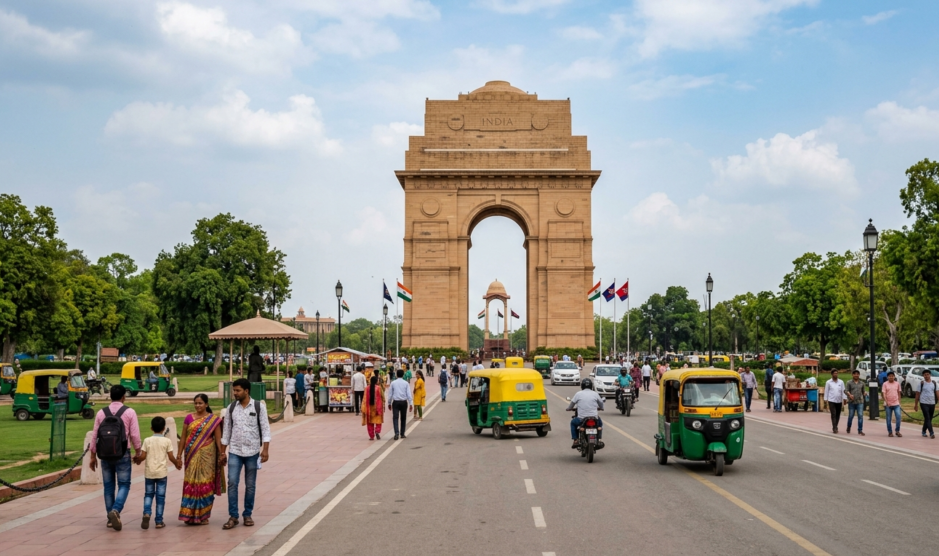
New Delhi :- The Epicenter of Heritage, Power, and Modernity
New Delhi, the heart of India, is a city that beautifully bridges the gap between historical grandeur and contemporary growth. Characterized by its wide tree-lined avenues, monumental government buildings, and bustling commercial hubs, it stands as a testament to India’s democratic strength and cultural diversity. From the legacy of the British Raj to the energy of a 21st-century metropolis, New Delhi captivates every traveler.
Detailed History :-
The creation of New Delhi marked a monumental shift in the geopolitical landscape of modern India. During the historic Delhi Durbar in December 1911, Emperor King George V announced the transfer of the capital of the British Indian Empire from Calcutta (now Kolkata) to Delhi. While the older parts of Delhi carried the legacy of Mughals and previous Sultanates, the British desired a brand-new, systematically planned administrative capital.
The task of designing this grand city was entrusted to prominent British architects Sir Edwin Lutyens and Sir Herbert Baker. They envisioned a city of monumental scale, combining Western classical architecture with Indian motifs, which came to be known as ‘Lutyens‘ Delhi’. New Delhi was officially inaugurated on February 13, 1931, by the Viceroy, Lord Irwin. Post-independence in 1947, it naturally transitioned into the capital of the sovereign Republic of India.
Detailed Architecture :-
The architectural landscape of New Delhi is a brilliant synthesis of classical European elements and traditional Indian craftsmanship, utilizing red and buff sandstone.
- Rashtrapati Bhavan :– Formerly the Viceroy’s House, this massive structure is the official residence of the President of India. Its central silhouette features a magnificent dome inspired by the Buddhist Stupa of Sanchi. It houses 340 rooms and is flanked by the breathtaking Amrit Udyan.
- The Parliament Complexes :– The historic old Parliament House (Samvidhan Sadan) is a iconic circular building surrounded by a colonnade of granite pillars, believed to be inspired by the Chausath Yogini Temple. In contrast, the newly inaugurated Parliament Building features a cutting-edge triangular design symbolizing the aspirations of modern India.
- India Gate :– Standing at a height of 42 meters, this triumphal arch was designed by Lutyens to honor the Indian soldiers who died in the First World War. Its design echoes the famous Arc de Triomphe in Paris.
- Connaught Place (CP) :– The commercial heartbeat of New Delhi, CP is a Georgian-style architectural masterpiece structured into two concentric circles. Its distinctive white colonnades house global brands, legacy restaurants, and underground markets.
Travel Guide & Routes :-
- Tickets & Entry Fees :– Public monuments and landmarks like India Gate, Kartavya Path, and Connaught Place have no entry fees. Tours of Rashtrapati Bhavan and Amrit Udyan require online pre-booking and a nominal registration fee of approximately ₹50. Museums like the National Museum charge an entry fee ranging from ₹20 to ₹50.
- Visiting Time :– While India Gate and CP are accessible 24/7, the ideal time to explore the commercial and cultural hubs is between 10:00 AM and 10:00 PM. Most government museums and Rashtrapati Bhavan remain closed to visitors on Mondays.
- How to Reach :–
- By Air :– Indira Gandhi International Airport (IGI) connects New Delhi globally. The dedicated Airport Express Metro Line links the airport to the New Delhi Railway Station in under 20 minutes.
- By Rail :– New Delhi Railway Station (NDLS) is the primary rail gateway, supplemented by Hazrat Nizamuddin and Anand विहार terminals for cross-country connectivity.
- By Metro & Local Transport :– The Delhi Metro is the most efficient way to navigate the city. Rajiv Chowk (CP) and Central Secretariat serve as major transit interchange hubs. App-based cabs, auto-rickshaws, and e-rickshaws are readily available for short-distance commutes.
- Photography Spots :– The lawns along Kartavya Path with India Gate in the backdrop, the ancient stepwell Agrasen ki Baoli, and the symmetric white corridors of Connaught Place offer stunning photographic frames.
- Local Flavors :– Do not miss the local street food and chaat at Bengali Market, premium dining in CP, or the highly affordable, authentic regional cuisines served at various state emporium canteens like Andhra Bhavan.
- Famous Markets :– Connaught Place for high-end shopping, Janpath Market for street shopping, handicrafts, and junk jewelry, and Palika Bazar for budget apparel and electronics.
Interesting Facts :-
- New Delhi is widely recognized as one of the greenest capital cities in the world, thanks to the extensive canopy of old trees planted during its initial layout.
- The grand ‘Kartavya Path‘ (formerly Rajpath) acts as the ceremonial axis of India, playing host to the world-famous Republic Day Parade every 26th of January.
- Palika Bazar, located in the inner circle of Connaught Place, was India’s very first fully air-conditioned underground market setup.
- To build the expanse of New Delhi, nearly 150 villages were cleared, reshaping the topography around the historic Raisina Hill.
Important Questions and Answer :-
Question 1:- When is the best time of the year to visit New Delhi?
Answer:- The winter months from October to March are ideal for visiting New Delhi, as the weather becomes pleasantly cool, making outdoor sightseeing highly comfortable.
Question 2:– Is the entire Lutyens’ Delhi zone accessible to tourists?
Answer:- Public spaces like India Gate, Janpath, and Connaught Place are entirely open. However, core administrative zones like the North and South Blocks, Prime Minister’s residence, and internal Parliament sectors have strict security cordons and require authorized passes or guided tour bookings.
Question 3:– What makes Janpath Market a popular spot?
Answer:- Janpath is famous for its vibrant street stalls selling artisan goods, Kashmiri shawls, traditional Indian wear, and unique souvenirs at highly negotiable prices.
Author’s Thoughts :-
To me, New Delhi is much more than a clinical hub of bureaucracy and political power; it is a city that breathes character. The brilliant design executed decades ago seamlessly absorbs the rush of modern daily life. Walking past the grand sandstone structures gives a profound sense of the nation’s journey. Beneath its formal exterior lies a soulful city where heritage trees shade modern streets and diverse cultures effortlessly melt into one unique Delhi identity. It is an urban experience that commands respect yet offers immense warmth.“New Delhi is not merely a geographic capital, but a living chronicle of a nation’s glorious past meeting its ambitious future.”