
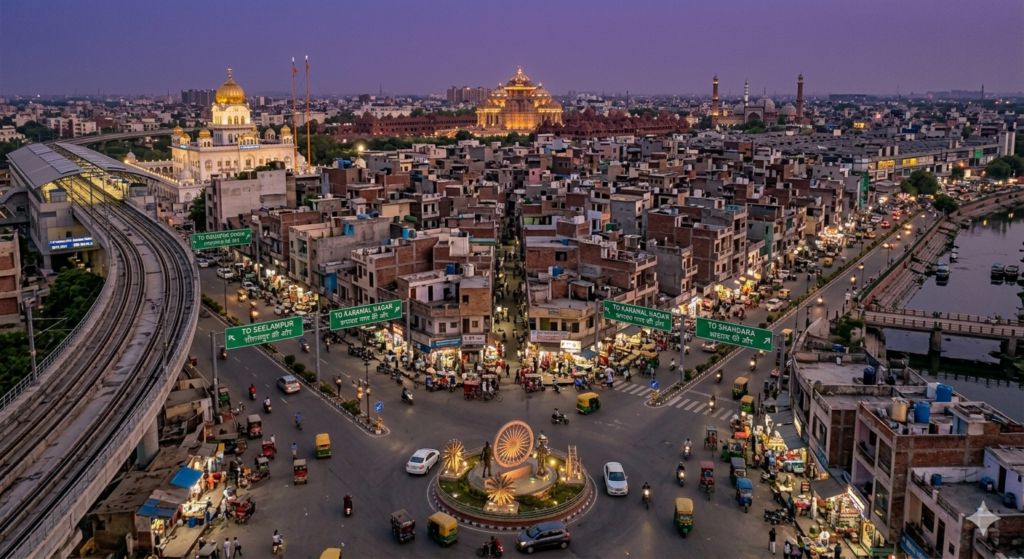
North East Delhi :- The Dynamic Hub of Multicultural Heritage, Commercial Zeal, and Small-Scale Industries
North East Delhi, positioned on the eastern banks of the Yamuna River, is a vital segment of the National Capital Territory celebrated for its high demographic density, diverse socio-cultural fabric, and bustling small-scale industrial ecosystem. Often recognized as an integral part of the ‘Trans-Yamuna‘ tract, this district serves as the industrious homeland for millions of migrants who have actively shaped Delhi’s economic landscape. Characterized by hyper-active trading alleys and tight-knit community living, this region offers an authentic, grassroots glimpse into the capital’s survival and growth.
Detailed History :-
The contemporary history of North East Delhi is fundamentally rooted in the post-1970s phase of industrial relocation and residential expansion within the capital. Chronologically, this land running parallel to the Yamuna floodplains was originally composed of agrarian pockets and historic villages outlying Shahjahanabad (Old Delhi).
Post-independence, an unprecedented influx of workforce migration from neighboring districts of Uttar Pradesh, Bihar, and Haryana brought a major demographic shift. To manage this expanding population, the government developed specialized residential-cum-industrial rehabilitation enclaves in sub-localities like Seelampur, Jafrabad, Welcome, and parts of Shahdara. Driven by pure perseverance, the inhabitants gradually transformed these blocks into national manufacturing centers for textile sorting, scrap metal restructuring, and plastics recycling. Today, it stands as one of the most self-reliant and densely packed economic sectors in the city.
Detailed Architecture :-
The architectural planning of North East Delhi is heavily defined by high-density urban residential layouts and pragmatic mixed-use blueprints, where every cubic foot of space is designed to support both habitation and commerce.
- Mixed-Use Industrial Enclaves :– In central blocks like Seelampur and Jafrabad, structures present a unique style of ‘vernacular commercial architecture’. Buildings typically feature two-to-three-story concrete layouts where ground levels are fully equipped with power looms or sorting units, while upper decks serve as family quarters.
- Religious Architecture :– The district boasts numerous historic and contemporary mosques, temples, and gurudwaras. Their structures showcase an intersection of traditional Indian and Islamic masonry patterns, featuring soaring minarets and carved domes rising elegantly above closely built market alleys.
- Modern Structural Milestones :– The iconic ‘Signature Bridge‘ is the ultimate architectural pride of this region. It stands as India’s pioneer asymmetrical cable-stayed bridge, featuring a monumental 154-meter-high octagonal steel pylon that anchors structural cables to connect North East Delhi with North Delhi over the Yamuna.
Travel Guide & Routes :-
- Tickets & Entry Fees :– Entry to all prominent commercial markets, religious complexes, and public vantage zones around the Signature Bridge is entirely free of charge. No ticketing or reservation mechanisms are active.
- Visiting Time :– Major wholesale bazaars and small industrial units operate with peak intensity from 10:00 AM to 09:00 PM. For culinary explorations, the optimal time to witness the bustling street-food network is between 06:00 PM and 10:00 PM. Note that key wholesale markets close on Mondays for their weekly holiday.
- How to Reach :–
- By Metro :– The Delhi Metro network’s ‘Red Line’ and ‘Pink Line’ act as the primary transit gateways for North East Delhi. Key interchange hubs and terminal access points include ‘Welcome’ (Red/Pink intersection), ‘Seelampur’, ‘Jafrabad’, and ‘Shahdara’ metro stations.
- By Road :– The area offers direct vehicular paths via the Grand Trunk Road (GT Road), Wazirabad Road, and the outer Pushta Road network, linking Delhi seamlessly to the Loni and Ghaziabad borders of UP. The Kashmere Gate ISBT is located just a 15-to-20-minute drive away. App-based aggregators, auto-rickshaws, and eco-friendly e-rickshaws dominate local street transit.
- Photography Spots :– The panoramic geometry of the Signature Bridge (especially under multi-colored architectural lighting at night), the avian habitats along the Yamuna Khadar banks, and the neon-lit, atmospheric evening street markets of Jafrabad.
- Local Flavors :– For lovers of authentic Mughlai food, the culinary alleys of Jafrabad and Seelampur are exceptional. Local kitchens are famous for charcoal-grilled Seekh Kebabs, rich Mughlai Mutton Koram, slow-cooked Nihari, and freshly baked Khameeri Rotis. Conversely, Shahdara and Bhajanpura offer incredible traditional sweets, thick Rabri-Falooda, and crisp Bedmi-Kachori breakfasts.
- Famous Markets :– ‘Seelampur Market’ (highly sought-after for affordable fabrics, ready-made garments, and industrial surplus materials), ‘Jafrabad Market’ (renowned for leather apparel and wholesale textiles), and ‘Bhajanpura Bazaar’ (a massive market for domestic utilities and academic stationery).
Interesting Facts :-
- The Seelampur trading grid ranks as one of Northern India’s largest textile sorting and material recycling hubs, repurposing surplus and post-industrial garments from all over the country.
- The monumental Signature Bridge stands twice as high as the historic Qutub Minar, featuring a specialized glass observation deck built at the pinnacle of its structural pylon.
- Due to its organic social growth, the district presents an incredibly unique, hyper-collaborative urban environment where diverse regional cultures run joint trading cartels.
Important Questions and Answer :-
Question 1:– What makes the Signature Bridge the definitive landmark of North East Delhi?
Answer:- The Signature Bridge is vital because it drastically reduces transit times across the Yamuna between North and North East Delhi. Architecturally unique, its dramatic cable design has turned it into a premier structural icon, tourist hotspot, and selfie destination in the capital.
Question 2:– What should retail and wholesale buyers expect when visiting Seelampur Market?
Answer:- Buyers can expect an extensive, highly economical inventory of ready-made garments, unstitched dress materials, and export-surplus textiles. It caters to both bulk B2B commercial traders and retail budget shoppers looking for highly competitive pricing.
Question 3:– Are there any environmental or natural ecosystems to explore in North East Delhi?
Answer:- Yes, the vast ‘Yamuna Khadar’ wetlands situated near Wazirabad and the base of the Signature Bridge offer a rustic escape. During the winter months, these marshy banks attract an array of migratory waterfowl, making it an excellent location for bird-watching and nature photography.
Author’s Thoughts :-
From my perspective, North East Delhi is an urban sector that masterfully converts every structural challenge into a collective business triumph. While Lutyens’ Delhi offers quiet, manicured elegance, the high-energy streets of North East Delhi reveal the raw, unyielding entrepreneurial heart of India’s working class. The local communities running small family-owned factories drive a massive parallel economy that fuels national retail supply chains. The aromatic smoke rising from Jafrabad’s kebab stalls and the perpetual hum of Seelampur’s markets show that this district is one of the most resilient, grounded, and thoroughly authentic foundations of Delhi’s identity.“North East Delhi stands as a powerful testament to grassroots enterprise, where tightly packed urban communes pilot the core engines of national small-scale trade.”